


Woodsmoke is drifting across the cabin deck, your boots are drying by the door, and someone's already asking who brought the good bourbon. Or it's the other transition, salt stiffening your collar after a morning surf, sand in the truck, and a cold drink waiting if you can get warm without looking like you packed for Everest. That's where the Flannel vs Fleece decision matters. Not on a spec sheet. In the parking lot, on the deck, at the lodge bar.
I'm opinionated on this because the wrong layer turns a perfect hour clammy, cold, or sweaty. The right one lets you holster your tech, stay socially confident, and be present for those serendipitous encounters that only happen when you're comfortable enough to stick around. Fleece is the reliable midlayer. Flannel is the look-right layer. And yes, a heavy flannel can absolutely outwarm a light fleece. Judge each fabric by its job, not its label.
Flannel vs Fleece at a Glance
Neither fabric wins everywhere, and anyone who tells you otherwise is selling you a slogan. The right pick depends on whether you're moving or sitting, dry or wet, and whether you want a layer that looks like a shirt when you walk inside.
That's the whole game for après-ski style, cabin wear, and post-surf comfort. You're dressing for the transition, the drive home from the beach, the first drink after the lifts close, the morning coffee before anyone else is awake. Get the layer wrong and you'll fidget. Get it right and you forget you're wearing it.
The Short Answer First
Fleece is a lofted knit built to trap air and dry fast. Flannel is a brushed woven built to breathe, hold its shape, and read as clothing, not gear. One carries the weather. The other carries the room.
| Criterion | Flannel | Fleece |
|---|---|---|
| Core material | Brushed woven fabric, traditionally wool, now often cotton or synthetic | Knit polyester pile, usually virgin or recycled polyester |
| Warmth for its weight | Good in heavyweight versions, driven by fabric mass and nap | Strong, because the lofted pile traps still air |
| Breathability | High, feels soft and dry in low-output settings | Good, but thick pile can trap heat when you're active |
| Wet performance | Cotton absorbs moisture and loses insulation when damp | Absorbs little water and keeps insulation better when damp |
| Drying speed | Slow, especially cotton | Fast |
| Best setting | Dry cabin, fireside, styled as an overshirt | After surf, après-ski midlayer, uncertain weather |
Rule of thumb: Fleece for moving or getting wet, flannel for dry, seated and social hours.
Why They Feel So Different
History explains the personality split. According to Wikipedia's flannel history, flannel production is documented in Wales from the 17th century, when textile workers used locally available wool to make warm cloth, and it later became common in the United States during the Civil War for inexpensive, durable coats and undershirts. Modern fleece arrived centuries later as a synthetic polyester knit engineered for technical warmth.
That heritage is why flannel signals tactile comfort and fleece signals performance. Flannel began as regional wool cloth. Fleece began as lab-built insulation. You can feel that difference the moment you put either one on over a tee.
One more practical note before you shop. Our fleece is made in California, which matters if you care where your luxury thermal layers come from and how they're finished. Wherever you buy, check the fiber label. Flannel describes a brushed finish, not one mandatory fiber, so cotton, wool, and synthetic versions behave differently.
For a weekend away, the table row that matters most is wet performance. Warmth is easy to buy. Warmth that survives sweat, snowmelt, or sea spray is harder. If your plans stay dry, breathability and look take over. If they don't, drying speed decides whether you're still smiling at sunset.
Warmth Depends on Weight, Loft and Wind
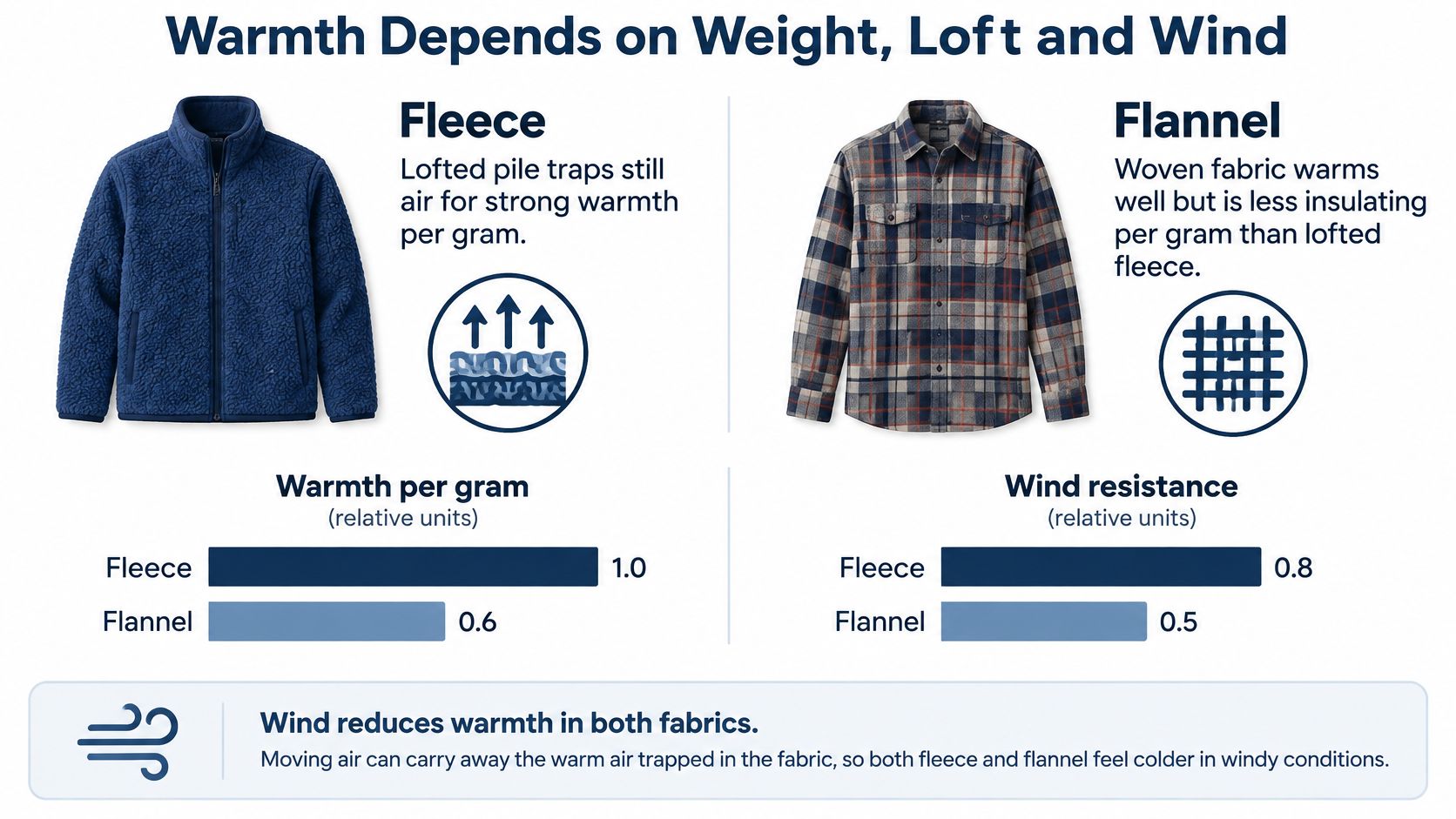
Stop asking which fabric is warmer. Ask which garment, at which weight, in which wind. Fiber type alone won't answer your question, and it never could.
Fleece warms efficiently because its lofted pile traps still air, giving you strong insulation per gram. Flannel warms differently. Its insulation comes from fabric mass, nap, and weave density, so you need more material to get the same trapped air. That's not a flaw. It's a different tool.
Compare at Equal Weight or Don't Compare at All
A dense, heavyweight flannel can outperform a lightweight fleece, and that's exactly why labels mislead people. The RAFF guide to military fleece technology makes the technical point plainly, thermal resistance is evaluated using ISO 11092 Rct testing, while air permeability is measured separately under ASTM D737. Neither fleece nor flannel is a single standardized performance class.
Weight is your starting clue, not your verdict. If you want to understand why two shirts that look similar feel completely different on your back, read up on how GSM affects garment weight before you blame the fiber. Grams per square meter tells you how much fabric you're carrying. Loft tells you how much air it's holding for you.
Wind Changes Everything
Fleece is not windproof. Wear a beautiful high-loft fleece alone on a breezy ridge or beach and the wind will strip that trapped air right out. Put that same fleece under a shell and it becomes a furnace. A dense flannel weave offers some wind resistance on its own, though how much depends on its weight and tightness.
| Garment | Warmth | Wind protection | Best layer role |
|---|---|---|---|
| Lightweight flannel overshirt | Low to moderate | Low | Dry lounging, worn over a tee |
| Heavyweight flannel shirt | Moderate to high | Moderate | Standalone layer on cool, dry days |
| Lightweight fleece layer | Moderate | Low | Base-to-mid layer under a shell |
| Midweight fleece under a shell | High | High with the shell | Active après-ski midlayer |
| High-loft fleece midlayer | High | Low alone, good under a shell | Coldest days, paired with a windproof outer layer |
For cold days that start on snow, follow our guide to thermal layering for ski trips and build from the skin out. Pick the lightweight flannel overshirt when the plan is dry and social, and pick the midweight fleece when the plan is insulation under a shell. Don't ask one garment to do both jobs badly.
The useful question isn't flannel or fleece. It's which layer, in which conditions.
What Happens When Flannel or Fleece Gets Wet
Water settles this argument faster than any spec sheet. Dry cotton flannel feels wonderful. Soaked cotton feels like a cold apology.
The mechanism is simple. Cotton drinks water, polyester mostly shrugs it off. Once flannel absorbs sweat or spray, it gains weight and its brushed nap compresses, crushing the little air pockets that were doing the insulating.
The Numbers That Settle It
One technical comparison cited in Fabric Supplier's flannel vs fleece guide puts moisture regain at roughly 8.5% for cotton versus about 0.4% for polyester fleece, and estimates that saturated fleece retains about 90% of its dry insulation while cotton flannel holds on to only 20 to 30%.
The takeaway: a damp fleece still works for a living. A saturated flannel is a costume.
Fairness demands one concession. Cotton flannel can feel less clammy during low-effort lounging because it buffers a little moisture against your skin. On a dry cabin night where you barely move, that feels great. The bill comes due when the shirt needs to dry, and it won't, at least not quickly.
Wet fleece has its own compromises. As moisture builds in the fabric, air permeability drops, so a soaked midlayer breathes worse until it dries out. Thick, dense pile can also trap humid air against your skin and slow evaporation. You dry faster than cotton, but you don't feel fresh instantly.
Construction matters inside the category too. Yarn placement and fiber content change drying speed, which is why two fleeces can behave like distant cousins after the same surf session. For days built around that exact wet-to-social transition, our guide to coastal comfort clothing has the full playbook.
Pro Tips for the Transition
- Pack a dry layer. Keep a clean flannel or fleece in the truck for the ride home, because no fabric rescues a base layer that's already soaked.
- Pick fleece for beach-to-bar. It dries faster after surf, snow or light rain and keeps insulating while it does.
- Save flannel for dry cabin nights. Breathable, soft, and right at home by the fire when staying dry is guaranteed.
If your plans involve water, weather or both, the midweight fleece earns its place as the reliable midlayer for beach-to-bar and après-ski duty. The cotton flannel stays home for the cabin, where its real job is looking right by the fire. Call it physics.
Après-Ski Layering and Social Technical Pockets
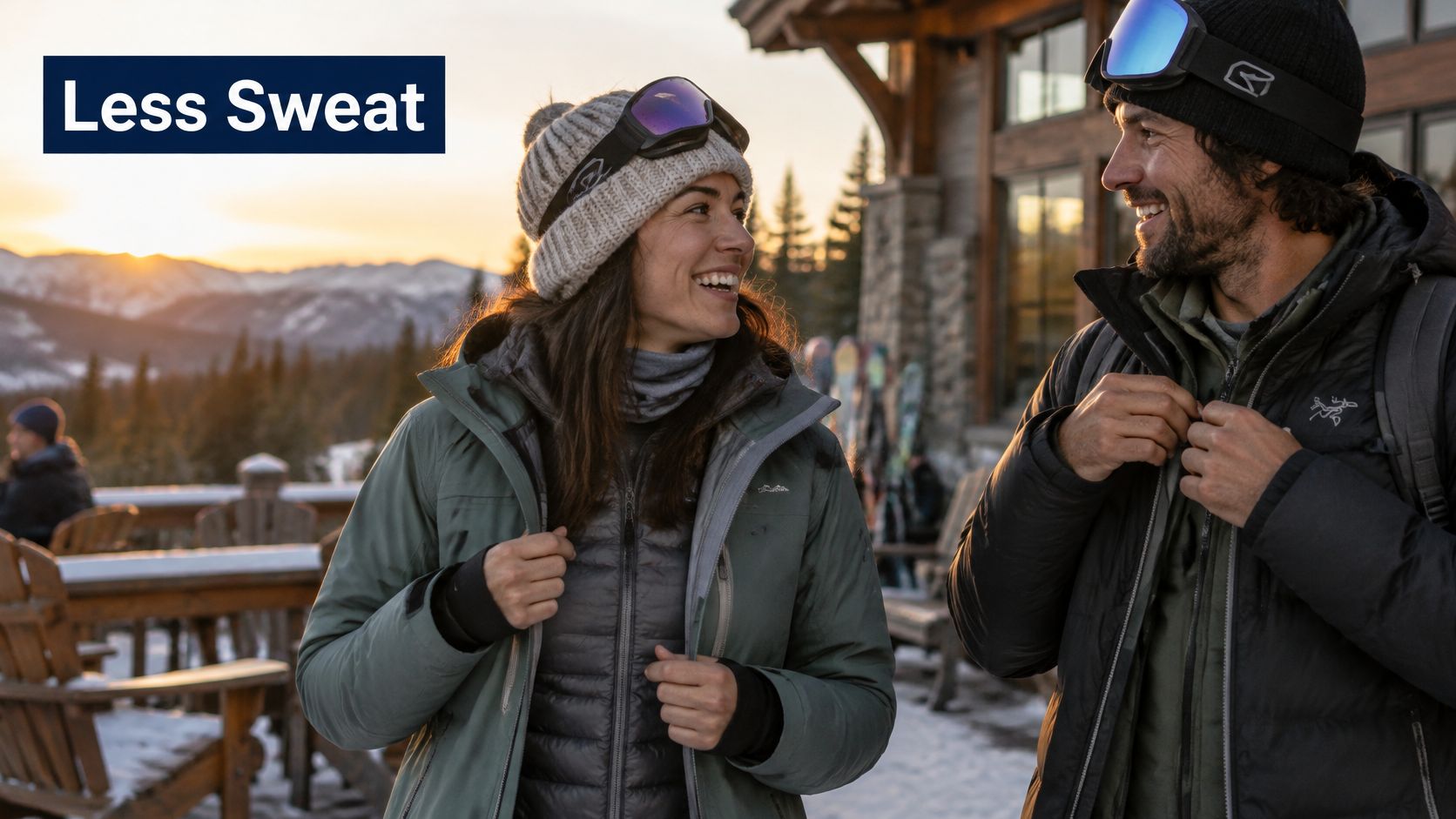
Last chair to first round is the trap: you sweat on the run, stop moving, and the chill finds every damp inch under the shell. Skiers blame the jacket. The layer order usually did the damage.
Fleece has one job here: stay under the shell as the reliable midlayer and keep insulating while moisture moves. Flannel has a different job: the dry, look-right layer you put on when the skis are racked. A heavy flannel can outwarm a light fleece at the lodge, but it should not be the sweaty workhorse on the lift.
Where the Sweat Actually Lives
A wear-trial study on layer structures found that a combined configuration produced 33.8% less sweat and 25.0% lower sweat accumulation than a separated configuration, with 35% to 39% of total sweat accumulation in the third fleece layer compared with 13% in the outer jacket. Translation: your fleece midlayer is where the clamminess lives. Treat it that way.
- Unzip before the lodge: Dump heat on the walk in so you do not arrive already steaming.
- Keep fleece under the shell: It insulates there. Worn over a shell, it just collects snow and wind.
- Swap into dry flannel for the bar: Once the skis are racked, the soft layer finally makes sense.
Social Technical Means Your Hands Stay Free
Social Technical design earns its name once the helmet comes off. Our Men's High Sierra Shirt is lined with thermal fabric and has a zippered dry pocket for a phone plus a bonus beer pocket, so the carry stays neat without a backpack. The Out of Pocket Pouch fits into the zippered dry pocket of all technical apparel, keeping cards and cash protected while your hands stay free for firewood, handshakes, and the bottle you are opening for someone else. For the deeper thinking behind protected storage, read our piece on water-resistant pocket apparel.
Social Spec, Why a Zippered Dry Pocket Changes the Lodge Bar: Your phone stays dry and out of your hand, your drink has a home, and the conversation gets your attention instead of your gear.
The Women's High Sierra Shirt uses the same logic in her fit: throwback thermal lining, a zippered dry pocket for a phone, and a beer pocket. Pick fleece for the ride up, pick flannel for the lodge, and let the pockets handle the small stuff.
Care, Shrinkage and Microplastics Over Time
The laziest take in this whole debate is fleece bad, flannel good. The evidence is messier, and your laundry habits matter more than your tribal loyalty.
Yes, polyester fleece sheds. Its brushed, loose surface is built for softness, and that same openness lets fibers escape in the wash. But natural textiles shed too, and pretending cotton is automatically clean helps nobody.
What the Washing Evidence Shows
A 2025 peer-reviewed study in PMC found that 100% polyester fleece released an average of 1.4 mg of microplastic fibers per gram of fabric after the first wash, 1.3 mg/g during washes two through five, and 0.59 mg/g during washes six through ten. Much of that early release appeared to come from manufacturing residue, which is one more reason the first washes deserve care.
Balance that with the wider picture. Another 2025 review found that 62% of fibrous microplastics detected in wastewater were of natural origin and 37% were synthetic. Fiber counts alone don't crown an environmental winner.
Scale matters too. Patagonia's polyester footprint page notes polyester production reached approximately 86 million metric tons in 2024, representing about 59% of worldwide fiber production. The same page cites an assessment that semi-mechanically recycled polyester avoids approximately 50% of carbon-dioxide-equivalent emissions compared with virgin polyester, so recycled content on the label is worth looking for.
Shrinkage, Stretch and the Habits That Help
Here's our honest care note. Drying shrinks the gear back a bit, and wovens and knits can stretch out after a couple wears. That's true across this category, so buy your real size and don't hang heavy wet garments by their shoulders. Our philosophy on quality over quantity clothing starts right here, fewer pieces, washed gently, worn for years.
| Care factor | Flannel | Fleece | Better habit |
|---|---|---|---|
| Fiber shedding | Natural fibers such as cotton or wool shed during washing | Synthetic microfibers, highest in early washes | Wash cold, full loads, less often |
| Shrinkage | Shrinks a bit after drying | Shrinks a bit after drying | Air-dry flat or use low heat |
| Stretch | Wovens can stretch out after a couple of wears | Knits can stretch out after a couple of wears | Choose a fitted size and avoid hanging wet |
| Pilling | Brushed nap can compress and pill with friction | Brushed surface can pill and shed with friction | Turn inside out and wash gently |
| Lifespan | Structure holds, hand feel fades with wear | Loft holds until the pile flattens | Buy fewer, better-made pieces |
The lowest-impact garment is the one you don't replace. Buy the fabric whose performance fits your actual life, wash it less, and wear it until it has stories.
Which Fabric to Wear and How to Complete the Look
Enough theory. What I'd pack, occasion by occasion, for High Sierra gear days, beach lifestyle apparel weekends, and everything social in between.
| Situation | Pick | Why it works |
|---|---|---|
| Après-ski on the slopes | Midweight fleece under a shell | Traps warmth and dries faster after sweat |
| Fireside cabin evening | Brushed flannel overshirt | Breathable, soft, and looks right in the lodge |
| Beach to bar after surf | Fleece layer with a dry pocket | Dries quickly and keeps the phone protected |
| Cold, wet or unpredictable day | Fleece midlayer under a waterproof shell | Insulation holds up better when damp than cotton flannel |
| Group weekend photos | Coordinated flannel shirt | Reads as a look, not gear |
| Long dry day indoors | Heavy flannel shirt | Comfort without overheating |
The Verdict, Plainly
Flannel carries the look. Fleece carries the weather. If you're building one kit for a mountain weekend, pack both and let each do its job. Fleece earns its place on the slopes and after surf. Flannel earns its place the moment you sit down with people you like.
Start with High Sierra Flannels as your main product path for the best men's luxury flannels for après-ski. The Men's High Sierra Shirt in Campfire Check is labeled Classic Fabric, and it's the flannel I'd hand a friend who wants one shirt for the whole cabin weekend. For slow cabin mornings, the El Garibaldi Robe is the hero product, coffee on the deck, no rush, nowhere better to be. If you're still deciding what the full outfit looks like, our guide on what to wear après-ski pulls it together.
Heading somewhere cold with a crew? This is also where coordinated group gear shines for bachelor party outfit ideas and unique groomsmen gifts, matching flannels that people will wear again. And if your version of cold-weather polish leans plaid at the neck too, the Kilts4Less guide to men's tartan scarves is a useful read on picking a pattern that works with, not against, a checked shirt. For friends ordering from abroad, we ship to most countries for $30.
Complete the Look
- Hat: A warm, low-profile hat for the walk from the lifts to the lodge, because wet hair plus wind is nobody's friend.
- Tee: A clean base tee under your flannel, so you can shed layers indoors without losing the outfit.
- Koozie: A koozie in the pocket for the tailgate, small, social, and always borrowed by someone who forgot theirs.
Join the Vital Few newsletter for first access to drops, restocks, and the limited runs that sell out before the weekend they're made for. That's the list our regulars read, short, useful, and timed for real trips. Life offline looks better when your layers are sorted before you leave.
Ready to dress for the transition instead of just the activity? Shop thermal-lined High Sierra flannels, California-made fleece, and the El Garibaldi Robe at California Cowboy, then holster your tech and go be socially confident somewhere with woodsmoke, salt air, and good company.

