


Woodsmoke drifts across the cabin deck, salt still drying on one shoulder from a morning in the water. Boots are off, the first drink is on the rail, and the hoodie you grabbed in the parking lot is now the whole outfit. A color block hoodie earns that hour only if the panels do a job, not just a pose. Each block brings its own seams, pocket, and wash risk. Buy for the transition, from lift line to last drink, and you stay warm, hands free, and socially confident without checking a screen.
What Makes a Color Block Hoodie Different
Cold air off the lift line still sits in the hood when you step back onto the deck. A color block hoodie is a sweatshirt cut from separate panels of solid color, usually the hood, sleeves, chest, and body, with hard edges between blocks instead of a print.
That system comes from the geometric compositions of Dutch painter Piet Mondrian and reached mainstream fashion in the 1960s, when designers such as Yves Saint Laurent turned it into clothing, as the color blocking overview on Wikipedia traces. Big sweatshirt surfaces make the contrast readable from across a room.
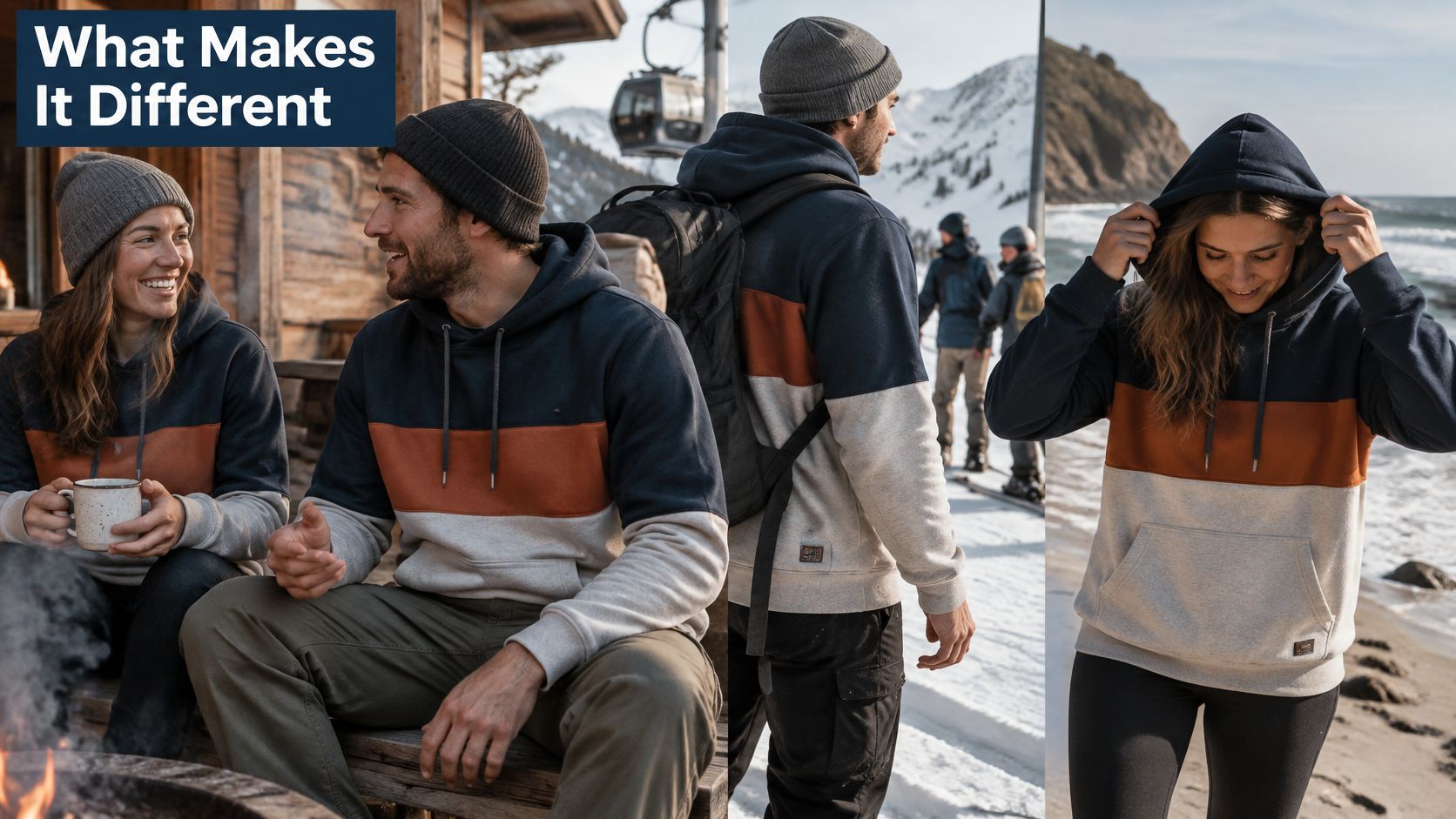
You notice three edges first: the block seams, the hood edge, and the cuffs. What stays familiar is warmth, a roomy fit over other layers, a front pocket, and a hood for wind.
If the color lines carry the design, it is a color block hoodie. If the color sits in a print, it is not.
Fabric Weight and Fiber Blend to Check
Two numbers rarely show on a hangtag, and both decide the evening. Fabric weight in GSM and the fiber ratio tell you whether the hoodie is a lodge layer or a beach towel with sleeves. A color block hoodie is only as warm as its coolest panel. Identical-looking blocks can feel different if the mill used different constructions.
A controlled fleece study held fabrics at the same 280 GSM. A 90% cotton / 10% polyester blend produced the lowest thermal conductivity, while raising polyester toward 35% increased conductivity and water-vapor permeability, according to the Kumaraguru fleece fabric study. About 10–20% polyester supports warmth and lower air permeability. More polyester moves vapor and dries faster, with a cooler hand.
| Fiber blend (cotton / polyester) | Thermal conductivity and vapor transport | Feel and drying |
|---|---|---|
| 90% cotton / 10% polyester | Lowest thermal conductivity in the study | Soft and warm, slower to dry |
| 80% cotton / 20% polyester | Warmth supported with lower air permeability within the 10-20% range | Warm with everyday breathability and moderate drying |
| About 65% cotton / 35% polyester | Higher thermal conductivity and higher water-vapor permeability | Cooler hand, faster drying |
Buying rules
- Lodge and cabin: Choose a moderate cotton blend with 10 to 20% polyester when warmth and everyday breathability have to share the same garment.
- Wet beach days: Choose a polyester-heavier build when drying speed matters more than a soft hand.
- Matched panels: Keep panel weight consistent. A heavy body with a thin hood gives you a warm torso and a cold head.
Ask for GSM, the fiber ratio, and whether the lining is brushed fleece or terry. Color and visual thickness won't tell you. If you want the heavier end of that range for cabin weekends, start with our notes on heavyweight hoodies.
Built-In Pockets and Loops Worth Checking
Holster your tech. A useful hoodie keeps the phone, cards, bottle, and sunglasses out of your hands so a serendipitous encounter doesn't start with a juggling act.
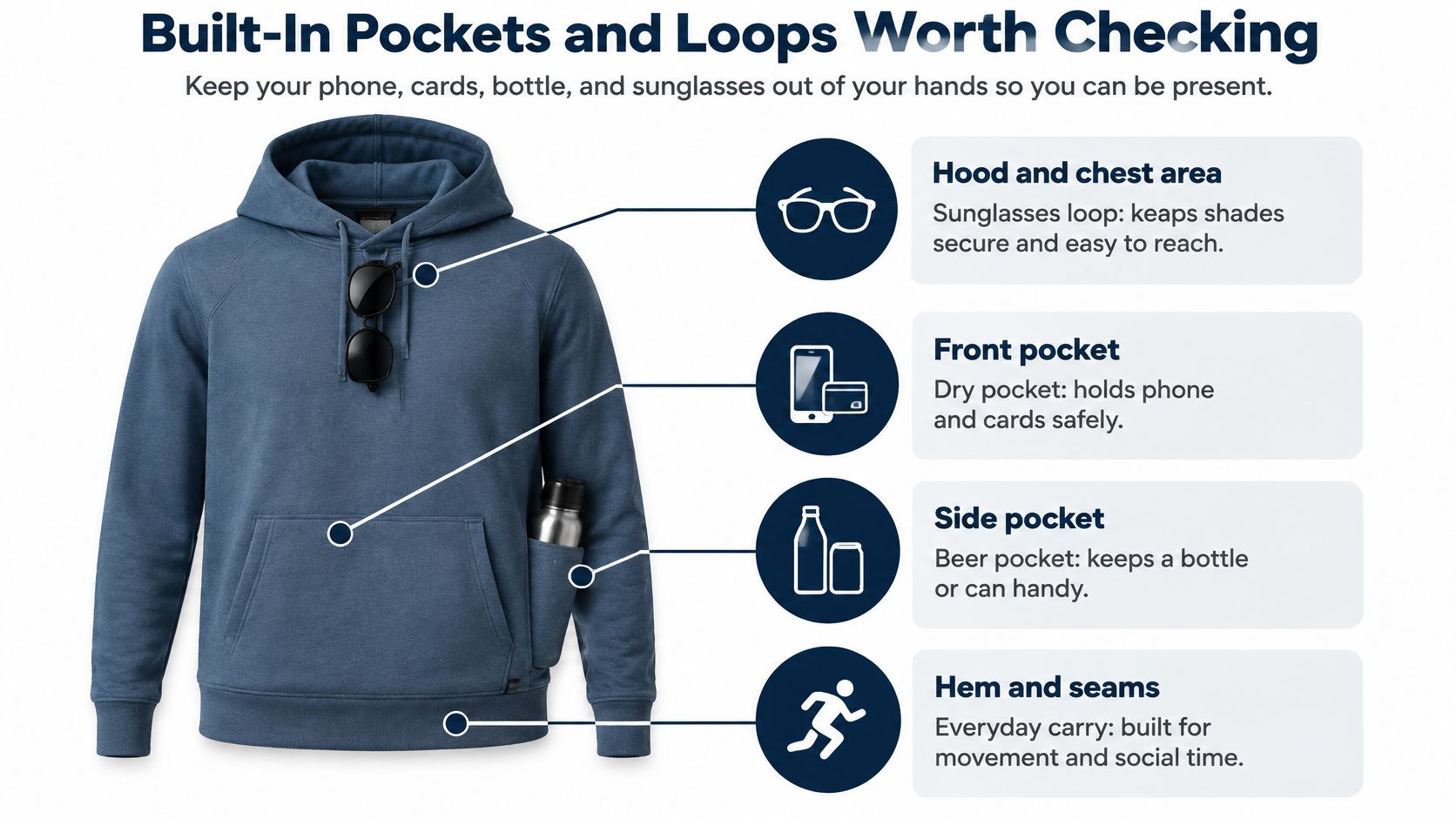
Walk the garment the way you pack it.
- Hood and drawcord. The cord should tuck or lock so it doesn't slap a drink or catch a car door. A hood that needs constant adjusting is a hood you'll stop wearing.
- Chest zip dry pocket. This is the closed home for a phone and keys at the bar, on the lift, and after a rinse at the beach. A zip beats an open kangaroo when the fabric gets damp.
- Secret pen pocket. A slim slot inside the front holds a card or a pen without printing a rectangle through the color block.
- Bottle pocket. Side or low back, with reinforced stitching and a lining that can take a cold can. Free hands mean handshakes, not a bottle pinned under your arm.
- Sunglass loop. Collar or placket, so shades stay put when the sun drops on the boat or the deck.
Before you pay, tug the pocket zips for a smooth run, check that the lining doesn't ghost through a light panel, and look for extra stitches at the bottle pocket. The same logic sits behind a hoodie with hidden pockets.
Social spec: A dry pocket changes the parking-lot hangout because the phone stays zipped, dry, and off the table. You can talk with both hands and still know the keys didn't migrate into the snow.
Styling a Color Block Hoodie From Lift Line to Last Drink
The drive home from the beach, the first drink after the lifts close, morning coffee on the cabin deck. That's the window. The hoodie is the bridge, so it should look intentional while it still does a job.

Say the group spills from the lot to a fire pit. Ski pants are already in the car. Dark denim and a beanie finish the color block hoodie faster than another technical layer. The bright panel near your face does the talking. Nobody needs a logo the size of a trail map.
| Scene | Bottoms that work | Layer or accessory | Transition detail |
|---|---|---|---|
| Apres-ski lodge | Dark denim or fleece joggers | Beanie and a shell over the hood | Change out of ski boots before the first drink |
| Cabin weekend | Relaxed chinos or flannel pants | Thick socks and slides | Hood up on the deck with morning coffee |
| Surf-to-sand | Board shorts or cut-offs | Sandals and a sunglass loop | Rinse salt from the hood edge before the walk |
| Casual city day | Straight jeans | Clean sneakers | One contrast panel carries the outfit |
Surf-to-sand is the fussy one. Rinse salt from the hood edge, wear the hood over damp hair for the walk, and pull a dry layer from the zip pocket before you sit down. Salt left in a seam shows up as a pale crust by dinner.
More lodge pairings live in our après-ski outfit ideas.
Three pro-tips
- Face-level color: Keep the bright block near the face so the color reads across a crowded room.
- One cuff roll: Roll the cuffs once to show the color seam without shortening the sleeve into a shrug.
- Collar under the hood: Layer a collared shirt underneath so the neck stays clean and you don't stack bulk under the chin.
Choosing Contrast and Palette for Your Wardrobe
Most searches ask which colors look good. The better question is how often you'll wear the hoodie. A palette that works with one pair of pants is a costume. A palette that works with the denim, the chinos, and the board shorts is a uniform.
Who What Wear, citing Lyst, reported that color blocking gained momentum in 2025, with an 18% demand increase from August to September and purple, yellow, and green among the leading colors. Those hues suit a statement piece. They also fence the hoodie into one kind of night.
Three contrast levels cover almost every closet:
- Tonal blocks stay inside one color family. They read as lounge wear, not a billboard, and they travel from cabin to a quiet city day.
- Earth-tone contrasts suit mountain and cabin days, and they sit next to denim without a fight. See how those shades behave in earth tone colors for clothes.
- Bright accent blocks earn beach days and group weekends. Use one loud panel, not three.
I would pick the restrained palette when the hoodie has to move from lodge to coast to an informal office. Cost-per-wear beats a single loud Saturday.
Placement changes the shape you see. A dark hood on a light body shortens the visual torso. A block across the chest widens the upper body. Choose the one that matches the proportion you want, not the one in the campaign photo.
Count the neutral outfits you already own. Pick a block color that matches at least two of them. Skip any palette that survives with only one pair of pants. Hold the hoodie in daylight beside your face before you buy. A bright block near the face reads differently on warm, cool, and deep skin tones. Tonal and earth-tone palettes leave more room to adjust than a loud accent.
Fit, Sizing and Layering Room Explained
The usual miss is sizing for a single tee, then discovering there's no room for a shell or a fleece. The color seams pull, the pocket gapes, and the hoodie becomes a fair-weather layer.
Fit checklist
- Shoulder seam: It should land at the edge of the shoulder, not halfway down the arm. A dropped seam looks sloppy once you raise a glass.
- Chest: One layer underneath should sit without dragging the color seams. If the panel lines bow, the size is tight.
- Sleeve: It should reach the wrist bone. With arms bent, the cuff sits at the base of the hand, not mid-forearm.
- Body length: The hem should cover the waistband when you reach up for a shelf or a chairlift bar.
A regular fit works over one mid-layer. A relaxed fit suits a shell worn over the hoodie, which is the colder drive home. Stretch knits and fleece-backed panels can shift, so recheck the hem and cuffs after the first wash before you decide the size was wrong. Our men's fit guide is the place to compare those cuts before you guess.
When two sizes fit, choose the one that layers. This hoodie is usually worn over something.
How to Wash a Color Block Hoodie Without Fading
Dark and light panels share seams, water, and detergent. That's where a color block hoodie fails in the laundry room, not on the deck. A 2025 survey of 1,000 U.S. adults found that 69% reported clothing damage from color bleeding or fading, 73% from shrinking, and 31% from stretching or warping. More than half could not identify the "do not bleach" symbol, and only 33% said they always check care labels, according to the Homeaglow laundry survey covered by Fashionating World.
| Care risk or habit | Share of respondents |
|---|---|
| Clothing damage from color bleeding or fading | 69% |
| Clothing damage from shrinking | 73% |
| Clothing damage from stretching or warping | 31% |
| Could not identify the do-not-bleach symbol | More than half |
| Always check care labels | 33% |
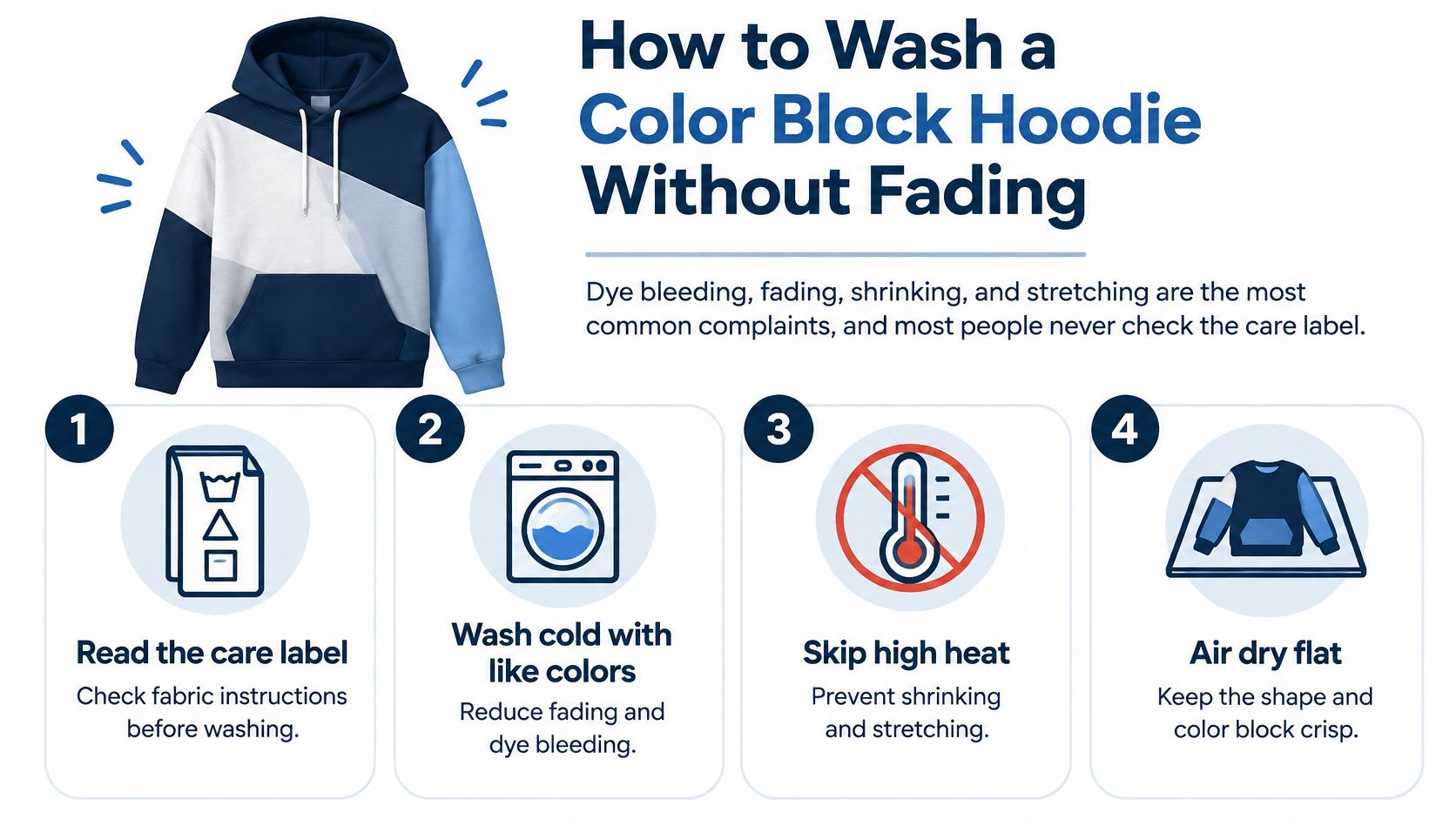
The five-step routine
- Read the care label. Find the bleach and temperature symbols before the hoodie hits the machine. Guessing is how a cream panel turns gray.
- Turn it inside out and zip the front. That protects the dry pocket and the color seams from abrasion against the drum and against other clothes.
- Wash cold, gentle, alone or with similar darks. Cold water limits dye moving from a dark panel into a light one.
- Pre-treat stains, and don't rub the blocks together. Friction at a seam is where color crocks onto the pale side.
- Dry flat or on low tumble. Keep it off high heat and out of long sun. Cotton-rich blends shrink when the dryer runs hot.
If a light panel picks up dye, add a color-catching sheet on the next wash and inspect the rib cuffs and hood edge. Between wears, air the hoodie. You don't need a wash after every cabin morning if it only smells like woodsmoke.
Pick Your Hoodie and Complete the Look
Buy the color block hoodie whose fiber blend, fit, and pockets match the day you already have planned. The checks above do the sorting. The palette only has to survive more than one pair of pants.
Complete the look
- Hat for the lodge deck: A matching beanie keeps the hood optional once you're by the fire.
- Tee under the hoodie: A clean collar line beats a bunched neck when you push the hood back for dinner.
- Koozie or pouch for the bar: The Out of Pocket Pouch fits the zippered dry pocket of technical apparel and comes with 3 removable, interchangeable statement patches. Our double-layered hoodie carries a zip dry pocket, a secret pen pocket, and a double needle-stitched bottle pocket with nylon lining. Once the hoodie comes off on the cabin deck, the El Garibaldi Robe takes the next hour.
Join the Vital Few for first access to drops, then put the phone away for the evening.
California Cowboy builds hoodies, High Sierra layers, and cabin robes for the hour after the lifts, the surf, or the drive. A color block hoodie from the line is cut for warmth, pockets, and real company, not for a single photo. Visit California Cowboy and pick the layer you'll still want on when the fire dies down.

