


Woodsmoke clings to your jacket. Boots crunch over gravel. The last chair light catches the peaks while somebody opens a cooler beside the car, and the air has that clean, cold mix of pine, salt, and impending dinner. You're wearing a taupe jacket, a cream beanie, and a cocoa henley under a flannel. Nothing matches perfectly, yet everything belongs.
That's the quiet power of earth tone colors for clothes. They make the transition look intentional, whether you're leaving the beach, the mountain, or a cabin deck where the coffee has gone cold because everyone kept talking. These colors are built for life offline, for socially confident layers that let you holster your tech and stay open to serendipitous encounters.
What Earth Tone Colors Actually Mean for Clothes
Earth tones are muted, low-saturation colors drawn from the natural world. Think soil, bark, clay, stone, dried grass, moss, and sun-faded wood. The core families are easy to recognize once you know what to look for: clay, sand, stone, moss, and bark. Their more specific cousins include terracotta, ochre, sienna, taupe, sage, slate, bone, and cocoa.
Fashion references commonly place brown, tan, beige, taupe, khaki, olive, moss, gray, white, and rust inside the earth-tone family because these colors mix easily across casual and formal wardrobes (earth tone color references). That flexibility makes them useful beyond a single season or aesthetic. Earth tones can look polished in a wool coat, rugged in a canvas overshirt, or relaxed in a terry-lined beach layer.
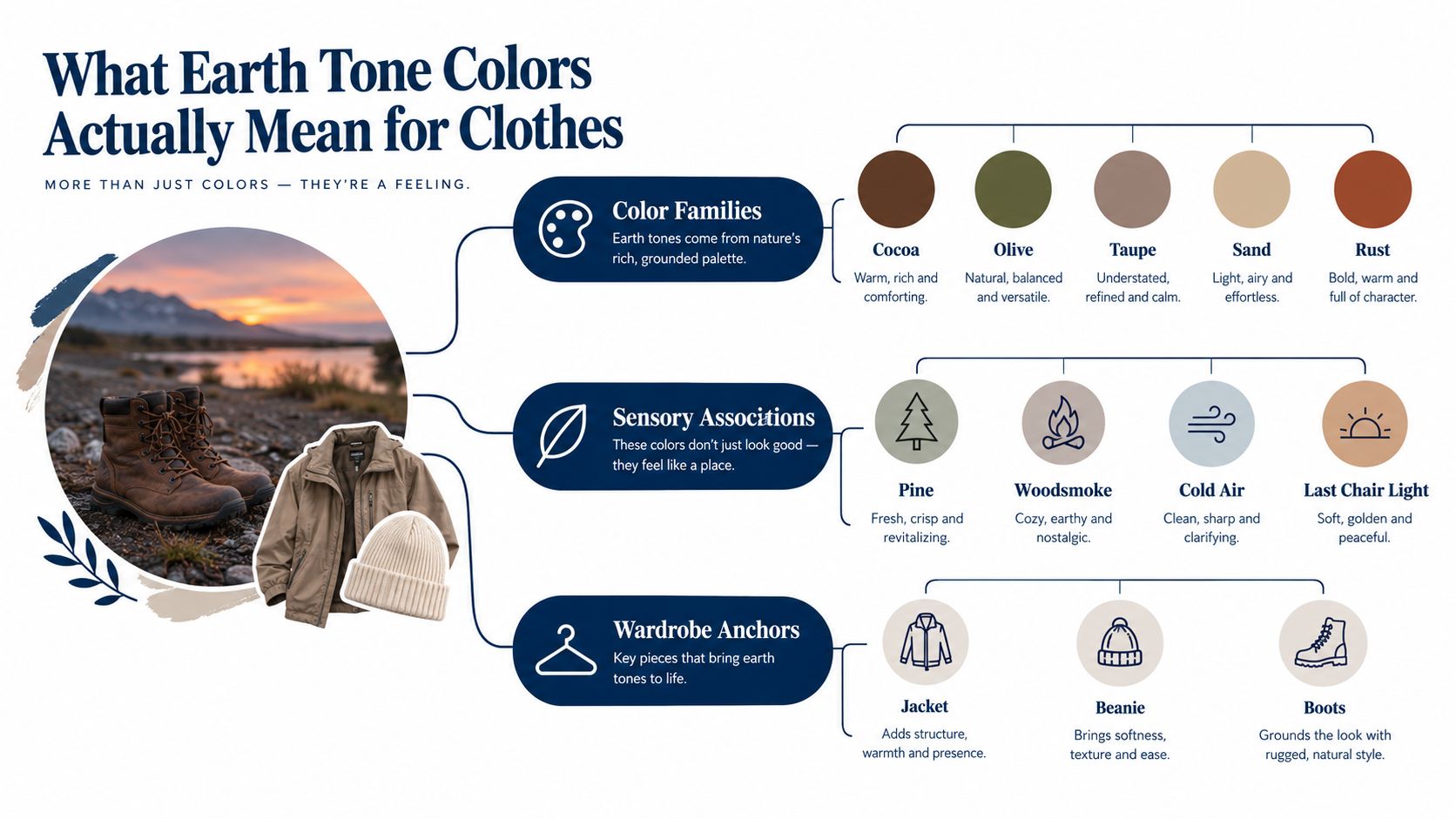
Warm and cool earth tones
Warm earth tones carry red, yellow, or golden undertones. Terracotta, camel, rust, ochre, and chestnut bring heat to an outfit and work especially well with cream, ecru, denim, and tobacco brown. Cool earth tones lean toward green, gray, or blue. Sage, slate, driftwood, moss, and charcoal taupe give an outfit a quieter, more alpine or coastal feeling.
That split matters when you start pairing pieces. A rust overshirt and bone tee feel sunlit and social. A sage jacket over a slate thermal feels cooler, cleaner, and more mountain-ready. You can mix warm and cool tones, but give them a value difference so they don't collapse into one muddy block.
The practical rule: Earth tones should feel grounded, not dull. Use contrast in lightness, fabric, or texture to keep the outfit alive.
The best earth-tone wardrobe also has a tactile point of view. Matte cotton, linen, hemp, wool, and silk can make these shades appear deeper because their surfaces absorb light rather than throwing it back (earth tones and natural colors). That's why a cocoa knit feels richer than a shiny brown synthetic shell, even when the color looks similar on a screen.
If you're shopping for a green accessory and want to see how a dark natural shade can move between refined and outdoorsy, this forest green purse buying guide offers useful context. The lesson applies to clothing too: green can read elegant, utilitarian, or casual depending on its value, finish, and neighboring colors.
Why Earth Tones Keep Coming Back Season After Season
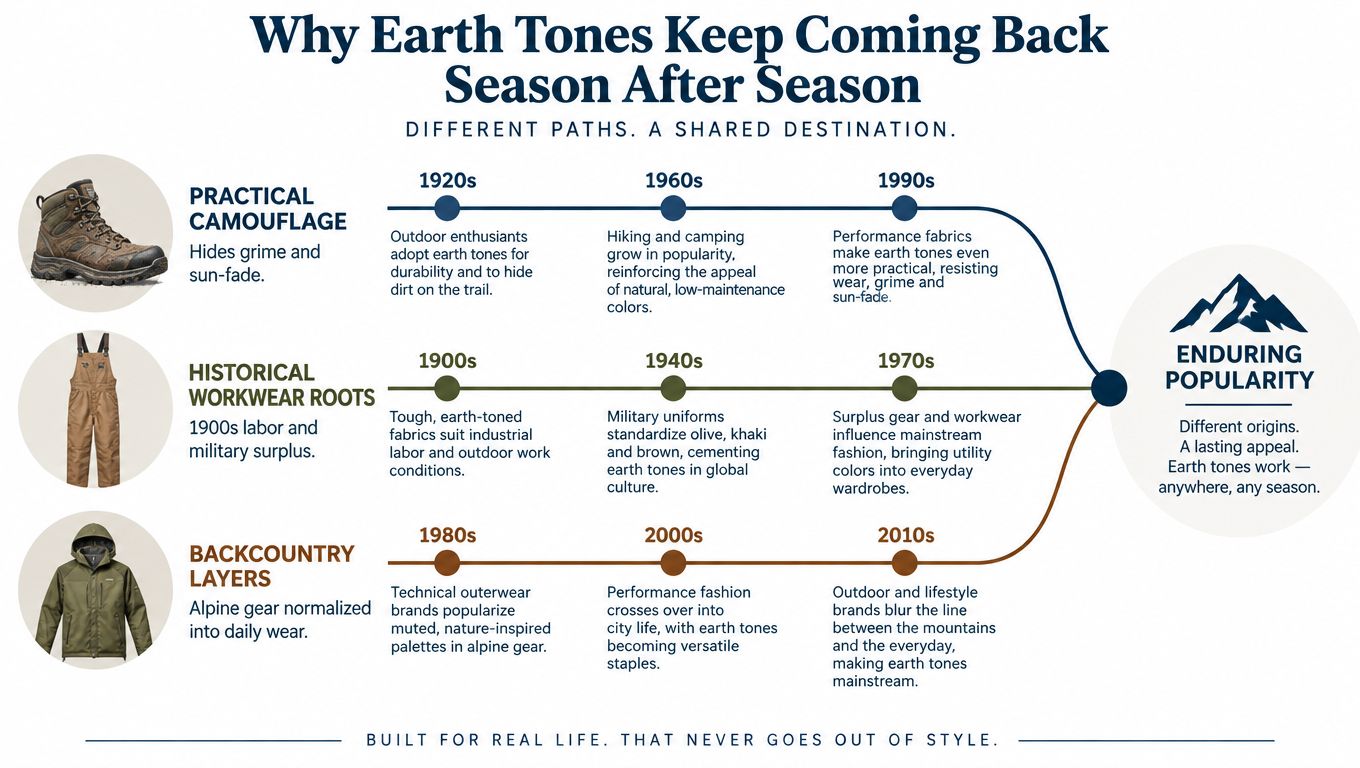
Earth tones survive fashion's mood swings because they solve a real wardrobe problem. They connect technical outerwear, natural-fiber shirts, knit layers, and worn-in footwear without creating a color argument between them. A sage shell can sit over a cotton henley. A bark overshirt can work with nylon pants. A sand tee can make dark denim look deliberate instead of default.
Their history helps explain the staying power. Early fabrics were often colored with materials that were easy to acquire, including dirt, grass, and clay, which gave earthy hues a practical place in everyday clothing (Hallmark's history of earth tones). That association with durability and ease still lingers, especially in workwear, utility clothing, cabin layers, and backcountry gear.
The palette also keeps resurfacing in fashion. Runway coverage identified a strong earth-tone return in 2018, with 1970s-inspired cords, prairie shapes, faux fur, brown, tawny taupe, and rusty red. Spring and summer coverage later described earth tones as a polished alternative to bright palettes, while Pantone's New York Fashion Week Autumn/Winter 2026/2027 report places earthy tones and carefully considered neutrals beside vivid shades (Pantone's Autumn/Winter 2026/2027 report).
The palette fits the transition
Loud colors can look excellent in a single setting. They can also feel strangely costume-like once the activity ends. Earth tones handle the in-between moments better, the drive home from the beach, the first drink after the lifts close, or the walk from the cabin deck to the grocery store for more firewood.
That makes them a natural fit for the Social Technical idea. A shirt with useful storage, a warm lining, or a loop for sunglasses should move through the day without announcing that it was engineered for a specific activity. Earth tones support that handoff because they look at home beside snow, sand, gravel, wood, denim, and concrete.
Why the colors feel less disposable
Earth tones also benefit from visual forgiveness. Muted shades tend to absorb the small realities of outdoor life: dust near a hem, a little salt on a sleeve, or the softened surface that comes from repeated wear. They aren't magic stain removers, but they're less precious than a bright, high-chroma color that makes every mark obvious.
That's why the palette is a foundation, not a temporary trend. A brown overshirt can survive several style cycles. An olive pant can shift from hiking-adjacent utility to dinner-ready casual with a change of footwear and a cleaner top. The outfit doesn't need a costume change just because the chairlift stopped running.
How to Build an Outfit Around Earth Tones
Use the anchor, partner, repeat method. Pick one substantial piece in an earth tone, add a second shade with a different value, then repeat one of those colors in a third item. This gives the outfit structure without forcing every piece to match.
Start with the anchor. A jacket, sweater, trouser, or overshirt in clay, cocoa, stone, or moss gives the rest of the outfit a job. Add a lighter or darker partner, then echo either shade near the face or feet.
| Anchor | Partner | Repeat Shade |
|---|---|---|
| Cocoa henley | Sage overshirt | Bone chinos |
| Taupe flannel | Ecru tee | Terracotta beanie |
| Moss utility pant | Bone thermal | Bark chore jacket |
| Stone overshirt | Rust tee | Stone-colored sneakers |
Value contrast matters more than exact color matching. A dark cocoa top with pale bone pants has clear visual separation. A mid-tone taupe shirt with mid-tone khaki pants can look flat unless the fabrics or silhouettes create enough interest. Don't stack every muted shade you own and hope texture will save you. Sometimes it will not.
Three rules that keep the palette sharp
- Limit the pattern: Use one visible pattern at most. A checked flannel can be the focal point, while the rest of the outfit stays quiet.
- Let texture do the work: Pair smooth cotton with brushed flannel, dry linen with terry, or wool with worn leather.
- Echo a shade: Repeat one color across the top and the foot, such as a rust cap with rust-toned boots or a sage overshirt with olive socks.
A cashmere sweater can also serve as the anchor when you want the outfit to move toward polished rather than rugged. This guide to buying a cashmere sweater is useful for thinking through fiber quality, weight, and the difference between a warm brown that looks luxurious and one that feels heavy.
For a practical smart-casual combination, use a cocoa knit, ecru tee, dark olive trouser, and a weathered shoe. The smart-casual guide for men is a useful next step when the destination is a dinner, a travel day, or a cabin gathering where nobody wants to look overdressed.
Styling move: If the outfit feels too quiet, change the fabric before changing the color. Corduroy, fleece, flannel, and leather add character without breaking the palette.
Après-Ski and Cabin Looks in Earth Tones
The best après-ski outfit starts before you reach the parking lot. Begin with a mid-weight thermal or henley in oat, bone, or muted cream. It should feel comfortable under a layer, but presentable enough that you won't immediately hide when someone suggests a drink.
Add a knit sweater or napped fleece in cocoa, charcoal taupe, or deep moss. The middle layer should bring warmth and surface texture. A smooth technical shell alone can leave the outfit looking like it stopped at the gear shop. A soft, tactile layer makes the move toward the fire feel intentional.
Build from the ground up
Dark bottoms do useful work here. Charcoal, deep olive, bark, and dark denim give the upper layers room to show contrast. Finish with a chestnut leather boot or another warm brown shoe, then add the outer layer that gets tossed on in the parking lot.
That final layer can be a flannel shacket, fleece-lined shirt, or après-ski outerwear with a terry or fleece interior. The technical exterior handles the walk from the mountain, while the soft interior keeps the outfit comfortable once the group starts circling a firepit. For a complete progression from lift line to lodge, use this men's après-ski wear guide.
Moss green, rust, aged camel, and charcoal taupe can coexist because they don't all compete for attention. Let one shade lead, keep another close to the face or torso, and reserve the third for a small repeat in a hat, boot, or glove.
The parking-lot checklist
- Base: Oat thermal or muted cream henley.
- Insulation: Cocoa knit, napped fleece, or brushed flannel.
- Bottom: Dark olive, charcoal, or deep denim.
- Footwear: Chestnut, bark, or dark brown boot.
- Outer layer: Taupe, moss, or rust shirt jacket with a useful pocket layout.
When the group moves from gear to fireside, swap the bulky shell for the flannel shacket or lined shirt. That single change can make the silhouette look relaxed without making you look like you forgot where dinner was.
Après rule: Keep the bottoms dark, the middle layer textured, and the final layer easy to remove. You're dressing for the transition, not just the weather.
A dry pocket, sunglasses loop, or bottle opener loop can make that final layer more useful when everyone is carrying gloves, phones, keys, and a drink. Good Social Technical design should disappear into the garment until the exact moment someone asks where to put something.
Coastal and Surf-to-Bar Looks in Earth Tones
The surf-to-bar transition has its own dress code. First there's the wet wetsuit, then the salty towel-down, then the brief period when your hair is doing something impossible and someone suggests tacos. Your outfit needs to move from damp and practical to socially present without requiring a full bedroom, locker room, or personality change.
Start with a terry-lined button-up or towel-lined outer layer in a warm neutral. Sand, faded ochre, driftwood beige, and sun-softened terracotta feel more natural beside beach light than icy white or saturated primary colors. Add a sandwashed tee and faded olive shorts, then keep the footwear simple and weather-friendly.
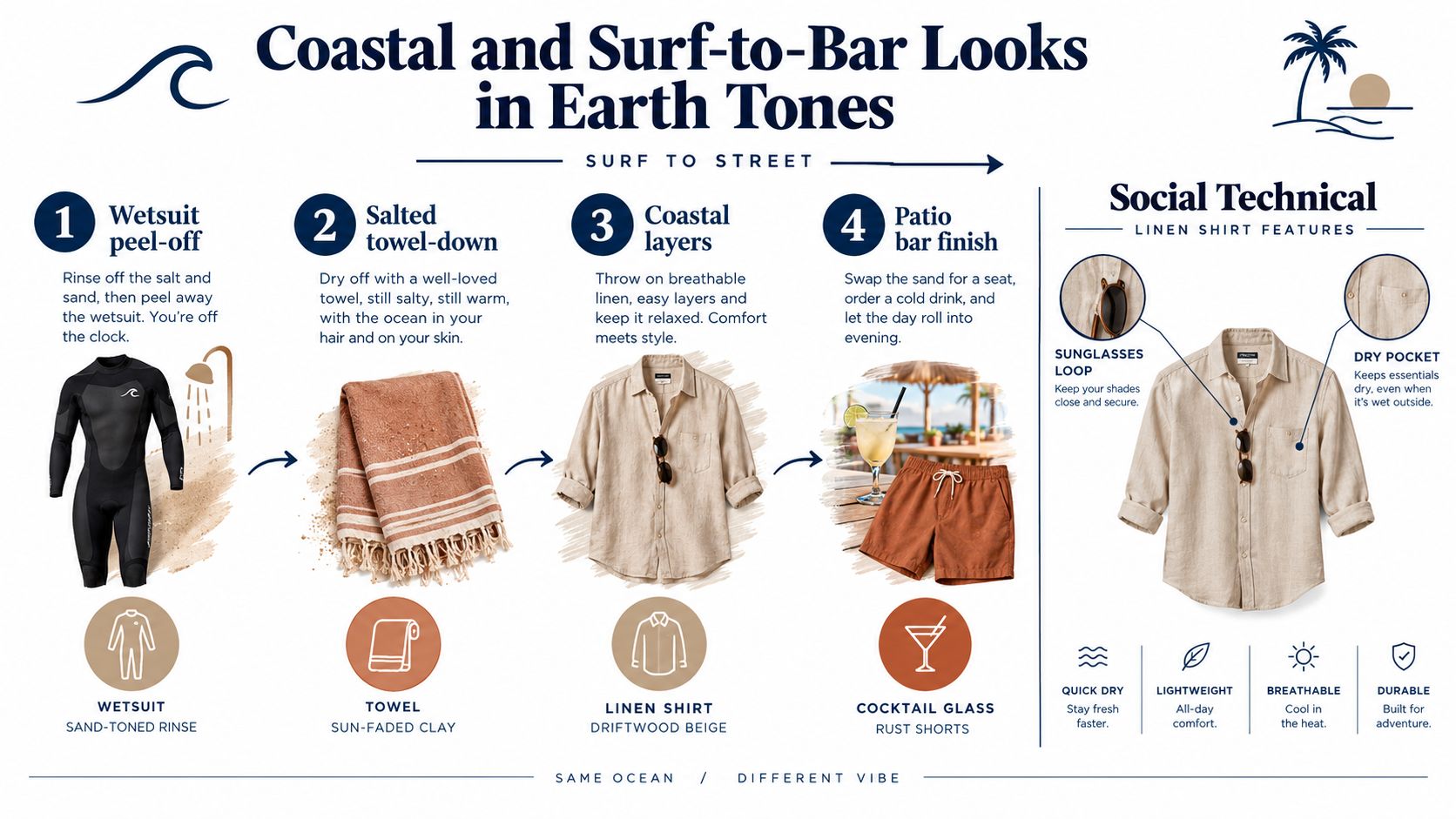
From wet to dry to ready
The first layer should help you recover from the water. A terry-lined shirt can absorb moisture and add warmth without looking like a robe once you leave the sand. Over a dry tee, it becomes a casual overshirt that works at a patio table.
The palette should get warmer as the day moves inland. Seafoam-tinted neutrals, driftwood beige, faded clay, and dusty olive feel connected to coastal weathering. A brand-new saturated color can look too loud beside naturally softened cotton, salt-faded towels, and sun-worn canvas.
The coastal comfort clothing guide offers a useful reference for building that wet-to-warm-to-social sequence. Keep one layer practical, one layer breathable, and one item polished enough for the bar.
Make the outfit look lived in
Texture carries this look. Terry, linen, canvas, and washed cotton create depth without requiring complicated color combinations. A linen shirt in driftwood beige over a clay tee can look more considered than a stack of perfectly matching pieces.
If your home or rental needs to support the same coastal mood, these beach and coastal wall decor ideas offer a helpful reminder about restraint. The strongest beach-inspired spaces rarely rely on a single loud color. They use sand, weathered wood, faded green, and soft blue-gray to create atmosphere.
For a group, let people share the palette rather than the exact outfit. One person wears rust shorts, another wears olive, and a third brings in sand or faded ochre. That creates visual cohesion for a beach bonfire without making everyone look like they were issued uniforms at check-in.
Coastal rule: Choose colors that look better beside salt, sun, and worn canvas. Save the neon for the rescue equipment.
Seasonal Shades, Fabrics, and Lighting That Make Earth Tones Work
Earth tones aren't one fixed palette. Lighter shades such as sage and morning oat suit spring and summer, while deeper chocolate and forest green feel more natural in fall and winter (seasonal earth-tone styling). The shift isn't about obeying a fashion calendar. It's about matching visual weight to light, temperature, and the setting.
| Season | Key Earth Tones | Fabric Finish | Best Setting |
|---|---|---|---|
| Spring | Sage, bone, soft taupe | Matte cotton, light knit | Cabin deck, city errands |
| Summer | Sand, faded clay, morning oat | Linen, terry, washed cotton | Beach, patio, travel |
| Fall | Rust, cocoa, ochre, moss | Brushed flannel, corduroy | Tailgate, dinner, fireside |
| Winter | Forest green, charcoal taupe, deep brown | Wool, fleece, dense knit | Après-ski, lodge, cold travel |
Light changes the decision
Blue-hour snow can pull gray and sage toward a cooler, sharper appearance. Golden-hour coastal light warms sand, camel, and terracotta. Indoor bulbs can make cocoa, rust, and ochre look richer, while flash photography may flatten a low-contrast outfit into one dark shape.
That's why value contrast matters in group settings. If everyone wears mid-tone brown, the photographs may lose definition. Add bone, ivory, ecru, or a lighter stone layer near the face, then use a deeper shade at the bottom to anchor the silhouette.
Fabric finish changes the read as much as the color. Linen and terry make light earth tones feel relaxed and coastal. Brushed flannel, wool, and corduroy give deeper shades more warmth and visual density. Style guidance also repeatedly pairs earth tones with cotton, linen, suede, knitwear, corduroy, and leather because those materials add depth to muted colors (natural textures with earth tones).
Production matters too
Earth tones can be made with natural dyes or industrial systems designed for lower-impact production, but fastness and process control still matter. Archroma says its EarthColors technology uses agricultural and other waste-based raw materials, with up to 100% of the natural raw material transformed into dyestuff, and that the dyes can be used on standard yarn, woven, and garment-dyeing equipment (Archroma EarthColors).
For shoppers, the useful takeaway is simple: check how a garment behaves after washing. Dark olive, rust, and brown can look excellent at first and shift warmer, duller, or patchier if the fiber and finishing chemistry weren't handled well. If you want a lighter coastal layer, explore this linen button-down guide and pay attention to weight, opacity, and surface texture rather than color alone.
Complete the Look and Make Earth Tones Yours
A strong earth-tone outfit needs one clear anchor, supporting shades, a repeated color, and a change in texture. Start with a moss overshirt, add bone and rust beneath it, then repeat olive in the socks or a muted green cap. Finish with flannel, denim, or toweling so the outfit feels lived-in rather than overly smooth.
For a cabin weekend, wear a cocoa shirt with an ecru tee, dark denim, and a rust beanie. For a beach-to-bar afternoon, choose a sandwashed tee, faded olive shorts, a terry-lined overshirt, and a walnut belt. At a fireside dinner, swap the tee for a fine knit and leave the outer layer open so the contrast between light and dark stays visible.
Group style without matching uniforms
Loose coordination suits cabin weekends, wedding barns, bachelor gatherings, and beach bonfires. Keep the group within clay, moss, sand, rust, bark, and bone, then let each person choose a silhouette that fits their style and plans.
The result photographs as intentional without turning everyone into a uniformed cast. A coordinated robe, shirt, or accessory also earns more wear after the event, becoming part of a travel or weekend wardrobe instead of sitting in a closet.
Before ordering group shirts, use this shirt measuring guide to reduce fit surprises. Coordination works best when people want to wear the clothes, not when a color board does all the deciding.
Add the pieces people remember
Accessories should carry the palette without taking over:
- Hats: Choose muted ochre, olive, walnut, or faded canvas.
- Scarves: Use cocoa, stone, or soft sage for warmth and texture.
- Socks: Repeat rust, moss, or bark near the shoe.
- Koozies: Pick a low-saturation shade that works beside denim, flannel, and fleece.
- Bags: Choose dark green, taupe, or worn brown to connect polished and outdoorsy pieces.
The best accessory makes the outfit easier. It belongs at the parking-lot tailgate, on the cabin deck, at the patio, or during the first drink after the lifts close. Leave room for a stranger to ask about the hat, then put the tech away and enjoy the conversation.
Join the Vital Few newsletter for earth-tone styling ideas, product drops, and practical advice for the next post-adventure transition.
California Cowboy makes shirts, robes, and outerwear for social living, with warm layers and functional details suited to cabin weekends, beach days, and fireside hangs. Look for an earth-tone layer that can follow you from the activity to the people waiting afterward.

