


Woodsmoke hangs over the deck. Somebody's damp towel is slung across the tailgate, and the group chat has one question left in it.
Where do we get the shirts made?
Three people have opinions and two have quotes. The print shop in town came back cheap for twenty tees with a mountain graphic across the back. The embroidery place quoted per piece for names on the chest. Nobody has explained why the numbers landed where they did, or which one is going to look right in the photos, or which one survives the rental cabin washer that runs hot and eats socks.
You don't need a loyalty argument about thread versus ink. You need to know what your artwork is, what the garment is made of, and how the thing is going to get washed for the next five years. Those three answers pick the method almost every time.
The Short Answer for Your Crew
For names, monograms and small logos on robes, polos, caps and heavier garments, embroidery is usually the better fit. For bold, flat or multicolor artwork across a large area, screen printing is usually the better fit, especially when everyone in the crew wants the same design. The garment and artwork should make the call, not a blanket claim that one method always lasts longer.
Fabric, wash routine and artwork size matter more than the decoration method alone. Dense stitching can pucker a lightweight tee and feel stiff against the skin. A print can work well on heavier fabric, but its performance depends on the ink and how the garment is cared for.
Embroidery has a long history. A timeline of embroidery history documents early examples, and the practical distinction remains simple: thread builds a raised mark, while ink creates a flat one.
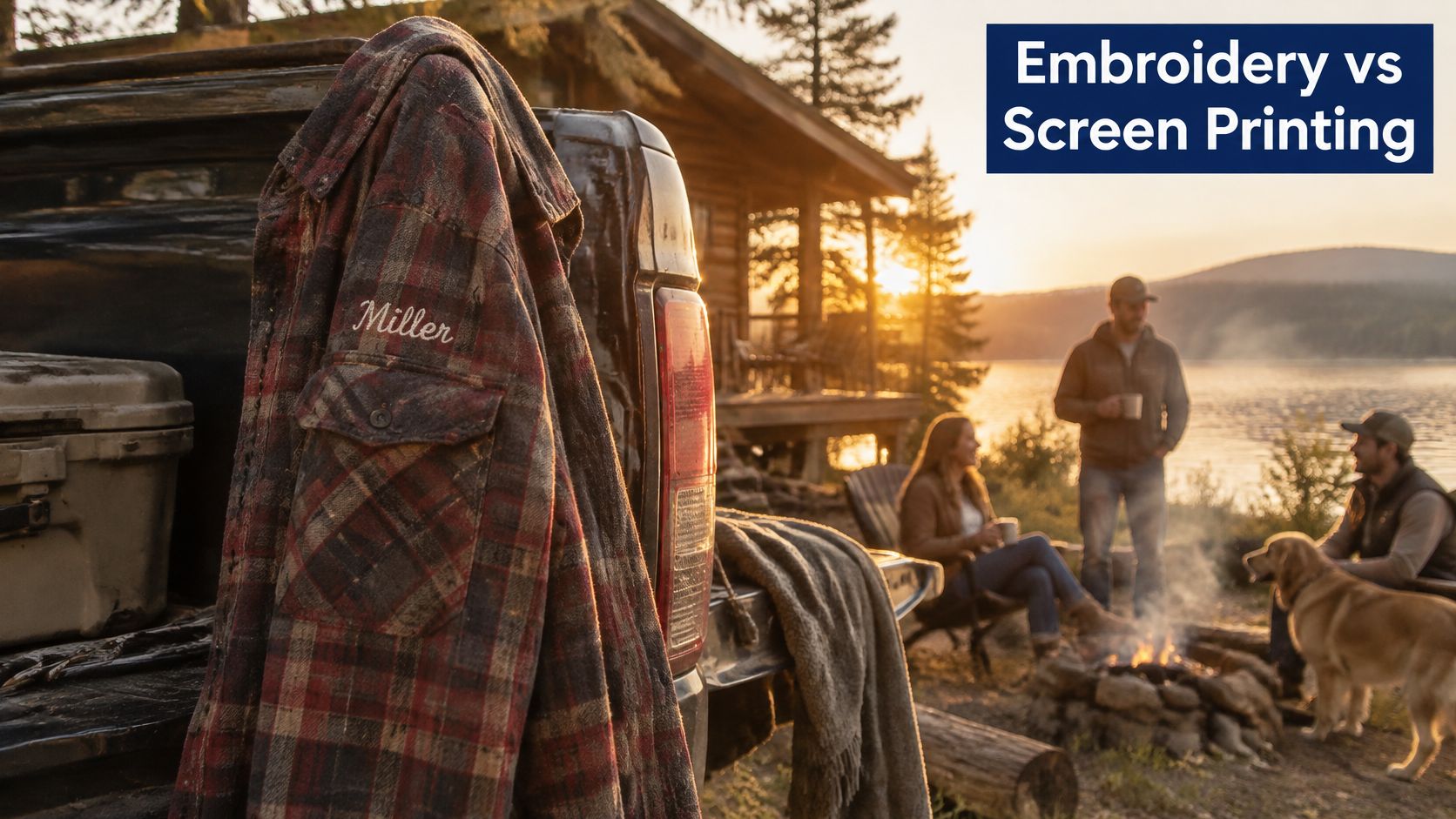
Embroidery turns artwork into a stitch file, then builds the design into the garment with thread. Screen printing pushes ink through a mesh stencil, using a separate screen for each color.
Start with the fabric, the size of the artwork and the way the crew will wash the garment. Those details point to the method that fits the order.
Embroidery vs Screen Printing at a Glance
| Criteria | Embroidery | Screen printing |
|---|---|---|
| Best artwork | Logos, monograms, initials, small text | Bold flat art, large back graphics, color blocking |
| Surface texture | Raised, dimensional thread | Flat, smooth ink film |
| Color handling | Extra thread colors without an extra screen | One screen per ink color |
| Setup | Digitized stitch file and machine time | Screens prepared for each color |
| Run economics | Strongest for one-off or small personalized runs | Strongest for many identical garments |
| Best garments | Polos, robes, caps, fleece, outerwear | Tees and shirts with large printable areas |
| Durability drivers | Stitch density, fabric, backing, wash care | Ink system, curing, fabric, wash temperature |
| Personalization | Names and monograms per piece | Same design repeated across the run |
Read the first two rows together and you have the texture decision. Thread wins for compact marks where perceived value matters. Ink wins for broad, flat or multicolor artwork across large areas.
Color handling is the row to watch on a multicolor mark. Adding a fifth thread color costs you nothing in screens. Adding a fifth ink color adds a whole screen to the setup before a single shirt gets printed.
The rows that decide most real orders are run economics and best garments. The cost section below walks the numbers. Nothing in this table is a fixed law, though. Digitizing quality, ink chemistry and fabric weight can flip the result on any single garment, which is why the durability section exists.
One market note in favor of not picking a side: in the United States decorated-apparel market, embroidered apparel accounted for 39.93% of revenue in 2023, and a market summary reported that garments represent more than half of U.S. screen-printing activity while forecasting screen-printed apparel to grow at a 14.8% compound annual growth rate from 2024 through 2030, according to a screen printing and embroidery market summary. Neither method has pushed the other out, because they answer different questions.
Thread Texture vs Printed Ink
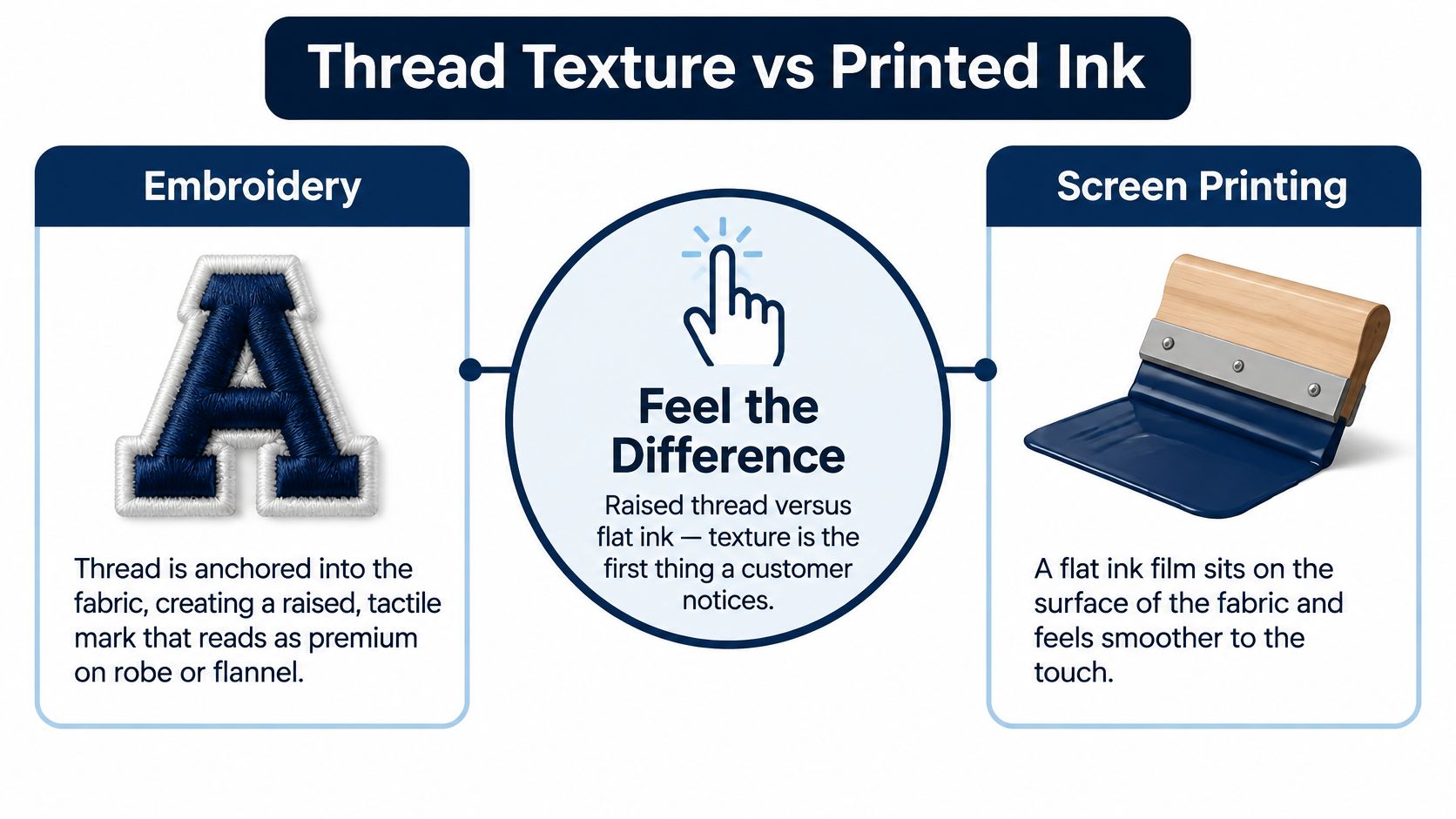
Textured versus smooth is the whole argument, and you can settle it with one finger.
A screen print lays a flat film of ink across the fabric surface. It's smoother against the skin, it holds gradients and photographic shading, and it covers a full back panel without adding weight. Embroidery anchors thread into the weave and builds a ridge you can feel through a shirt pocket. On a robe or a heavy flannel, that ridge is the point. It reads as considered, not printed-on.
Feeling the Difference Before You Commit
Run a fingernail across the mark with your eyes closed. Thread gives you a braided, slightly springy ridge. Ink gives you a flat plane that stops where the stencil stopped. Then fold the garment in half at the decoration and look at the fabric around it. If the weave gathers or the shirt won't sit flat, the stitch count is too high for that substrate.
Design quality lives or dies in digitization. Coats' embroidery thread guidance notes that stitch density has to match thread weight and needle size, with representative densities running from about 3.5 stitches per 10 mm for heavier thread up to 8 stitches per 10 mm for fine thread. Push past that and lightweight fabric stiffens, the garment puckers, and needles take damage. Drop below it and you get visible gaps and weak coverage.
That same Coats guidance puts upper-thread consumption at roughly 6 meters per 1,000 stitches and recommends testing your digitized file on the actual fabric, because thread coverage changes with the substrate. A stabilizer and backing that work on a mid-weight woven will behave differently on terry pile or a stretch blend. Test those separately.
Social Spec: Why Pocket Placement Changes the Tailgate Game
Function details decide where a monogram can live. The High Water shirt carries a beer bottle pocket and a sunglass loop (K13), and the High Sierra shirt has a zippered dry pocket for a phone plus a bonus beer pocket (K25). Those pockets are the reason a chest monogram needs to sit above the pocket seam, not across it.
Where a Monogram Can Live on the Garment
Picture the Social Anatomy of the shirt as a labeled map. The dry pocket sits on the chest, the bottle pocket sits lower and to one side, the sunglass loop sits at the placket, and the clean zone for a name runs across the left chest above the pocket line or high on the back yoke.
Put a name where a hand goes and you've buried your own detail work under a forearm.
Two practical moves follow. First, order a hat for anything you want visible in photos, since the front panel gives clean embroidery ground and no pocket conflicts, and our six panel hat update walks through how lettering converts into a stitch file before production. Second, browse the High Sierra flannel collection and pick the garment before you pick the font, because the pocket layout on each shirt changes the usable embroidery area.
Worth knowing before you build a cart: our custom embroidery is machine embroidered at our Fairfax, CA location (K1), so the thread work happens in-house rather than at a third-party shop.
Give that a watch before you finalize placement. A stitched mark that fights a pocket is a permanent decision you'll notice every time you reach for your phone.
Durability Depends on the Fabric, Not Just the Method
The most repeated line in this entire category is that embroidery always outlasts screen printing because thread goes into the fabric while ink sits on top and eventually cracks. It sounds logical. It's also the claim most likely to get your order wrong.
Comparative workwear testing reported by the TKnP embroidered workwear resource found that both embroidery and screen printing achieved the highest wash-resistance score in testing at 60°C, while transfer printing scored lower. Two methods, one top score. That single result dismantles the tidy story.
Durability runs on ink chemistry, curing temperature and time, fabric type, wash temperature, abrasion, and how much of the garment the decoration covers. A print that was under-cured in a cold shop will fail while an embroidered name on the same shirt survives for years. Reverse the conditions and the ink wins.
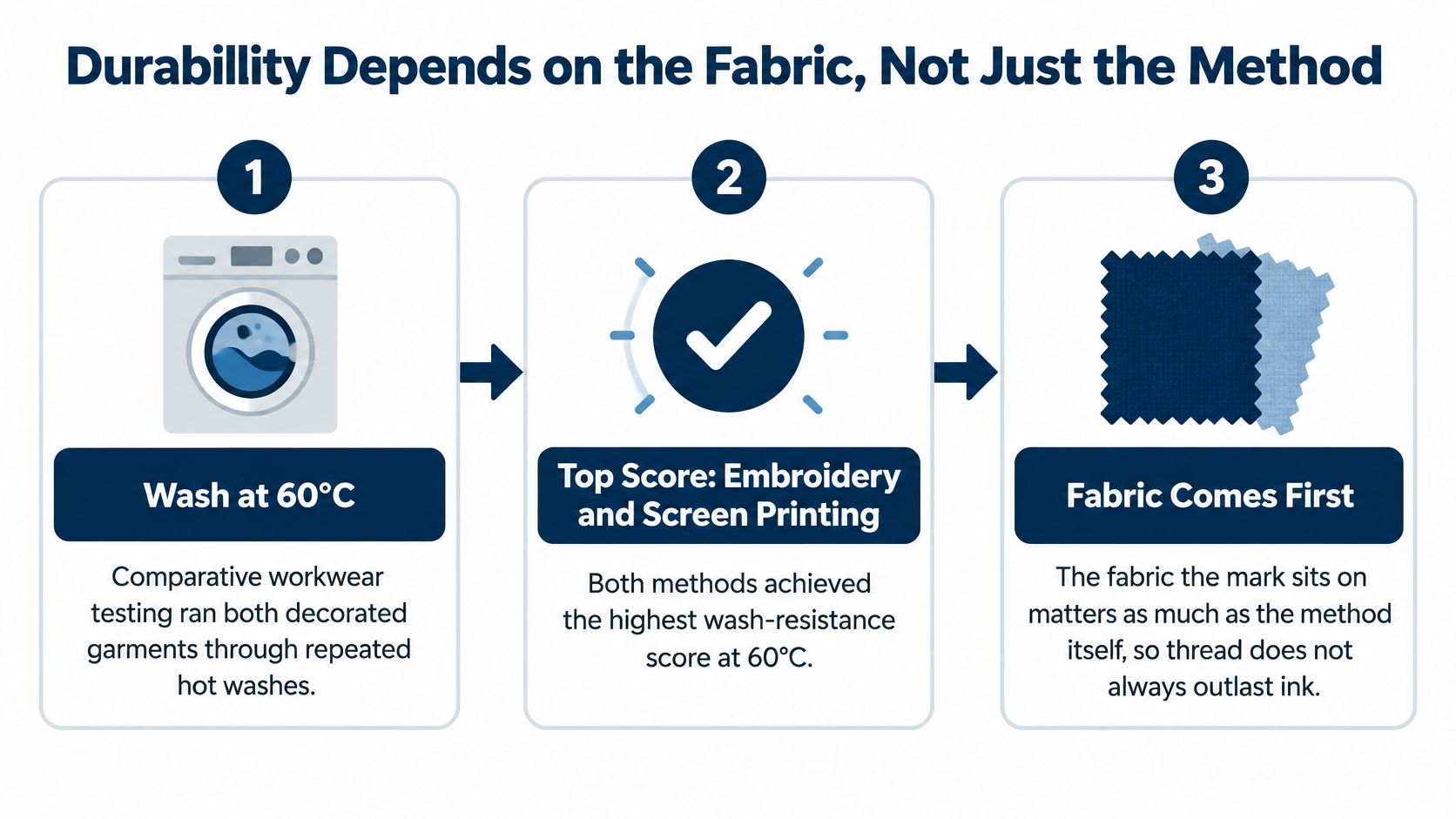
The substrate matters more than most buyers expect. Research on printed textiles shows how far the variables stretch: one tested low-viscosity ink reached complete failure after 25 wash cycles on a particular nonwoven substrate, per the printed textile ink transfer study. That's not a universal lifespan for apparel prints. It's a demonstration that "screen print durability" can't be specified without naming the fabric and the process controls.
What Actually Kills a Decoration
Three things, in order of how often they cause problems. Under-curing, which leaves ink brittle and prone to flaking at the edges. Abrasion, which is why a print across the seat of a garment dies before a chest mark. And heat, whether from a hot wash or a dryer running on high.
Fabric movement does the rest. Drying shrinks the gear back a bit, and wovens and knits can stretch out after a couple wears (K9). A stitched design moves with that stretch because thread has give. A rigid ink film on a fabric that grows and shrinks puts stress on the bond at every edge.
The care rule is the same for both methods and it's simple: machine wash cold on a gentle cycle, then tumble dry low or dry flat (K10).
A Wash Test You Can Run at Home
Stop guessing and test the actual sample before you commit a crew's worth of money.
- Wash the sample cold on gentle, then dry it the way you'd dry the finished garment, whether that's low tumble or flat.
- Repeat for five to ten cycles and log each one with a phone note, including anything that changed at cycle three versus cycle seven.
- Inspect for cracking, edge lift, thread pull or puckering at each checkpoint, and photograph the same spot under the same light.
- Compare hand feel after drying against an untouched piece of the same garment, because softness is the failure wearers notice first.
Run that on a terry-lined piece and the result tells you something extra, since pile fabric changes how both thread and ink sit. Our terry lined shirt range is where that test pays for itself.
Match the decoration to the fabric, the artwork size, the contact points and the care routine. The method is the last variable, not the first.
If you want a printed graphic that stays soft on a tee, the construction of the blank matters as much as the print, and our softest graphic tees breakdown covers which blanks take ink well.
What Each Method Costs for One Piece vs a Whole Crew
Screen printing and embroidery are built differently, and the price follows the build. Screen printing forces ink through a separate screen for each color, so a four-color logo generally requires four screens and corresponding setup work, according to Arklavo's screen print vs embroidery guide. Embroidery skips screens entirely and converts artwork into a digitized stitch file instead.
That one structural difference explains almost every quote you'll receive.
| Cost driver | Screen printing | Embroidery |
|---|---|---|
| Setup | One screen per ink color, prepared before the run | Digitized stitch file for the design |
| Color count | Each added color needs another screen | Extra thread colors do not need an extra screen |
| Run size | Cost per shirt falls as the run grows | Cost per piece stays closer to flat as the run grows |
| Design size | Larger prints use more ink without extra setup | Stitch count and machine time grow with size |
| Garment type | Works best on tees and flat panels | Heavier garments such as robes and outerwear need stabilizer and backing |
| Single personalized piece | Usually uneconomical due to setup | Usually practical, e.g. a custom embroidery item at $30.00 USD |
How Volume Changes the Math
Screen printing gets cheaper per shirt as the run grows, because the screen cost spreads across more pieces. Embroidery never enjoys that curve. Each piece costs roughly what the last one cost, since machine time and stitch count don't shrink with quantity.
The interesting wrinkle is the small multicolor order. A chest logo with four thread colors needs one digitized file, while the same four colors in ink need four screens. On a handful of pieces, embroidery can come in competitive on a mark that screen printing would price like a small production run.
Here's the rule I'd hand a crew captain. If the order is one or a few personalized pieces, embroidery usually costs less to get right. If it's many identical pieces with a complex graphic, screen printing usually wins.
For a single robe with initials, our custom embroidery runs $30.00 USD (K3). Two working details make the timeline real: after you add an embroidery item to the cart, we contact you to confirm the name or monogram to be stitched (K4), and embroidery orders take an extra day for the embroidery service (K6).
Rule of thumb: digitize once, reuse forever. Your stitch file stays on record, so reorders skip the setup work that made the first run feel expensive.
When you request a quote from any shop, send four things in one message: the design size or stitch count, the number of colors, the quantity and sizes, and the exact garment. Shops quote faster and more accurately with all four on the table.
Browse the monogram and embroidery options to see what a single personalized piece looks like before you build a group plan, and our notes on personalized group gifts cover how mixed orders get organized.
Best Pick for Bachelor Party, Après-Ski and Beach Crews
Different crews, different constraints. Here's how the calls break down in practice, using Tidal Colors' embroidery vs printing breakdown as the technical baseline: screen printing suits broad artwork, large back graphics, bold shapes and gradients, while embroidery suits compact logos and text on polos, jackets, caps and heavier garments, and can't reproduce continuous-tone gradients the way ink can.
- Bachelor party, bold group graphic. Screen print the tees, because a full back panel with a loud design is exactly what ink does well. Then embroider the names. Splitting one order across two methods is normal and usually the right answer.
- Wedding party robes with monograms. Embroidery, no debate. A stitched name on a robe is a keepsake. If the group also wants a large back graphic, print the back and embroider the front.
- Après-ski team. The Unisex Après Ski Team Turtleneck is a double-layered turtleneck with a custom patch and a ribbon sleeve stripe (K12). The patch is embroidery work. Any large graphic on the body is print work. Two methods, one garment.
- Coastal weekend crew. Terry-lined shirts want light stitching or none, so test density before committing to heavy coverage. Dense embroidery on pile fabric adds stiffness where you least want it.
- Cold-weather hoodie order. Function details change where decoration can sit. The double-layered hoodie has a zip dry pocket, a secret pen pocket, and a double needle-stitched bottle pocket with nylon lining (K14), so plan a chest mark that clears all three.
The technical floor is worth knowing too. Tidal Colors' embroidery specification cites satin-stitch spacing of roughly 0.4 to 0.6 millimeters and fill-stitch spacing of about 0.5 to 0.8 millimeters for a 40-weight thread on a standard woven shirt. Below those tolerances, small text fills in and thin letterforms close up. If your logo has a tagline in a light serif, simplify it for stitching or expect mush.
The Decoration Footprint Question
Nobody asks this at the counter, and everybody should. Thread type, ink type, the number of colors and passes, material waste, shipping distance and whether personalization extends the garment's life all matter more than the label on the method.
A 2025 study in RSC Advances on biomaterial-based printing composites shows screen printing on cotton, cotton-polyester and linen with newly developed biomaterial inks, which means the environmental profile of printing is a moving target rather than a fixed cost. Embroidery isn't automatically greener because it skips the ink film, and printing isn't automatically worse.
A meaningful name on a robe lasts longer in the closet than a cheap graphic on a tee. Longevity is a design decision, not a decoration method.
If your crew likes a graphic tee with personality, the Tattoo Golf styling guide to funny golf shirts that still look sharp is a good read on picking artwork that won't feel dated by next season, which is its own form of durability.
Start with the El Garibaldi Robe when you're ordering a single personalized piece, since one name on one robe is the cleanest embroidery job there is. For a group that wants warmth and function, the hoodie and fleece range gives you decorated garments people wear past the weekend, and our custom bachelor party shirts guide maps out the split-order approach.
Lock In Your Method and Complete the Look
Work the decision in this order and stop as soon as you get a yes.
- Is the mark compact and personal? A name, monogram or small logo on a premium or heavier garment means embroidery. If the design fits on a business card, lean embroidery and don't think harder about it.
- Is the artwork large, flat or multicolor across many identical pieces? Screen printing, especially if it needs a full back panel or a gradient.
- Is the order mixed? Split it. Embroider the names, screen print the group graphic. One order, two methods, best result.
Three details to confirm before anything gets stitched. Get the exact spelling of every name and monogram, because we contact every embroidery customer to verify it (K4). Build in the extra day embroidery adds to your timeline (K6). And read the return terms, since embroidered products can't be exchanged or returned unless they're defective (K7). If the crew is spread across time zones, shipping reaches most countries for $30 (K27).
Complete the Look
- A tee or polo to match the crew. Something the whole group will rewear, so the tees and polos collection is the place to start.
- A hat for the tailgate. Best embroidery ground on the whole outfit, and the hats and accessories range has you covered for sun and photos.
- A pouch for the cooler. The Out of Pocket Pouch ships with 3 removable, interchangeable statement patches (K23), so it works for the crew that can't agree on one design.
Before you order, our custom group shirts overview covers how a mixed embroidery-and-print order gets built from first sketch to delivered box.
Then join the Vital Few newsletter for first access to product drops and the next group-order season. Holster the phone after that. The whole point of a stitched name is that it doesn't need a screen to mean something.
California Cowboy builds shirts, robes, hoodies and outerwear for the hours after the mountain or the water, with monogram and embroidery service done by machine at the Fairfax, California shop. Pick your garment, settle the artwork size, and let the fabric tell you whether it wants thread or ink. Head to California Cowboy to choose your piece, add a name, and get the crew outfitted before the next trip.

