


Three letters sit above the chest pocket of a robe draped over the deck rail, and the two people reading them don't agree on the name. One sees a first, middle and last initial in the order they were stitched. The other reads the enlarged center character as a surname and arrives at somebody else entirely. Neither is being careless. Monogram initials order changes with the layout, and three letters on their own don't tell you which convention you're looking at.
That ambiguity follows monograms into every gift you'll buy this year: a robe for a cabin weekend, a stack of towels for a wedding, a batch of shirts for a bachelor party. The fix isn't memorizing etiquette. It's learning to read the design the way the person who made it intended, then entering your name so the order form produces that design.
Monogram Initials Order at a Glance
The layout sets the order; the name just supplies the letters. Find the largest character first. When the center letter outweighs its neighbors, that letter is the surname and the other two are read around it. When all three match in size, weight and height, they follow ordinary name order. The table below is your lookup for the three layouts you will meet most often.
| Style | Layout rule | Example name | Initial order |
|---|---|---|---|
| Individual, enlarged center surname | First, Last, Middle | Alex James Smith | A S J |
| Individual, equal-size letters | First, Middle, Last | Alex James Smith | A J S |
| Couple sharing a surname | Bride first, shared surname centered, partner first | Emma and Daniel Jones | E J D |
Three rows cover almost every checkout screen. Read row one as a mark built around a family name, row two as three initials in a line, and row three as one shared surname with a person standing on either side of it. Alex James Smith can become either A S J or A J S, and both results are correct. Only the template decides which one you get.
Why the biggest letter carries the meaning
A monogram reads the way a newspaper page reads. The largest line announces the subject, and the smaller lines qualify it. Enlarging the surname tells the eye this mark belongs to a family, and your brain files that hierarchy away before it ever spells the letters out loud.
The convention has had a long time to settle. Monograms have a documented history extending back more than 2,300 years, beginning on Greek coins around 350 BC, when city-states used combinations of their names' first letters to identify the issuing authority, as Envato's guide to monogram types traces, before the mark traveled through medieval craft stamps and Victorian household linens. What began as an authentication device became a personal and family identifier, which is what it still is on a towel or a cuff.
Typography functions as a data field here. A larger center character establishes the surname as the dominant identifier, while uniform characters imply a literal left-to-right reading. Independent monogram guidance maps equal-sized block layouts to first, middle, last and enlarged-center layouts to first, last, middle, as Builderology's monogram etiquette reference explains. There is a practical wrinkle on the production side: stitch density, font width and hoop constraints can make a center letter look dominant even when nobody intended it, which is why the layout has to be chosen on purpose rather than left to the machine.
So when you pick a template, you are really picking which initial gets the center. A design that enlarges the middle character expects the surname to fill that slot. A design with uniform letters expects first, middle, last in a row. A gift that arrives with an oversized middle initial reads as someone else's mark, even when every letter is technically right.
The ten-second test: if the center letter is larger, the surname sits there. If all three letters are the same size, read them left to right in name order.
Browse the custom monogrammed clothing and gifts page for monogram and embroidery options before you commit to a layout.
How to Order Initials for a Traditional Monogram
Nearly every wrong monogram is decided at the form, not at the embroidery machine. The needle does precisely what the fields tell it, so the routine below is really about feeding it clean instructions.
Here's the sequence that keeps those fields honest.
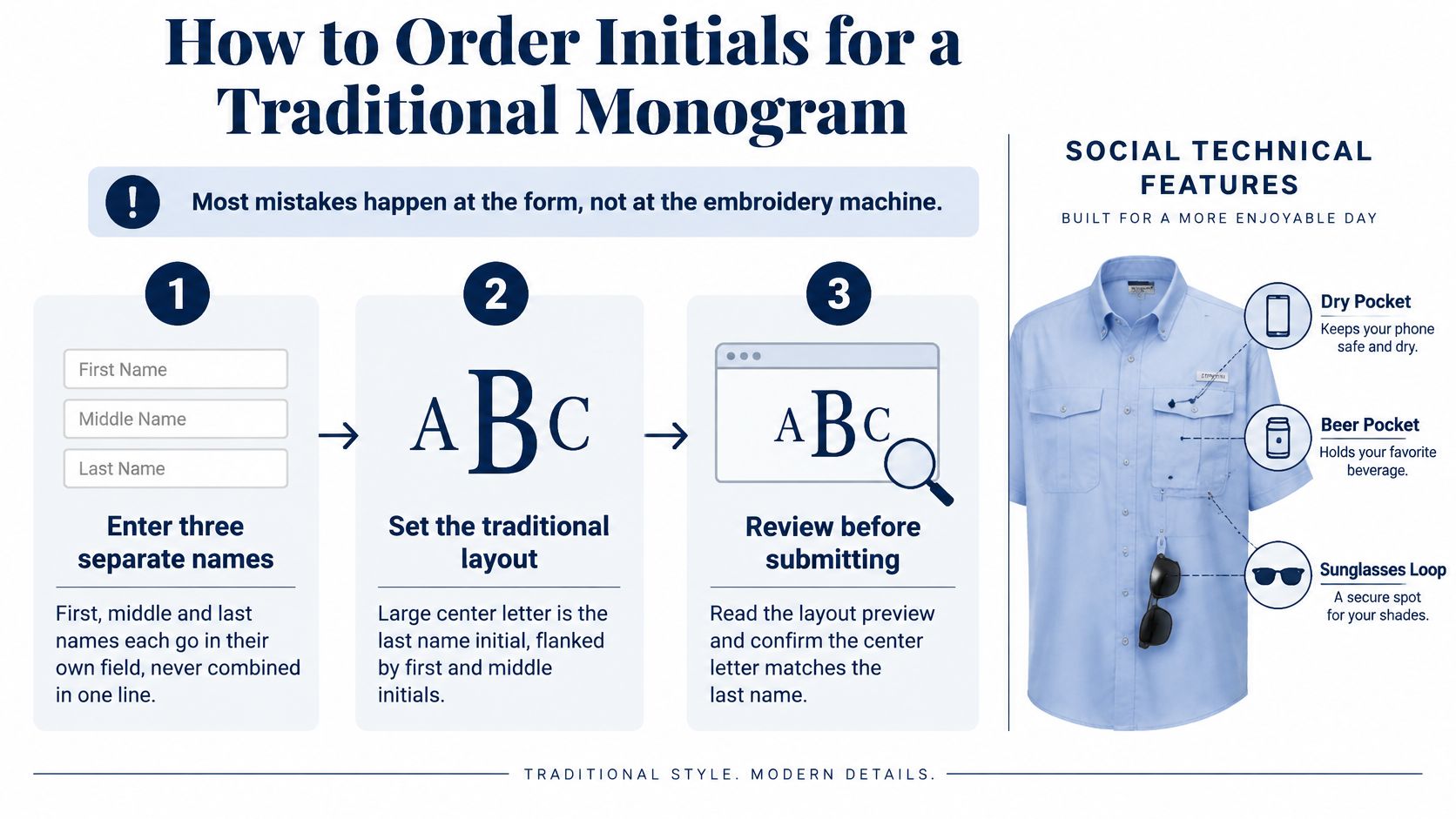
- Split the name into three fields. First name, middle name and last name each go in their own box, never typed as one long string. A combined entry is what pushes the surname into the middle slot and produces the wrong hierarchy.
- Choose the layout before you choose a font. Decide between an enlarged center surname and equal-size letters first. Script and vine templates are drawn around a dominant center character, so equal sizing inside them reads flat no matter how pretty the letterforms are.
- Build the traditional arrangement deliberately. The first-name initial goes on the left, the surname initial sits in the center and is enlarged, and the middle-name initial goes on the right. The American Sewing Guild describes the conventional format as three letters with a larger central surname initial and smaller given-name initials flanking it. The common slip is typing the surname into the middle field and the middle initial into the last field, which gives you the right letters in the wrong places.
- For equal-size letters, stop rearranging. Read left to right as first, middle, last and enter them that way. Here the slip runs the other direction: people choose a flat, modern set of letters and then expect the traditional center emphasis to appear anyway.
- Approve the rendered preview, not the mental image. Compare the largest letter to your surname, then check the left character against your first name. Skipping this because the letters look fine in a text field is how a misspelled or misordered set reaches production.
A correct traditional preview is unambiguous at arm's length. The largest letter is the surname, the first name anchors the left side, and nothing about the arrangement leaves a reader guessing which name they're looking at.
The same discipline applies beyond fabric. If you're adding initials to a leather piece, this guide to personalized full-grain bags for men covers where a stamp or emboss sits so it doesn't fight the hardware, and the ordering logic is identical.
For anyone applying this to a robe, the monogrammed robe for men breakdown walks through placement on a garment that gets read across a breakfast table.
Couple Monograms Put the Shared Surname in the Middle
Two first names, one shared surname, and a disagreement over which partner stands on the left. It's the most common pre-wedding text message in the registry business.
The couple pattern is straightforward once you fix the center. The bride's or partner's first initial goes on the left, the shared surname initial is centered and enlarged, and the groom's or other partner's first initial goes on the right. Emma and Daniel Jones become E J D, with the J carrying the weight. That structure, along with the individual formats, is documented in the history and conventions of the monogram, which also notes that these are conventions rather than universal rules.
Individual conventions get mixed into couple orders all the time, and they don't behave the same way. A traditional women's monogram commonly uses the enlarged surname-centered arrangement. A traditional men's monogram is often set in a straight line with equal-size letters in first, middle, last order. The same person can therefore render two legitimate ways, and reversing the letters changes the perceived convention even when every initial is right.
When the surname isn't shared
Partners keeping separate surnames have no shared center letter to enlarge, so the decision has to be made out loud before anyone orders. Agree on which surname takes the center and commit to it across the whole set of gifts, or drop the center emphasis entirely and let two equal initials sit side by side.
Decide the center first. Every other choice on the order form follows from that one letter.
Regional practice, family preference, typography and whether someone uses a maiden, middle, hyphenated or married surname all shift the finished design. The personalized gifts for weddings collection is a useful reference point for seeing how a shared center letter reads on a robe versus a smaller embroidered piece.
Edge Cases for Compound, Hyphenated and No-Middle Names
The standard rule holds right up until you meet a guest with two family names or a groomsman who has no middle name at all. Then the tidy three-letter formula needs a decision rather than a default.
- No middle name. With only two initials, there's no third letter to enlarge, so the pair reads left to right as first then surname. Enter both, check the preview, and don't let a form force a placeholder into the middle slot.
- Compound surname. Decide which initial represents the surname the wearer uses, then confirm it with them directly. A double-barrelled name squeezed into one letter is a guess, and guesses are what people notice on a garment they wear every weekend.
- Hyphenated surname. Agree on whether the hyphenated name shows as a single center initial or whether both letters appear. Neither answer is wrong. An unspoken answer is.
- Maiden name kept as a middle name. Use the name the wearer uses in daily life, not the one on an old record. A monogram is a label for a person, not a transcript of a birth certificate.
- Names that don't follow Western first, middle, last order. Ask the wearer how they want their name read before production starts. A Spanish or Portuguese name with two family names, or a name where the family name comes first, doesn't need to be reshuffled into a convention that was never built for it.
Ask before you stitch. One message to the wearer settles every case on this list, and it costs nothing.
Etiquette here is a convention, not a law. Consistency and the wearer's own preference can matter more than an inherited rule, particularly when the inherited rule was designed for a naming structure the wearer doesn't have. Western conventions get applied to names with entirely different shapes all the time, so the safest step is always the same one: ask, write down the answer, and match the design to it.
A wrong monogram is easy to avoid. It takes one question, asked before the order is placed rather than after the box is opened.
Group Orders Need Every Initial Checked
One wrong robe in a group of eight is a visible problem: seven people match, one doesn't, and every photo from the weekend carries the error. Get the count wrong across a bachelor or bachelorette party and the mistake multiplies, because these celebrations typically involve about 10 attendees and run roughly two days, according to Aisle's guide to who plans and pays for a bachelor party. Bachelor-party attendees average about $1,500 per person overall, with about $1,300 for one- to two-day events, $1,650 for three- to four-day events, $2,000 when they fly and $1,000 when they drive.
Bachelorette spending runs close behind, averaging about $1,300 per attendee, per Hipposplit's breakdown of who pays for a bachelorette party. Members of a wedding party spend an average total of roughly $1,100 on wedding-related participation, and three in five people set a maximum bachelor or bachelorette budget of $250 while nearly 30% would spend $1,000 or more, as WCCB's wedding-season budgeting report found. The spread matters: a group needs a piece that works for the friend at $250 and the friend going all in.
The pressure is real, too. 38% of Gen Z and millennial respondents report taking on debt as a result of attending weddings or bachelor and bachelorette events, according to Fortune's reporting on group-trip spending. A coordinated item that gets worn again is a different proposition from a one-use costume.
Four checks keep a group order clean:
- Lock the layout for everyone. Same template, same letter sizing, same placement, or the set photographs as a mismatch.
- Type each person's three names individually. Copying a column off a shared spreadsheet is how initials land in the wrong fields.
- Approve one preview per piece. Ten names means ten approvals, not one approval and a batch release.
- Confirm the embroidery timeline before paying. Delivery dates decide whether the set arrives before the trip.
For the logistics side of a bulk buy, this walkthrough of group shirt ordering step by step covers sizing spreadsheets and deadline math. When the layout is consistent, the personalized group gifts angle stops being a novelty and starts being the thing everyone still wears the following summer.
Confirm the Initials Before You Order Your Monogram
The name is entered, the layout is picked, and the cart is one click away. This is the moment to slow down, because the checklist that prevents errors is a different checklist from the one that produces the design.
- Confirm the printed result, not the typed input. Form order and printed order are separate questions, and only one of them ends up on the fabric.
- Write down the layout you chose. Enlarged center surname or equal-size letters, noted somewhere you can check again when the package arrives.
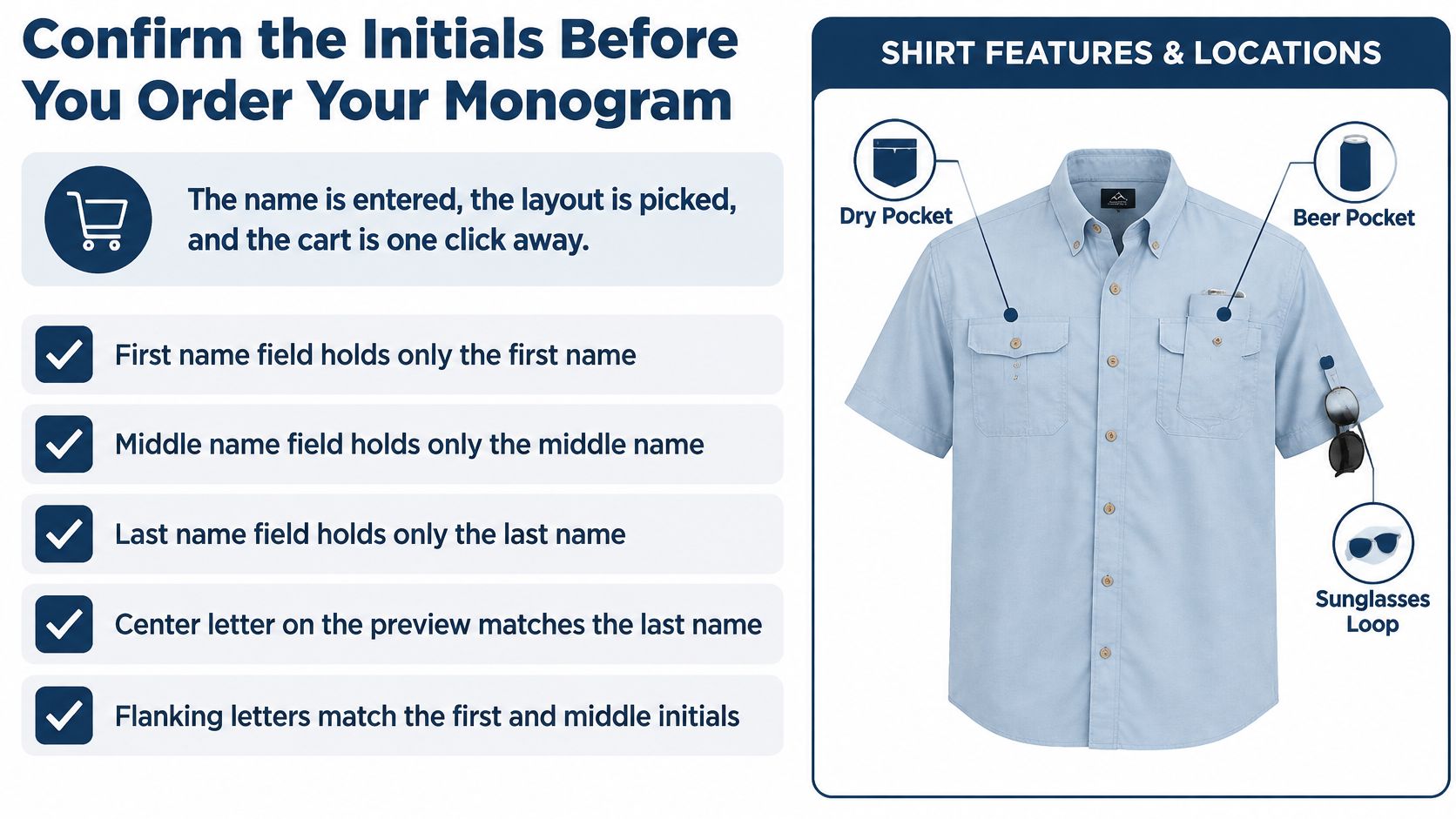
- Read the name fields back against your own spelling. First name in the first box, middle in the middle, last in the last, one per field.
- Allow an extra day for the embroidery service. Embroidery orders take an extra day before they ship, so build that into a tight wedding or trip timeline.
- Watch for a confirmation message. After you add an embroidery item to the cart, we contact you to confirm the name or monogram to be embroidered, and that reply is worth sending back the same day.
If you're weighing decoration methods for a formal piece, this comparison of custom stole embroidery versus print explains why stitched lettering holds up better on anything that gets worn and photographed repeatedly. Ready to move? Open the Monogram & Embroidery option, enter the three name fields in order, and approve the confirmation when it lands. The custom embroidery gifts page shows what the service looks like on finished goods, and the Vital Few newsletter gives subscribers first access to new drops.
Complete the look: embroidered initials sit best when the rest of the outfit stays quiet, so pair the piece with a plain tee, a brimmed hat for the deck, and a koozie that keeps one hand free for the people you came with.
California Cowboy makes robes, shirts and outerwear for the slow hours after the mountain or the beach, and monogramming is how you put a name on that ritual instead of a logo. Tell us which layout you want, enlarged center surname or equal-size letters, and we'll confirm the name before anything goes to the machine. Start at California Cowboy, choose Monogram & Embroidery, and let three well-placed letters do the introducing.

