


The lifts have closed, the trail dust is drying on your boots, and the air smells like woodsmoke, salt, or whatever heroic thing is sizzling on the tailgate grill. Your phone is somewhere in a pocket, your keys are somewhere else, and you're trying to move from physical effort to the first cold drink without looking like you've just escaped a gear catalog.
That's where off the grid pants earn their keep. The best pair isn't only rugged enough for a trail or job site. It should also feel comfortable on the drive home, hold the small things you need, and look socially confident when the activity ends and the good part begins.
Living Life Offline and On the Move
A day outside rarely ends at the trailhead. It tapers off. You rinse the sand from your ankles, pull into the mountain parking lot, or sit on a cabin deck with a mug of coffee while everyone compares the day's minor injuries. The pants that work best in those moments aren't necessarily the most technical-looking pair. They're the ones you stop noticing because they let you focus on the people around you.
That's the appeal of social technical clothing. It treats utility as a way to support connection, not interrupt it. A secure pocket keeps your wallet from disappearing between the beach and the bar. A comfortable waistband lets you settle into a camp chair. A fabric that dries without drama means you don't have to change after every damp adventure.
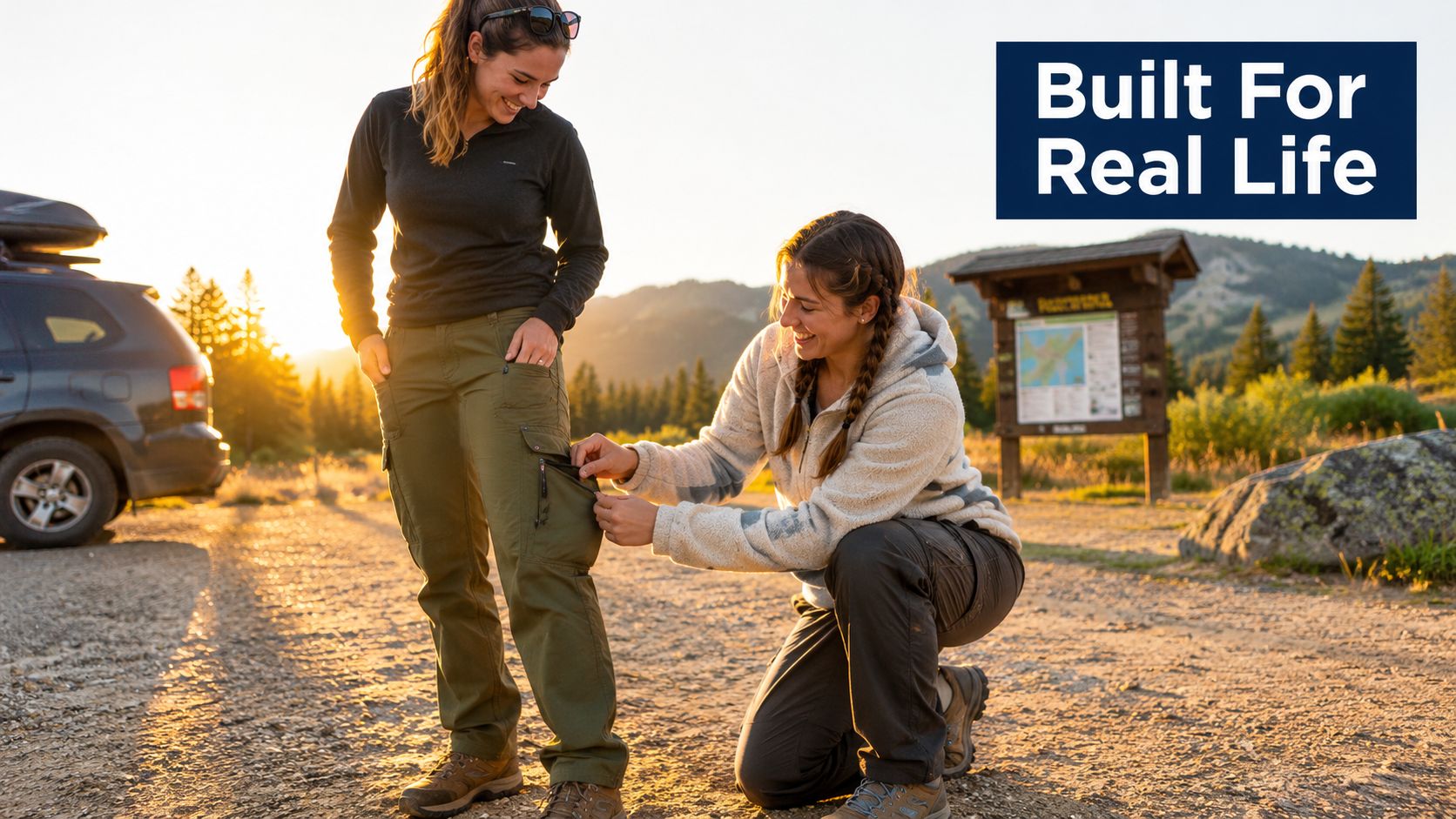
The transition is the test
A pair of pants can perform well during movement and still fail the après test. Some hiking trousers feel fine while you're climbing, then become clammy when you sit down. Some work pants carry everything but make you look like you're about to repair a satellite dish at a wedding. Others are stylish enough for dinner but punish you the moment you kneel on rough ground.
Look for a middle path. Off the grid pants should move through several scenes without demanding a costume change, from trailhead to brewery, beach parking lot to taco stand, or ski lodge to cabin fire. That means useful stretch, a clean silhouette, dependable pockets, and a material that can handle friction without becoming stiff.
If you're still defining what “off the grid” means for your own weekends, this practical guide to off grid living for beginners offers useful context around simplifying routines and spending more time outside. The clothing lesson is similar. Pack less, carry what matters, and make every item earn its place.
Practical rule: If your pants only work during the activity, they're activewear. If they work before, during, and after it, they're part of your social kit.
Holster your tech, not your personality
Hands-free storage matters most when your hands are already occupied. You might be carrying a coffee, opening a cooler, steadying yourself on a boat dock, or gesturing through a story that has become slightly more dramatic with every retelling. A phone pocket that stays secure lets you holster your tech without turning your clothing into visible tactical equipment.
The right pair creates room for serendipitous encounters. You can join the group at the picnic table instead of checking where you put your keys. You can walk into the après bar without emptying every pocket onto the counter. That's a small design choice with a surprisingly human result.
For more ideas on clothing that handles the movement between travel, activity, and social time, explore this guide to travel-friendly clothing. The goal isn't to dress like you're preparing for an expedition. It's to stay comfortable enough to remain present.
Material Benchmarks for Real-World Durability
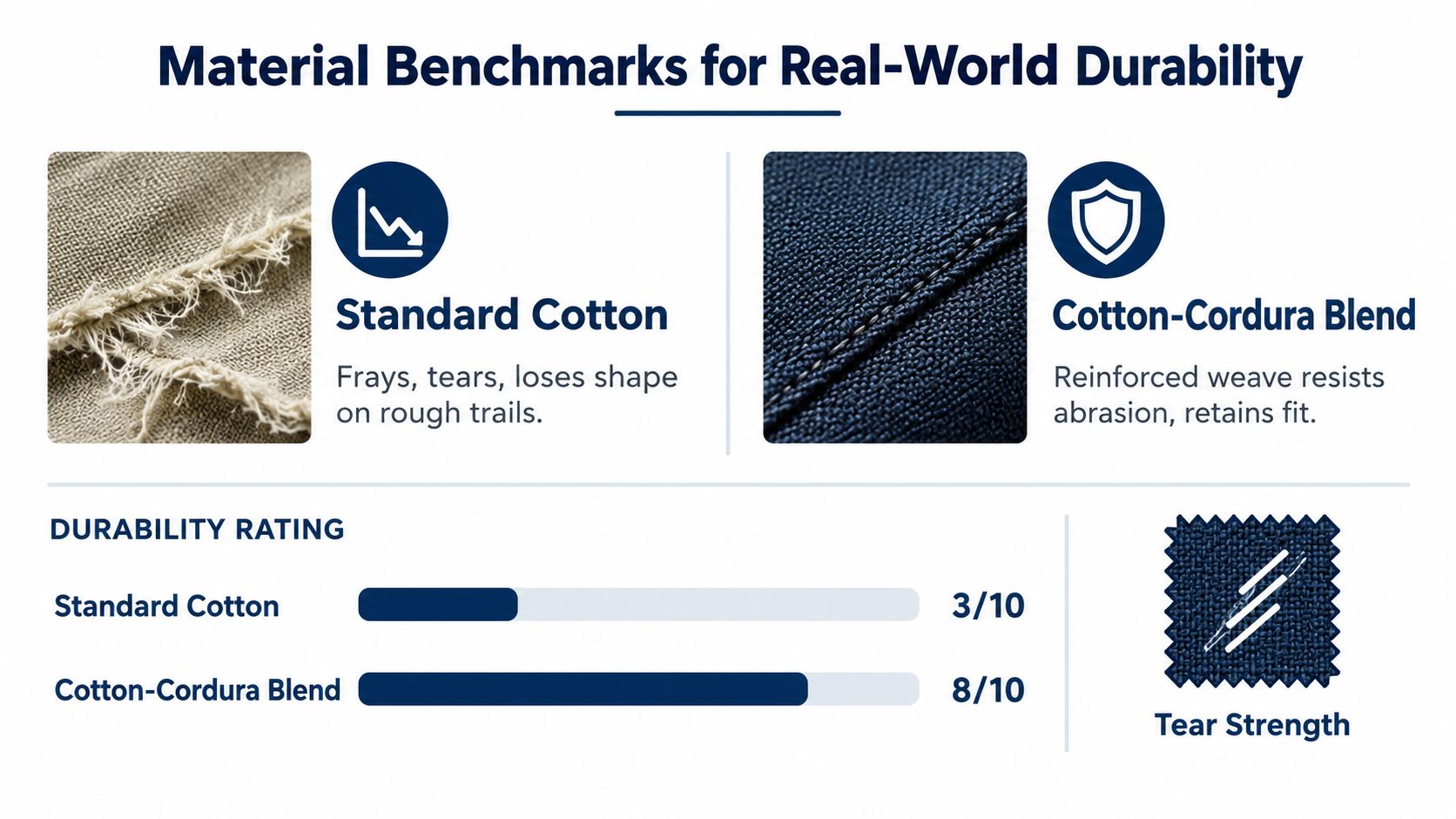
Fabric determines whether pants become a reliable companion or a short-lived favorite. Pure cotton often feels excellent on the first wear, but repeated contact with rough seats, trail surfaces, pack straps, and damp weather can expose its weaknesses. It can hold moisture, lose shape, and wear through where your body repeatedly creates friction.
A useful benchmark is a 70% cotton and 30% Cordura blend at 190 gsm, cited in a review of Vollebak Off Grid Pants. That review describes the fabric as abrasion resistant, breathable, wind resistant, and fast drying, a combination that makes sense for travel, cabin wear, and low-maintenance outdoor use. You can examine the construction in this independent review of Vollebak Off Grid Pants.
Read the fabric in the right order
Start with the fiber blend. Cotton brings comfort and a familiar hand feel. Nylon and Cordura improve toughness and help fabric dry more quickly, especially when the garment is worn through changing conditions. A tightly woven cotton canvas can also be durable, but it usually gives up some drying speed and softness compared with a performance blend.
Next, check the fabric weight in gsm, or grams per square meter. Weight isn't a complete durability score, but it helps you compare two garments that look similar online. A very light weave may feel wonderfully airy on a warm day, yet offer less protection when you kneel, scramble, or repeatedly pack it into a small bag.
The best evaluation sequence is straightforward:
- Confirm the blend: Look for nylon, Cordura, or tightly woven cotton canvas when abrasion matters.
- Check the fabric weight: Use gsm as a comparison point, not as a guarantee.
- Inspect the wear zones: Seat, knees, pocket openings, and hems deserve extra attention.
- Assess drying behavior: If you'll encounter rain, surf spray, sweat, or damp cabins, cotton-only construction can become a liability.
- Test the mobility details: Gussets and articulated knees matter more than a vague promise of stretch.
The strongest lab-tested benchmark in the supplied product research is more than 60,000 abrasion cycles for a durable stretch canvas utility pant. Other workwear references report about 9,100 abrasion passes for NYCO Cordura stretch canvas and about 7,900 passes for a nylon and spandex work pant, while a separate comparison described a nylon-cotton work pant as 10 times more abrasion resistant and twice as fast drying as similar-weight 100% cotton canvas. These figures come from the Tenthousand Tactical Utility Pant benchmark, and they're useful because they show why “feels stretchy” isn't the same as “will last.”
Stretch is helpful, until it isn't
Stretch improves comfort when you climb over a log, step into a truck, or sit through a long drive. But softness can hide a durability compromise. The most resilient fabrics often feel a little firmer because their yarns and weave prioritize longevity over lounge-pant comfort.
That trade-off is worth accepting when you need one pair for trail, work, and casual wear. A little structure helps pants retain their shape, especially after repeated sitting and packing. A garment that stretches generously but loses its form may feel great on day one and sloppy by the end of the season.
For a broader look at how premium outdoor garments balance material choice, construction, and everyday styling, see this guide to high-end outdoor apparel. Use it as a comparison tool, then return to the garment in your hands. The label matters. So does the stitching.
Designing for Social Living and Connection
Technical features become more valuable when they solve a social problem. A pocket isn't impressive because it exists. It's useful because it keeps your phone dry, your wallet secure, or your sunglasses available without forcing you to interrupt the conversation.
Hidden-pocket apparel uses discreet internal or side-panel compartments to store small essentials without adding visible bulk. That makes it especially effective for clothing worn in public settings, where a row of oversized pockets can push a relaxed outfit into full tactical territory. The category includes jackets, vests, pants, underwear, socks, and shirts, so concealed storage isn't limited to one type of garment. You can see how this mechanic works across travel clothing in this guide to pickpocket-resistant apparel.
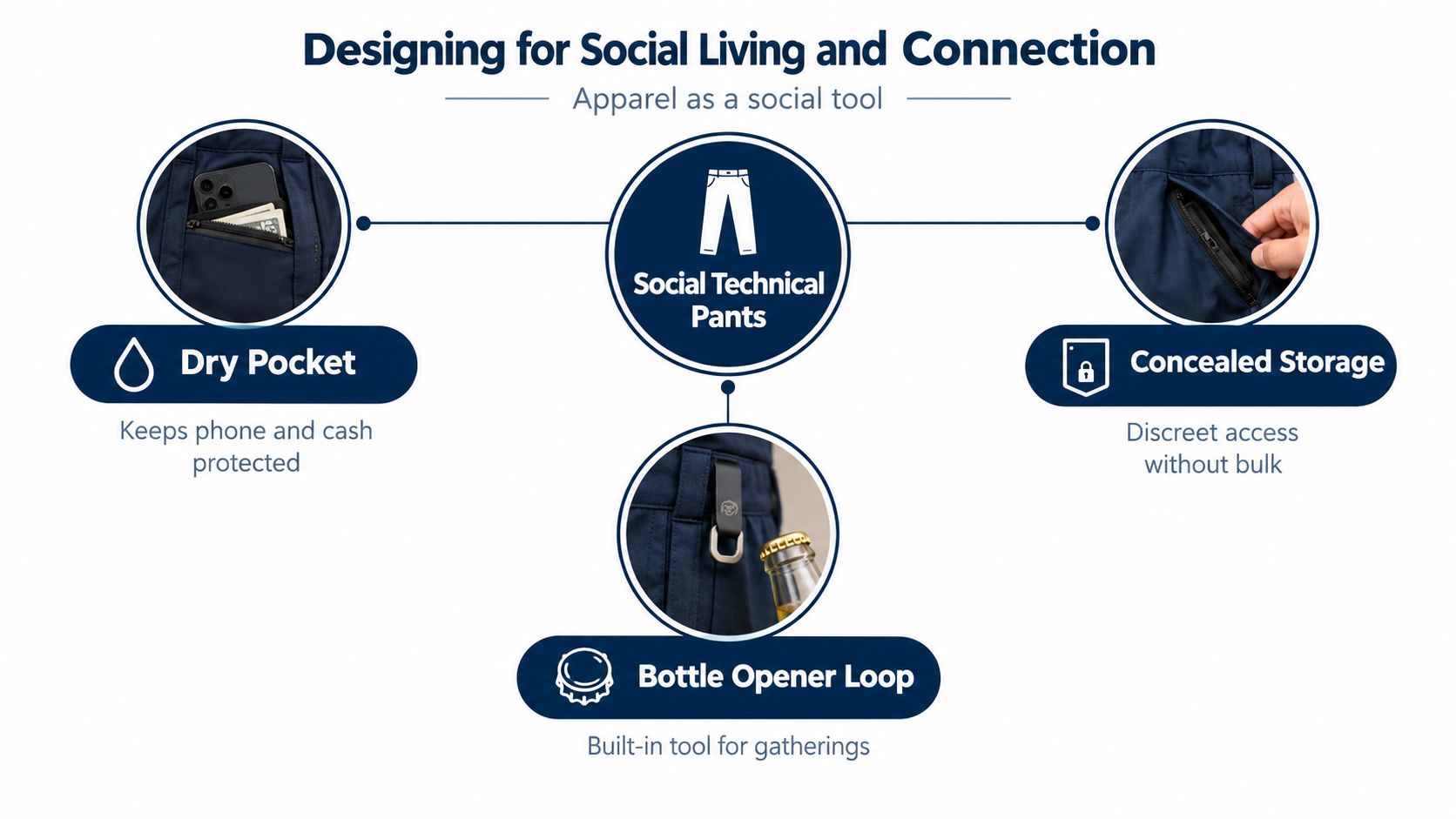
The anatomy of social technical pants
Think of the garment as a small system rather than a collection of pockets.
A dry pocket should separate your phone or cash from damp fabric, spilled drinks, or weather. It doesn't need to be huge. It needs a secure closure, a sensible position, and enough structure that the contents don't shift while you walk.
Concealed storage works best when you can reach it naturally. A pocket buried behind layers of fabric may be secure but frustrating. The practical sweet spot is discreet from the outside and easy to access when you need it.
A bottle opener loop or similar built-in tool can be useful at a tailgate, camp gathering, or beach cookout. It sounds like a novelty until you're standing beside a cooler with both hands occupied. Good social design anticipates those moments without making the garment shout about them.
Build the pocket system around the occasion
Before buying, decide what you really carry. The needs of a trail day differ from those of an après gathering.
- For travel: Prioritize a secure phone compartment, wallet storage, and pockets that don't dump their contents when you sit.
- For the trail: Look for closures, abrasion-resistant pocket openings, and enough room for small essentials without sagging.
- For tailgates: Choose easy-access storage and a loop or tool feature that earns its space.
- For post-surf use: Favor quick-drying construction and pockets that won't trap wet sand.
- For social events: Keep the silhouette clean. Function should be felt, not announced.
Pants are reported as the dominant product segment in hidden-pocket apparel, ahead of shirts, jackets, dresses, skirts, outerwear, activewear, and accessories, according to this hidden-pocket apparel market overview. That makes sense. Pants already sit close to the body, carry weight naturally, and can hide storage more easily than many upper-body garments.
The payoff is subtle but real. You aren't constantly checking whether your phone is secure. You don't need to clutch your wallet. You can holster your tech and stay socially confident, which is exactly what technical clothing should do when the trail becomes a gathering.
Styling Utility Pants for Mountain and Coastal Settings
Utility pants have moved beyond the narrow look of expedition gear. The strongest pairs now bridge mountain towns, city streets, cabin decks, and beach parking lots without requiring a full wardrobe reset. The trick is styling the supporting pieces so the pants read as intentional rather than accidental.
Après-ski demand has a strong blend of performance and luxury, with shoppers looking for apparel that moves from slopes to social settings. Search interest tends to peak seasonally in winter, which supports framing après content around the moments after skiing rather than only the time spent on the mountain, as described by this overview of après-ski demand.
Mountain settings
For cabin wear, pair durable pants with a luxury thermal layer or a soft knit that adds warmth without making the outfit bulky. A flannel overshirt works when the fabric has enough structure to balance the practical cut of the pants. Finish with clean leather or suede footwear rather than aggressive trail boots if dinner is part of the plan.
The result is mountain lifestyle clothing with a little polish. You still look ready to step outside, but not as though you're about to mark a route on a topographic map.
For a broader framework on balancing coordinated pieces with personal style at gatherings, this 2026 style guide for events is a useful reference. The same principle applies to cabin weekends. Coordinate the mood, not every stitch.
Coastal settings
Post-surf comfort demands a different fabric conversation. A terry-lined top, relaxed tee, or towel-lined hoodie can provide the absorbent layer that utility pants can't. Keep the colors simple and let texture do the work. Durable pants with a soft terry-lined shirt create a beach-to-bar outfit that feels California casual instead of aggressively nautical.
The coastal version should breathe and dry. A pant that becomes heavy after salt water or spray will ruin the transition faster than a missed wave. Look for the same fiber and drying logic outlined earlier, then pair it with lighter upper layers and footwear that can tolerate sand.
The comparison that matters
| Setting | What works | What doesn't |
|---|---|---|
| Cabin deck | Structured pants, thermal layers, soft overshirts | Loud tactical details and stiff fabric |
| Après ski | Clean silhouette, warm texture, secure storage | Thin fabric that chills when you stop moving |
| Post-surf | Fast-drying blend, terry-lined top, relaxed styling | Heavy cotton that stays damp |
| Tailgate | Easy-access pockets, comfortable seat, practical loop | Overloaded pockets and fragile fashion fabric |
The common thread is transition-ready design. You want warmth without bulk, utility without visual noise, and enough comfort to sit through the part of the day when stories get better and plans get looser. For more coastal layering ideas, explore coastal comfort clothing, then build your outfit around the setting rather than the activity you just finished.
Coordinating Group Gear for Events and Weddings
Group clothing works best when it creates recognition without turning everyone into a walking uniform. That matters for bachelor party outfit ideas, bachelorette weekend outfits, wedding weekends, and cabin trips where the group wants a shared visual language but still expects individual personalities to survive the photo.
Off the grid pants can anchor that look because they're neutral, useful, and easy to dress up or down. One person might wear them with a flannel, another with a tee and overshirt, and another with a polished jacket. The group still looks connected, but nobody appears to have been issued the same personality at check-in.
Coordinate the details, not the entire outfit
Start with one shared element. It could be a color family, a custom patch, a monogram, or a consistent overshirt. Keep the base garments comfortable enough for travel and active plans, especially if the event includes hiking, boating, tailgating, or a long day moving between venues.
Custom embroidery and monogramming add the emotional layer that generic group gear misses. A small name, date, location, or inside joke can turn a useful garment into a keepsake. Keep placement restrained. A discreet mark on a pocket or hem tends to age better than a giant slogan that everyone will have to explain forever.
Use this simple approach:
- Choose a shared foundation: Start with a common pant color or material family.
- Allow personal layers: Let each person choose a shirt, jacket, or hat that suits them.
- Add one meaningful mark: Use embroidery or a small patch tied to the event.
- Test the clothing in motion: Group gear should survive travel, sitting, walking, and celebration.
- Think beyond the photograph: The best gift still works after the weekend ends.
For custom group shirts and coordinated pieces, this group outfitting guide can help you think through color, personalization, and shared identity. The important point is to design for the whole experience, not just the group photo.
A strong wedding or bachelor party outfit should make logistics easier. Useful pockets keep the essentials close. Durable fabric survives the unplanned detour. A comfortable fit keeps everyone in a good mood when the schedule slips, which it will. The best group gear improves the event instead of becoming the event.
Care Instructions and Complete Your Look
Durable pants perform better when their care matches their construction. Read the garment label first, then choose a cool or moderate wash setting when the material allows it. Excessive heat can stress stretch fibers, affect fit retention, and shorten the useful life of blended fabrics.
Turn the pants inside out before washing. Close zippers and snaps, and keep them away from abrasive items that can roughen the surface. Skip fabric softener when possible, since its coating can change how technical fibers handle moisture. Air drying remains the gentlest default, particularly for pants with stretch fabric or concealed pocket construction.
Use this routine:
- Empty every pocket: Remove coins, keys, and forgotten trail snacks before the wash.
- Wash with similar fabrics: Keep rough hardware away from softer garments.
- Use restrained heat: High dryer temperatures can work against fit retention.
- Air dry when practical: Hang the pants in a ventilated space and reshape the waistband.
- Inspect high-wear zones: Repair loose stitching or pocket damage before it spreads.
Care protects the performance you paid for. A fabric blend may resist abrasion and dry quickly, but repeated overheating, an overloaded washer, or a neglected tear can undermine that construction.
Complete the look
Build the rest of the outfit around the transition after the activity. Add a packable hat for sun and travel days, a clean tee for the drive home, and a koozie for the inevitable tailgate handoff. In colder settings, use a warm overshirt or thermal base instead of piling on bulky technical layers.
That combination supports the Social Technical side of utility pants. You can leave the trail, boat, or field without changing immediately, keep essentials in reach, and stay comfortable while conversation, food, and drinks take over. Fit matters here. Pants should move during the active part of the day, then look composed enough for an informal gathering.
For a colder, more polished option, compare the construction and styling of winter wool pants. Choose based on whether the day demands abrasion resistance, warmth, travel comfort, or fireside ease.
Join the Vital Few newsletter for product drops and ideas built around life offline, including cabin weekends and beach-to-bar transitions. Visit California Cowboy to choose pieces that help you carry less, stay comfortable, and remain ready for the social part of the adventure.

