


The sun is dropping behind the main stage, the air smells like dust and woodsmoke, and your phone is somewhere inside a tote beneath sunscreen, a crushed festival map, and the mysterious sweater nobody remembers packing. The opener is building toward the good part. Your buddy is holding your drink. Your wristband is sticky. Both hands are occupied, and the moment is leaving without you.
A hidden-pocket hoodie changes that little logistical tragedy. Your phone can sit against your ribs, your passport can disappear along a side seam, and your cards can stay in a slim interior slot instead of rattling around with granola wrappers. This is Social Technical clothing, built for the transition after the activity, whether that means the drive home from the beach, the first drink after the lifts close, or coffee on a cabin deck. The point isn't to carry your entire apartment. It's to holster your tech, keep essentials close, and stay socially confident enough to clap, hug, toast, and make serendipitous encounters without guarding a bag.
The Hands-Free Moment That Started It
At the festival, the kangaroo pouch drops a warm hand while the crowd compresses around the barrier. Your phone buzzes against your chest, not at the bottom of a tote. A side-seam zipper swallows a passport or car key, and a small chest slot keeps a card within reach when the bar line finally starts moving.
That arrangement feels less like a gadget and more like good stage management. The clothing handles the backstage work so you can stay in the scene. A regular hoodie gives you a familiar front pouch, but a purpose-built hidden-pocket design adds storage where the garment already meets the body, with less visual noise and fewer loose objects wandering around.

Why the transition matters
The same logic works after a chairlift unloads you into cold air, when gloves, lift tickets, and phones seem determined to occupy separate universes. It works in a surf town too, when you're walking from damp sand to a taco counter and don't want a backpack between you and the afternoon.
Hidden storage has a long history because people have always needed to carry belongings privately. Detachable tie-on pockets were commonly worn by women from about 1650 through the close of the 19th century, often beneath petticoats and accessed through concealed slits in a gown or overskirt, as documented by historical clothing research on hidden pockets. The pocket wasn't decoration. It supported portability, privacy, and everyday autonomy.
The useful test: If the pocket helps you join the moment instead of managing your belongings, it's doing Social Technical work.
A hidden-pocket hoodie belongs to that same practical lineage. It isn't a novelty with a zipper attached for theater. It's a layer for festivals, ski lodges, airports, and beach weekends, where the best storage is the kind you stop thinking about.
What Makes a Hoodie Hidden-Pocket
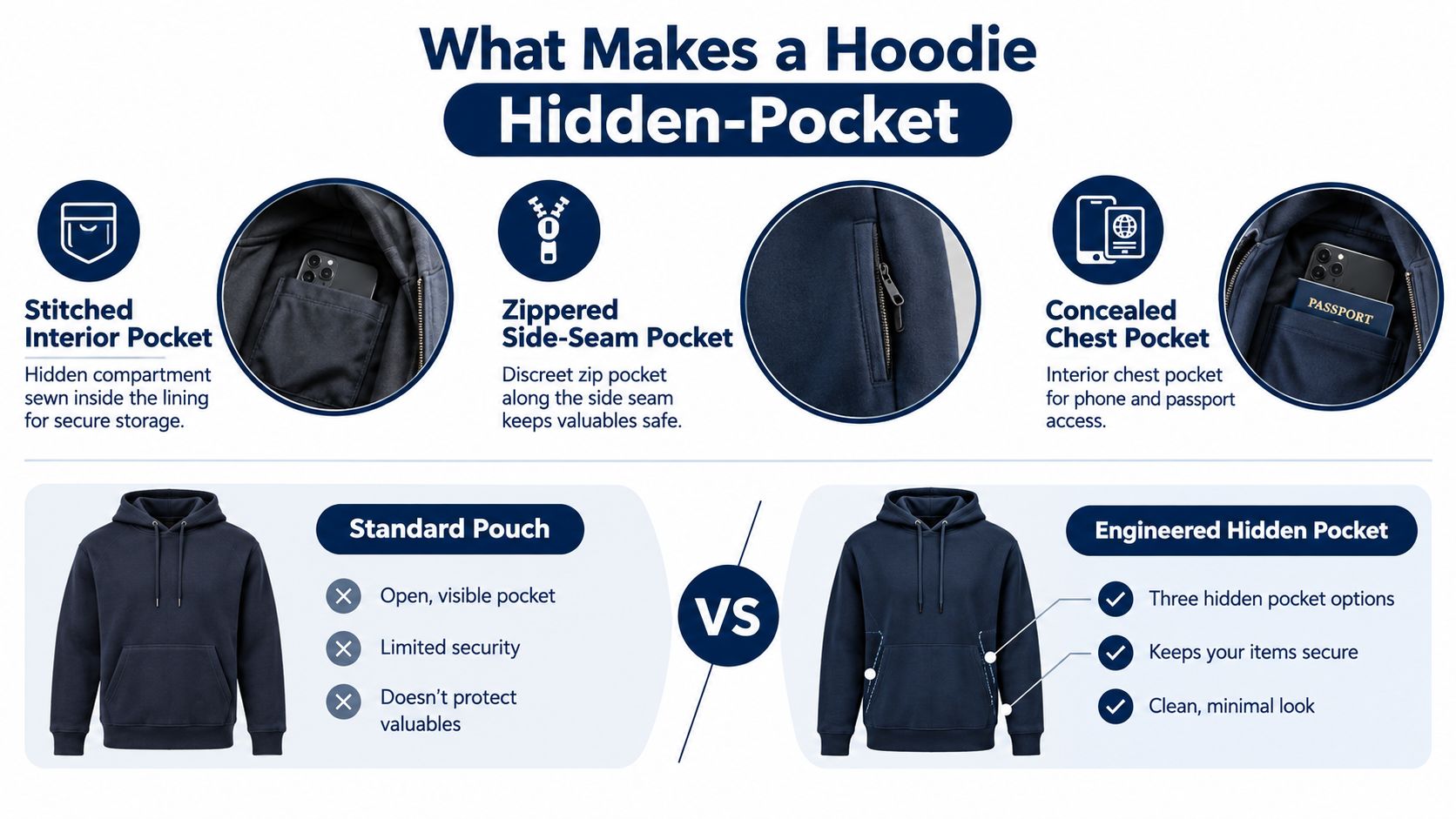
A standard kangaroo pouch is a single pocket sewn across the lower front of a hoodie, with openings on both sides so both hands can enter from opposite directions, as described in this breakdown of kangaroo hoodie pockets. It's excellent for warming your hands and carrying soft, low-risk items. It doesn't automatically make the hoodie a hidden-storage garment.
A real concealed pocket is engineered into the garment structure rather than exposed externally. The distinction appears in the construction, the opening, and the way the compartment controls movement.
Read the garment anatomy
Look for three common patterns:
- Stitched interior pocket: A compartment sits behind the lining or inside a front panel. It hides the contents and can keep a phone or passport close to the torso.
- Zippered side-seam pocket: The opening follows a natural seam line, so the pocket stays visually quiet and can sit flat beneath a jacket.
- Concealed chest pocket: A higher interior slot gives quick access to a phone, boarding pass, or card without making the lower front pouch carry everything.
Placement matters because the body bends, twists, and sits. A concealed-pocket garment patent describes positioning a pocket in relation to the wearer's hip flexion line and thigh centerline, illustrating why access and concealment depend on biomechanics as much as appearance.
Closures change the experience
A pocket without stabilization is just an invitation for gravity to become involved. Zippers provide a clear barrier against accidental drop-out, while magnetic snaps can offer quick access with less visual hardware. Coil zippers usually feel flexible and discreet. A PU-coated track can add weather resistance when the hoodie is heading toward drizzle, spray, or a damp ski bench.
Fabric changes the result too. Bonded fleece can disguise pocket structure and keep a smooth silhouette, while loose French terry may feel softer but reveal a phone's outline more readily. Before buying, put your hand through the opening, test the closure one-handed, and check whether the pocket bag pulls the garment out of shape.
For a deeper look at how concealed storage translates across apparel, browse California Cowboy's guide to hidden-pocket shirts. The principle remains simple: a true hidden pocket is built into the garment's architecture, not merely added to its front.
Where the Pockets Actually Sit
Pocket placement determines whether storage feels invisible or starts announcing itself like a guy with a Bluetooth speaker at a quiet beach. A side seam, chest interior, kangaroo pouch, and sleeve compartment each solve a different carry problem.
A side seam pocket usually sits flat against the body and disappears well beneath a jacket. That makes it a natural home for a passport, boarding pass, or car key during a long travel day. The tradeoff is reach. You may need to lower your arm or turn slightly to access it.
The chest interior pocket sits higher against the ribs. It offers quick access for a phone or card and can make airport boarding smoother, but a rigid item may bulge beneath a thin shirt or outer layer. A kangaroo pouch gives the fastest hand access and doubles as a hand warmer, yet its contents can telegraph their shape. A sleeve or cuff compartment works for a key card, earbuds, or lip balm, especially at a lodge, though it becomes less convenient when you're wearing gloves.
| Placement | Access Speed | Security | Bulk |
|---|---|---|---|
| Side seam | Moderate | Strong when zipped and close to the body | Low |
| Interior chest | Fast | Strong when stabilized | Moderate under thin layers |
| Kangaroo pouch | Very fast | Moderate unless closed | Visible with rigid items |
| Sleeve or cuff | Fast for small items | Moderate | Low for compact carry |
A useful design clue is whether the opening follows a natural access line. The patent record cited above connects concealment with the body's movement, which explains why a pocket placed near a seam or bend can feel intuitive rather than buried.
Pack by movement: Put rigid valuables where the garment can hold them flat. Put soft, frequently used items where your hand naturally lands.
RFID-blocking linings can add another layer for cards and travel documents, but they don't eliminate the need to choose sensible placement. On a long-haul flight, a zipped side seam can keep a passport stable against the body. On a muddy trail, a high chest pocket may keep a phone farther from splashes, while a sleeve pocket can make a lodge key easy to find without opening the entire garment.
The right layout isn't the one with the most compartments. It's the one that matches the objects you carry and the way you move.
How Many Pockets Are Worth Carrying
At a music festival, four pockets can keep your hands free for a wristband check, a paper cup, and the inevitable dance-floor shuffle. At a ski lodge, the same layout can separate a phone, keys, cards, and goggles cloth without turning your hoodie into soft luggage. Pocket count matters only when each compartment has a job.
For ordinary travel, a practical minimum is four well-placed zippered pockets. Designs with 18 to 21 pockets are described as excessive in travel hoodie guidance on pocket ergonomics. Under a backpack, extra compartments can feel less like clever storage and more like a utility vest. The hoodie becomes a Social Technical tool, organizing what you need while keeping your hands available.
Start with the loadout you carry. Phone, keys, passport, and cards cover much of a normal day. Add earbuds or lip balm only when they need separate homes. A beach weekend may call for fewer compartments than a festival, where quick access and closed storage both matter.
| Carry Scenario | Minimum Pockets | Recommended Pockets | Overkill Threshold |
|---|---|---|---|
| Airport day | Four | Four to five | 18 to 21 |
| Music festival | Four | Four to six | 18 to 21 |
| Ski-lodge transition | Three | Four to five | 18 to 21 |
| Beach weekend | Three | Four | 18 to 21 |
The four-pocket approach keeps the silhouette soft. One compartment can hold the phone, another can secure cards or a passport, a third can take keys, and the fourth can handle small accessories. That balance works on a drive, a bar stool, or a cabin couch.
A pocket-heavy hoodie separates every object, but added seams bring more structure, snag points, and pressure beneath a strap or ski bib. The brief's contrast between a 200-gram travel hoodie and a 600-gram pocket-heavy hoodie is illustrative, with the heavier option likened to wearing a small locker room. Treat those weights as comparisons, not a standard for every garment.
Buy the layout, not the fantasy: Count the items in your pocket on a normal day, then choose compartments that let them lie flat.
For intentional everyday-carry ideas, browse California Cowboy's cool EDC gear guide. Choose the pocket pattern that suits your festivals, lift lines, or surf-town weekends, rather than chasing the biggest number.
Packing a Hoodie for the Airport
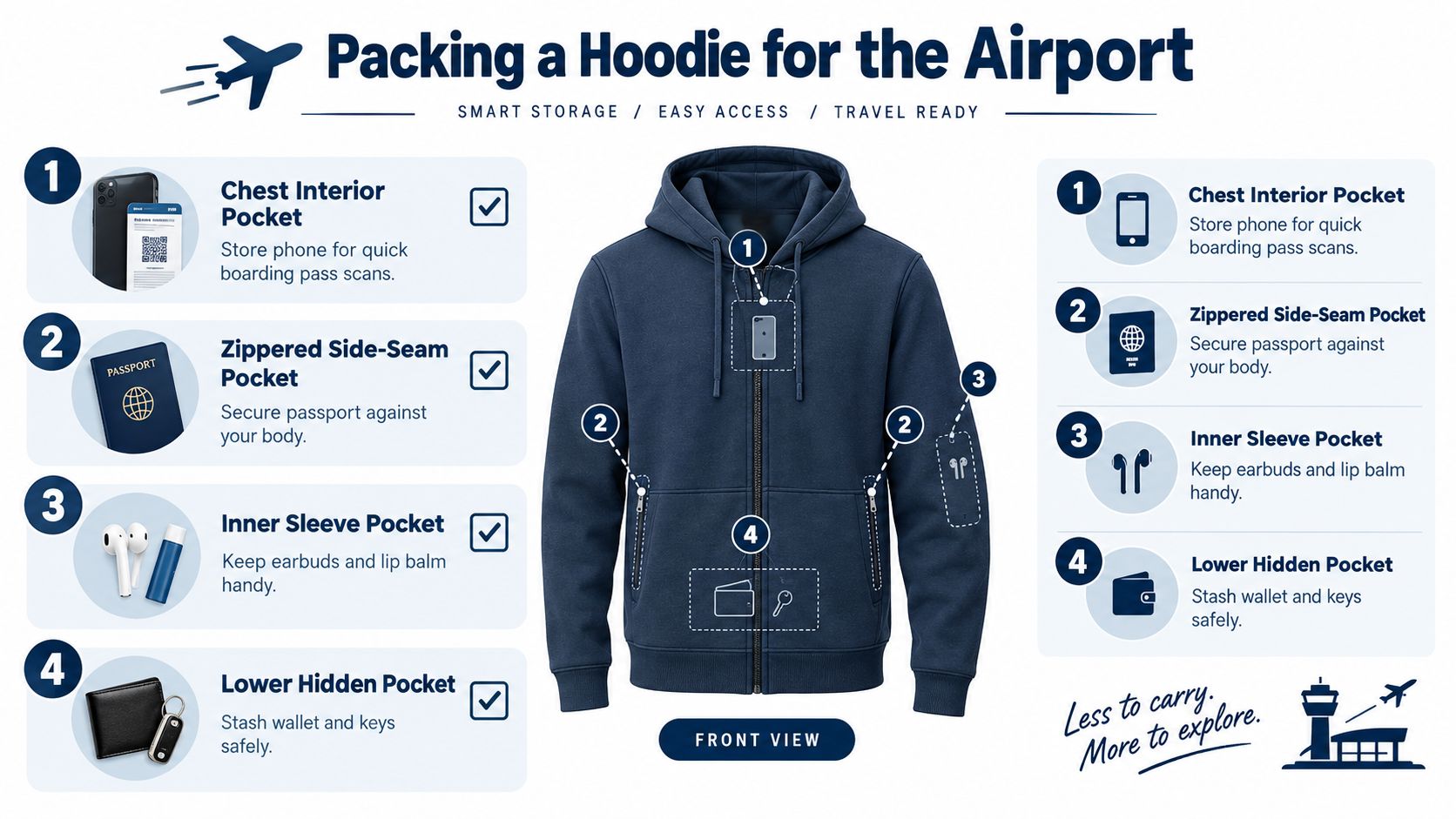
At the airport, the winning pocket layout reveals itself during the awkward moments: scanning a boarding pass, lifting a carry-on overhead, or sitting in a crowded gate with your jacket folded beside you. Load the hoodie for access, stability, and screening, then test it while standing, sitting, and reaching up.
Put the phone in an interior chest pocket so the boarding pass is close without digging through a backpack. Keep the passport in a zippered side-seam pocket against the body, where a vertical opening helps it stay put. Cards can go in an RFID-lined chest slot if the hoodie includes one. Place keys in a deeper lower pocket or kangaroo compartment, away from fabric that could catch in the zipper.
Check the closures before the checkpoint
Fabric and plastic zippers generally do not trigger metal detectors, although the objects inside the pockets still can. A chunky metal zipper, magnetic clasp, or concealed hardware may receive different treatment depending on the checkpoint and screening process, so inspect the closures before you leave home.
Keep the hoodie easy to open. If an officer asks to see a pocket, unzip it calmly instead of explaining its clever architecture while the line waits. Convenience works best when the storage is transparent enough to inspect.
Before leaving, rehearse the sequence:
- Pull out the phone and display the pass.
- Remove the passport without emptying another pocket.
- Move keys and coins into the screening bin when asked.
- Zip each compartment after collecting your items.
Use the checklist in what to pack for a charter flight to place the hoodie within your luggage plan. It should keep your hands free, not become a stuffed personal item with sleeves.
Weather adds another test. A dry pocket and stabilized opening help when rain, damp gear, or a rushed transfer enters the itinerary. Research water-resistant pocket apparel if your airport day may end at a wet ferry dock, a foggy surf town, or a mountain shuttle.
From Lifts to Lot to Late Night
At the lodge, the air smells like wax, wet wool, and coffee that has been waiting for its second career. A chest pocket keeps a lift ticket high and easy to reach, while the rest of the hoodie stays under a shell or jacket. Once the lifts close, you're already dressed for the first drink, with no frantic search through glove compartments.

At the tailgate, the kangaroo pouch earns its keep differently. It warms cold hands, holds a bottle opener or small accessory, and gives a wet phone a temporary landing spot when the table is already crowded with cans, napkins, and someone's overly ambitious portable grill. The pouch is quick, but it isn't stealthy, so keep rigid valuables elsewhere.
The festival is where a zippered interior compartment feels most deliberate. Bass moves through the crowd, your phone vibrates against your ribs, and you can check it without opening a tote or turning your back on the set. Concealment reduces visual clutter, but a stable closure still matters because movement creates its own little weather system.
At the beach bonfire, salt spray dries on your sleeves and everyone kicks sand toward the towels. A side-seam pocket can hold a car key while you walk from the water to the fire, provided the compartment is fully closed and the key is dry before storage. For more planning around music festival gear with hidden pockets, focus on the event's movement, crowd density, and transition points.
These scenes share one idea. The hoodie earns its place after the activity, when ski gear comes off, surf gear gets draped over a chair, or the festival crowd turns toward the food trucks. That is where hands-free clothing stops being a feature and becomes part of the social infrastructure.
Hidden Storage Versus Visible Security
A hidden pocket asks concealment to do the work. A visible zipper or security panel announces that the garment has a plan. Neither approach wins every setting.
At a crowded festival, a side-seam pocket can blend into the garment and avoid advertising where valuables live. That discretion suits a dressier California casual outfit, especially when obvious tactical hardware would make you look like you're preparing to rappel into the beverage tent. At an airport, visible access can be more useful. You may want to show a pocket quickly, remove an item without digging, or make the garment's security features legible to people around you.
Recent trend coverage describes a move toward visible security, including explicit zip compartments and RFID-blocking panels, rather than relying on concealment alone, as discussed by Stylix on anti-theft and security aesthetics. The shift reflects a practical tension. Stealth supports privacy, while visible features can make protection easier to understand and access.
Choose according to the crowd
Use a hidden side seam when you want a low-profile layer under a jacket, at a quiet airport, or during a beach-to-bar walk. Choose a visible zip when you need to find a compartment quickly, explain the garment at screening, or separate frequently used items from protected valuables.
Slash-resistant panels and RFID-blocking linings can broadcast a stronger security message, but the garment still needs comfortable placement. A feature that rubs against the ribs or catches on a backpack strap won't become more useful because it looks serious.
| Priority | More suitable approach | Why |
|---|---|---|
| Privacy in a crowd | Concealed side seam | Keeps storage visually quiet |
| Fast access | Visible zip or chest opening | Makes the compartment easier to locate |
| Card protection | RFID-blocking panel when available | Adds a dedicated layer for cards |
| Low-key styling | Interior pocket | Avoids overt utility hardware |
Security should match the social setting: Stealth is valuable when blending in matters. Visibility wins when proof and access matter more.
The most socially confident choice may be a hybrid. Keep your passport or wallet concealed, then use a visible chest zipper for the phone you check often. That way you can holster your tech without turning your outfit into a puzzle or a billboard.
Care Use and When to Upgrade
At a beach town, sand can work into a zipper before you reach the taco stand. After a muddy trail, grit hides in the teeth. Close every zipper before washing, then brush or rinse away debris once the hoodie is clean and dry. Coil and fabric zippers usually flex through regular wear, while coated tracks can help resist weather.
Turn the hoodie inside out before laundering, follow its care label, and avoid high heat when the fabric, pocket bags, magnetic components, or coated finishes need gentler treatment. Let every pocket dry completely before placing a phone, passport, or keys inside. A damp compartment traps moisture against both the lining and whatever you hoped to protect.
Run a small maintenance check
- Inspect seam stitching: Check side openings, chest panels, and pocket corners for loose threads or pulling.
- Clear the pocket bags: Remove sand, crumbs, and lint before they affect zippers or leave an odor.
- Test the closure: Open and close each zipper one-handed before a trip, not for the first time in a crowded terminal.
- Check the lining: A stretched pocket lets rigid items shift, bulge, or press against your body.
- Rotate travel layers: Two hoodies in rotation give each one time to air out between flights and weekends away.
Pilling, persistent odor, stretched openings, broken teeth, and seams that pull under an ordinary load signal retirement. A pocket that once held a phone neatly may eventually let it slide, pinch, or rub. That is a safety and comfort problem, not a reason to keep the garment for nostalgia.
Know when an upgrade makes sense
Choose more purposeful pockets, not the highest pocket count. A replacement should have closures suited to your routine, fabric appropriate for your climate, and openings that keep your usual carry flat. For cabin wear, fireside evenings, and the post-lift transition, compare heavyweight hoodies from California Cowboy with lighter travel layers. The right choice depends on whether your week includes cold lifts, crowded festivals, or salt-air walks.
The upgrade checklist stays short: better closure, stronger fabric, smarter placement. Extra compartments matter only when they match what you carry.
California Cowboy makes social-living apparel with engineered storage for post-adventure use, including layers designed to keep essentials close while you stay hands-free. Visit California Cowboy to find a pocketed hoodie or post-adventure layer for festival, après-ski, and beach-weekend routines, then join the Vital Few newsletter for product drops and field-ready ideas.

