


Woodsmoke drifts across the cabin deck and the cold has that dry, high-altitude bite. Forty minutes later, salt spray stings your face in a beach parking lot and the same jacket is doing the same work again.
Warmth is a moving target. The lining that feels perfect while you sit by the fire can turn clammy the moment you walk uphill to the lot, and almost nobody selling these jackets talks about that gap. What follows is how to match lining weight to the hours you'll spend outside, test the fit before you commit, and keep the fleece soft for seasons instead of months.
Short version: dress for the transition, not the thermometer.
"Match Lining Warmth to Where You Are Headed"
Woodsmoke curling off a cabin deck. Salt spray stinging in a beach parking lot. Two scenes, one garment, completely different demands on the same square foot of fabric.
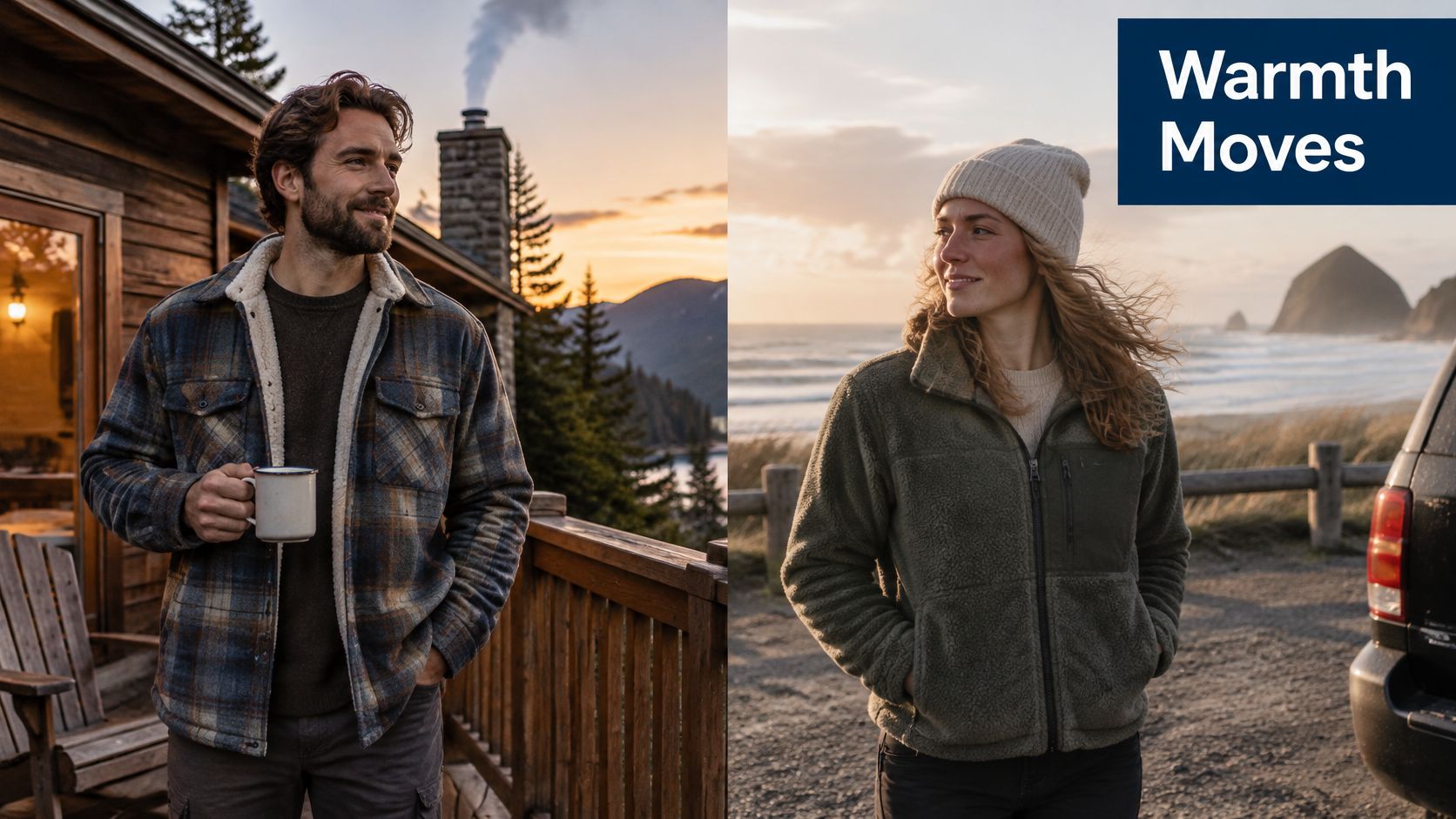
Warmth and layering by setting
| Setting | Conditions | Layer underneath | Overheat risk |
|---|---|---|---|
| Cabin deck or fireside, seated | Mild air near 50°F, warmer by the fire | Cotton tee or lightweight henley | Low, comfortable while you stay put |
| Après-ski village walk | Cold lot, then a heated bar | Merino or synthetic tee | Medium, rises once you walk and drink |
| Lift line and mountain walk | Near 20°F with wind or wet snow | Thermal base layer, shell if wet | High, sweat builds on climbs |
| Beach-to-bar, cool evening wind | Cool coastal evening, warmer indoors | Lightweight tee | Low to medium, rises indoors with the heat |
Default to the row that matches your moving hours, not your sitting hours. It's easy to buy for the fire and then wear the jacket in a lift line, which is exactly backwards.
The trade-off the table reflects is stubborn. Research on winter apparel finds that adding layers and thickness generally improves thermal insulation, while balancing that insulation against breathability stays difficult (a study on winter apparel insulation). A thick pile lining traps heat beautifully and also traps the moisture you generate walking uphill, which is why the same jacket that feels plush at 50°F and stationary feels wet and cold at 30°F and climbing.
Working rule: Choose the lighter lining when you'll move more than you sit, and save the heavier lining for long, stationary evenings.
A fleece lined shirt jacket lives between two categories. It's warmer than an unlined overshirt and less bulky than an insulated coat, and it works as a mid-layer under a shell or as a light outer layer on a dry night. What it doesn't do is replace a hardshell in wet snow or driving rain, and buying it expecting that is how people end up disappointed by a good piece of clothing.
If you want the heavier end of the range for fire-side duty, read up on high-pile fleece before you commit.
Check the forecast for the hours you'll be outdoors, not the hours you'll spend inside.
How to Test Fit and Layering Before You Buy
Fitting room mirrors flatter everything. Five minutes of movement tells the truth.
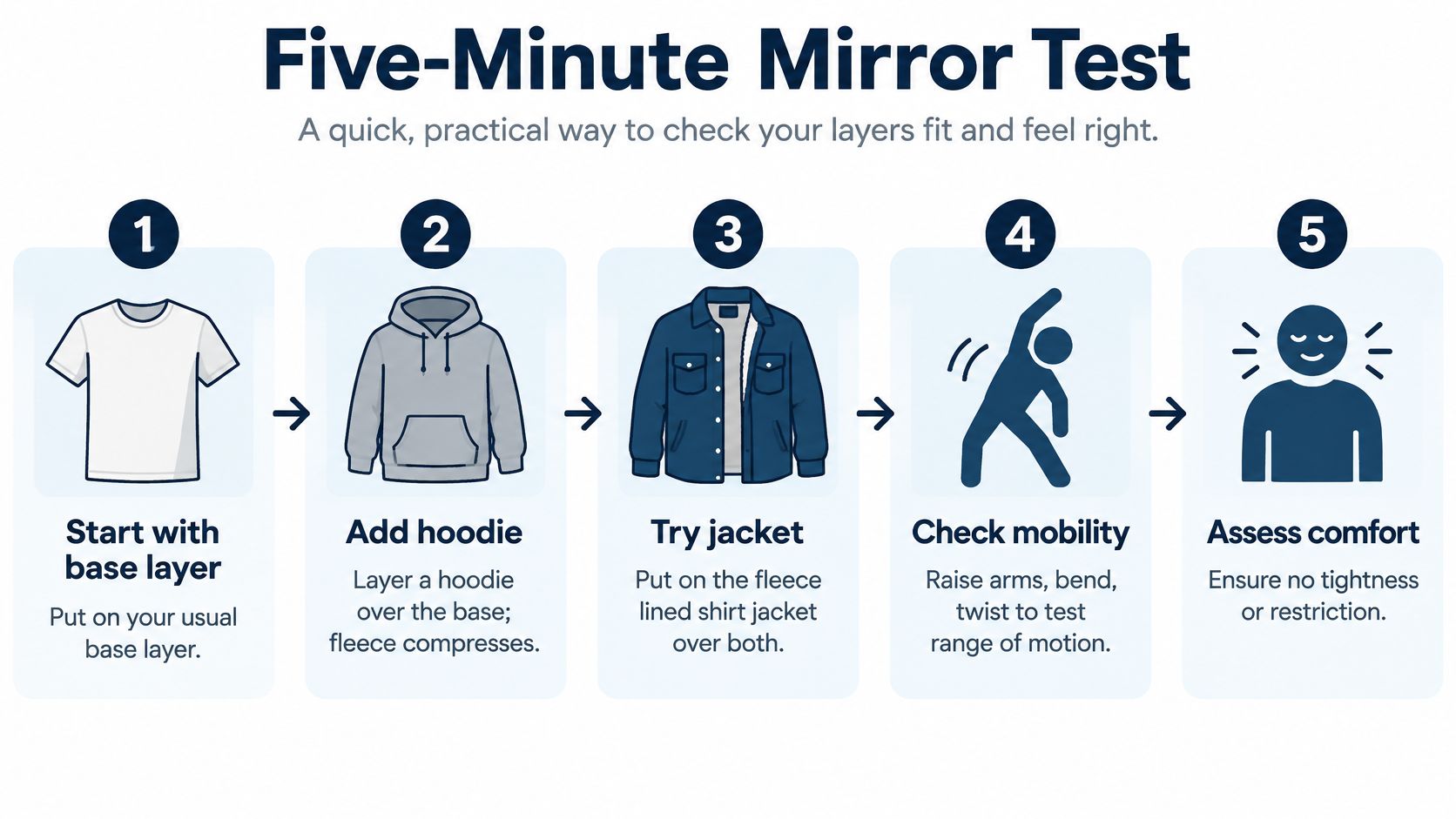
- Dress the layers you'll wear. Put on your usual base layer, then a hoodie, then the jacket. Fleece compresses under added layers, so a size that closes cleanly over a tee can pinch across the chest over a sweater.
- Find the shoulder seam. It should sit on the bone at the top of your shoulder, not slide down your upper arm. A dropped seam looks relaxed until you put a pack on and the whole jacket shifts.
- Reach both arms overhead. The hem should stay near your waistband and the cuffs shouldn't climb above your wrist bone. If the body lifts like a tarp, it's too short for layering.
- Sit down. The chest shouldn't pull across the front and the hem should cover your waistband. This is the check that decides whether the jacket works at a long dinner or only standing up.
- Trace the pocket line with your thumb. A zippered dry pocket needs to sit where a phone won't dig into your ribs once you're seated. Pockets that ride too high are the quiet annoyance almost nobody flags in a review.
- Walk a flight of stairs or a short slope. If your back feels damp within five minutes, the lining is the issue, not the size. Drop to a lighter lining rather than sizing up.
- Check the sleeve with the cuff pushed back. Fleece linings bunch at the wrist, and a sleeve that's right when pulled down can swallow your hand when pushed up.
That last one sounds fussy until you've spent an evening pushing a cuff out of your drink.
What Good Fit Looks Like
The jacket closes comfortably over a mid layer, pivots with your shoulders, and leaves enough room to breathe without looking like you borrowed it. If you'd rather work from numbers than guesses, our guide to how to measure for a shirt covers chest, sleeve and body length with a tape measure and a mirror.
A good fit also means one jacket cut that carries from a cold parking lot to a warm room without a change of clothes. Start with our Men's High Sierra shirt, lined with thermal fabric and built with a zippered dry pocket and a bonus beer pocket, and run the seven checks on a garment made for the whole evening.
Social Pockets That Keep Your Hands Free
Six friends walk up to a party and hand over their phones. No screens inside, no documentation, just the room and whoever is standing in it.
At a 2026 Pinterest activation connected with Coachella, guests were required to lock their phones away before entering, and the stated aim was presence and interaction rather than documentation (Skift Meetings). Which raises the practical question nobody asks before buying outerwear: if the phone isn't in your hand, what's in your pockets?
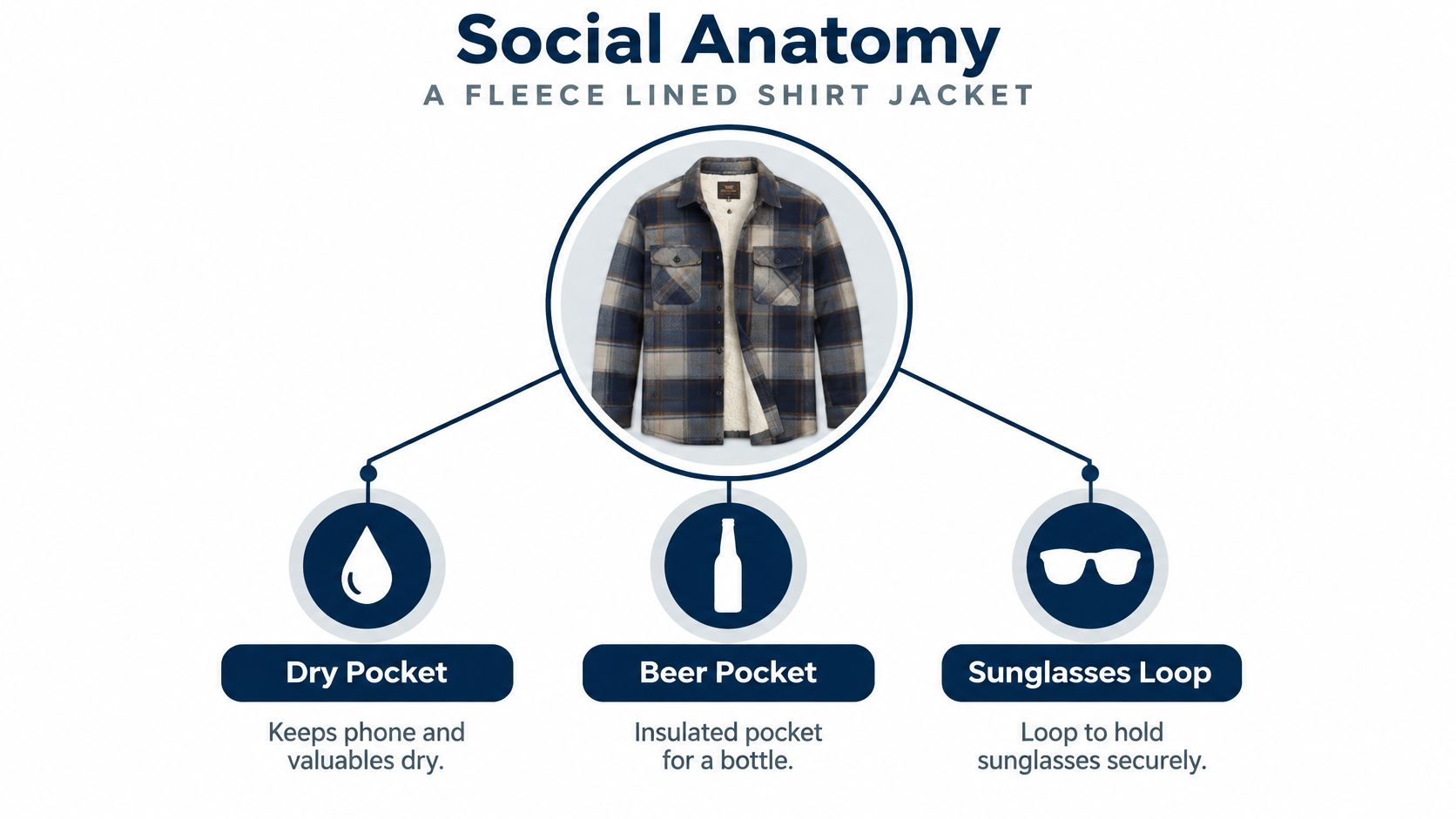
The zippered dry pocket is the workhorse: phone, cards, keys, closed against splashes and cooler ice. The beer pocket is the social one, sized and lined to hold a bottle upright so your hands stay free for a plate, a handshake or a chair you're dragging out of the trunk. A sunglasses loop keeps shades off your face and out of a lost-and-found bin. Some cuts add a low-back pocket that carries a bottle at the hip.
Pocket layouts shift between styles, so treat the diagram as the common set of zones rather than a promise about every shirt in the line.
Social spec: At a tailgate, the beer pocket holds the bottle so both hands stay free, while the zippered dry pocket keeps the phone dry and out of the splash zone.
That's the argument for pockets over a phone in your fist. When devices are stored away, secure storage becomes the thing that lets you stay in the conversation instead of guarding a pocket. Holster your tech at the door and the evening opens up to the serendipitous encounters you came for.
Show up warm, put the phone away, and let the night find you.
If you want more on how hidden pockets change a night out, our notes on hidden pocket shirts go deeper. The Out of Pocket Pouch is built for exactly this, sized to drop into the zippered dry pocket of every technical piece.
What do you need within reach when your hands are busy? Start there.
Dressing for the Move From Lifts or Surf to the Bar
The last chair unloads. The lot fills. Your boots are still buckled and the group is already voting on where to sit.
The 2023-2024 U.S. ski season recorded 60.4 million skier visits, the fifth-busiest on record, and Utah's ski economy alone averages roughly $2.1 billion to $2.5 billion annually, with out-of-state skiers spending an average of $404 a day, according to the Savills winter ski report. That population doesn't go home after the lift closes. It walks into bars, restaurants and spas in boots, still damp.
The coastal version runs the same script. Hawaii's 2023 visitor activity data recorded beach or sunbathing participation at 87.8% overall and surfing at 7.1%, per the Hawaii state data book. Even at the smaller number, that's a lot of people driving from sand to a café with wet hair and no intention of going home first.
A fleece lined shirt jacket covers that interval. Warm enough for a cold lot, light enough that you don't cook in a heated bar, and worn over a merino or synthetic tee rather than a ski shell you'll regret ordering dinner in.
On the coast, the lighter play is a terry or soft-modal lining that handles cool wind and damp fabric without the bulk of mountain gear. Our notes on coastal comfort clothing break down where that lining earns its keep.
One customer line we keep hearing sums up the flannel objection. "The High Sierra flannel shirt changed my avoidance of flannel shirts." The difference is the lining, not the pattern.
What to Pack
- The shirt jacket itself, worn rather than packed, so it does the work on the walk to the car.
- A dry base layer in the bag, because a damp tee under fleece is the fastest way to feel cold at dinner.
- Spare socks, the most underrated item in the trunk on a ski day.
- Sunglasses, for the walk out of a bright lot or off the sand.
- One secure pocket for phone and keys, so nothing ends up buried in a ski bag.
Browse the full High Sierra shirts collection if you want the lined, thermal end of the range for both halves of the evening.
The piece has to work in the parking lot and at the table. If it only does one, it's not the jacket.
Group Looks and Gifting Without the Uniform Feel
Five friends step out of a rental cabin in the same fleece lined shirt jacket. They look like a crew, not a costume party.
Match one element, then let the rest go. Same lining color, same fabric, or one embroidered detail. Fit, body type, and what each person does after the photo can handle the rest. A shared accent reads as a group. Head-to-toe copies read as a uniform.
Warmth moves with the night. The lining that feels right by the fire can turn clammy on the walk back from the trail or the lot. I match lining weight to the activity and to the hour after it, not to one temperature on the invite. A heavier thermal layer suits the person who stays by the pit. A lighter lining suits the one who keeps moving between cabin, photo, and bar. Same family of shirt. Different warmth.
Group outfitting covers bachelor and bachelorette weekends, groomsmen gifts, rehearsal dinners, cabin weekends, and shoulder-season wedding receptions where the air drops the moment the sun does. The Knot's 2019 Real Weddings Study found 36% of couples used custom attire designed to be uniquely their own and 22% changed into another outfit during the wedding (The Knot). People want the details to feel like them, not like a rental rack.
The Bulk Buyer Checklist
- Confirm sizes person by person before the order goes in. Collect chest and sleeve numbers. Don't take a guess.
- Pick one shared accent, a monogram, embroidered initials, or a single thread color, and stop there.
- Assign colors early, because the person who waits until the week before gets whatever is left.
- Order with a buffer, at least one extra unit for the fit change you can't predict.
- Ship to one address, then hand out pieces at the welcome event rather than chasing people down.
A personalized layer people still wear after the weekend beats a trinket that hits a drawer by Monday.
For welcome-gift duty, the Men's El Garibaldi carries a sunglasses clip and a built-in bottle pocket with a beer koozie and a brass-coated bottle opener. Guests reach for it at the cabin and photograph it at golden hour. By the fire it works as an easy layer. On the walk to the car, the clip and bottle pocket keep hands free without a shell you will shed at the door.
Build the group look around one photo moment, then let the evening run. For more on coordinating without matching, see group matching outfits.
Fabric and Care That Keep the Fleece Soft
Polyester fleece sheds. A peer-reviewed study found fleece released an average of 7,360 fibers per square meter per liter in a single wash, compared with 87 for the polyester fabric it was tested against (Environmental Science and Pollution Research). That is a real cost of softness, and it argues for washing with intent.
| Care step | Recommended setting | Why it matters |
|---|---|---|
| Wash frequency | Only when it smells or stains | Fewer cycles mean fewer fibers released |
| Wash temperature | Cold | Less wear on the pile and the seams |
| Garment position | Inside out | Protects the outer face and the lining from abrasion |
| Machine | Lower-agitation machine where available | Less mechanical action on the pile |
| Drying | Air dry, or low heat | Heat weakens the pile and the softness |
| Stains | Spot treat | Avoids a full wash cycle |
The machine row is advice, not a guarantee. Fabric construction, detergent, water temperature, abrasion and garment age all shift the result. A laundry filter catches some fibers, but it does not replace washing less often.
Two habits do most of the work. Hang the jacket to air after a night out instead of throwing it in the basket out of reflex. Treat a spot with a damp cloth and a drop of mild detergent before it becomes a reason for a full cycle. High heat is the other quiet killer: it collapses the pile, dulls the hand feel and shortens the life of the seams. Warmth is a moving target, and a lining that stays soft and dry is easier to trust when the evening cools.
The fleece in these jackets is made in California, which shortens the supply chain but does not change the care physics. If you want a broader reference on keeping pile and prints intact, these notes on caring for printed fleece pullovers cover the same ground from a print side.
Fewer, gentler washes extend both the softness and the life of the lining. That single change, washing on purpose rather than by habit, keeps the fleece from matting and keeps the jacket ready for the next cold start. That is the whole routine.
Pick Your Jacket and Complete the Look
Two people on a deck at golden hour with drinks in hand and a conversation running past the second round. That's the picture to build toward.
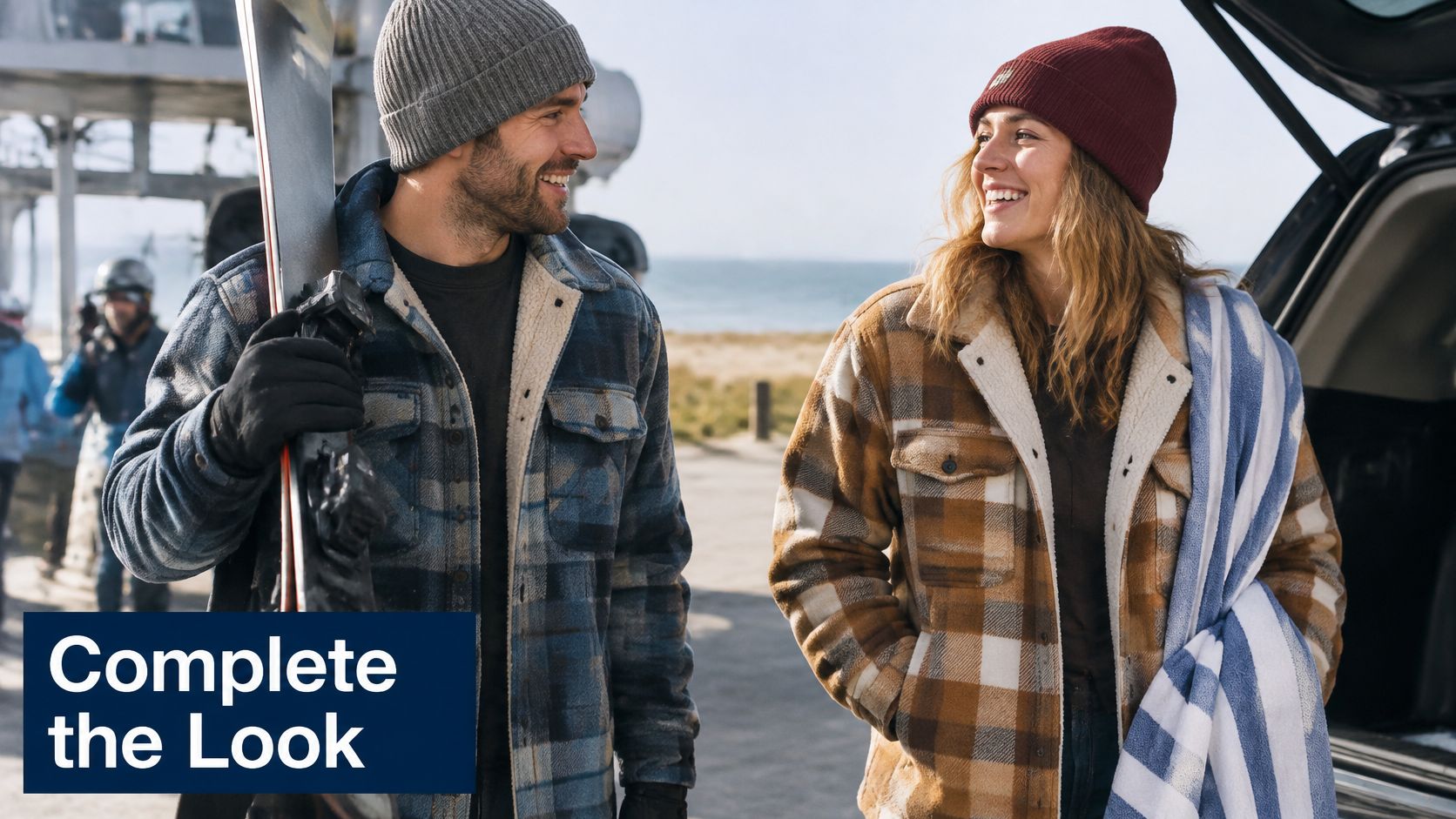
Three Pairings That Work
The hat. A beanie for the lift line or the beach lot does more for warmth than a heavier lining ever will, because you lose heat from your head first. Start with the hats and accessories rack and keep one in the car.
The tee. A lightweight tee underneath handles milder walks and cabin mornings, and gives you something to shed when the bar runs hot. Cotton for stationary evenings, merino or synthetic for anything with a hill in it.
The koozie. Small, cheap, and the item people ask about most. Pair it with the Out of Pocket Pouch, the rip-stop pouch with the Velcro closure that fits the zippered dry pocket of every technical piece and keeps cards and keys from rattling against a phone.
The hero pieces are where the details stack up. The Men's High Sierra shirt runs a thermal lining with a zippered dry pocket for a phone and a bonus beer pocket. The Men's El Garibaldi robe adds a sunglasses clip, a built-in bottle pocket with a beer koozie and a brass-coated bottle opener for the cabin deck.
Holster the tech, pour the second drink, stay for the third.
None of this requires a full kit. One warm layer with pockets that hold what you carry, worn over a tee you already own, handles the drive, the lot, the bar and the walk back.
Doors open first for the Vital Few.
California Cowboy makes shirts, robes and outerwear in Fairfax, California for the hours between the last run and the last round, with thermal and terry linings, hidden pockets and enough polish to walk straight into a bar. Every piece is built around the same idea this guide keeps returning to, that the right layer depends on where you're headed next. See the full range at California Cowboy and pick the one that matches your version of the transition.

