


Salt water still clings to your shoulders. Your fingers are cold from the board, the beach fire is beginning to crackle, and somebody has already produced a drink from the back of the van. On the mountain, the equivalent scene smells like woodsmoke and wet gloves, with the last alpine light sliding behind the peaks as the lifts close. These are the moments when a zip-up flannel earns its keep, not while you're posing beside the trail map.
The garment sits between shirt and jacket, using a brushed flannel face, a full-length zipper, and enough room for a base layer. Its real job is transition. It helps you leave the water, the slopes, or the trail without immediately retreating into a technical shell or a hoodie that looks like it surrendered at the first gust of wind.
The Art of the Analog Transition
The best post-adventure layer doesn't demand much from you. You pull it on, zip it against the evening chill, and return to the conversation. No app. No battery. No complicated membrane with a name that sounds like a minor European airport.
That simplicity matters during the analog transition, the short stretch between activity and gathering. It's the drive home from the beach with damp hair and sand in your cuffs. It's the first drink after the lifts close, when your ski jacket is too loud for the bar and your base layer is too optimistic. It's morning coffee on a cabin deck, when the air has teeth but the day hasn't decided what it's doing yet.
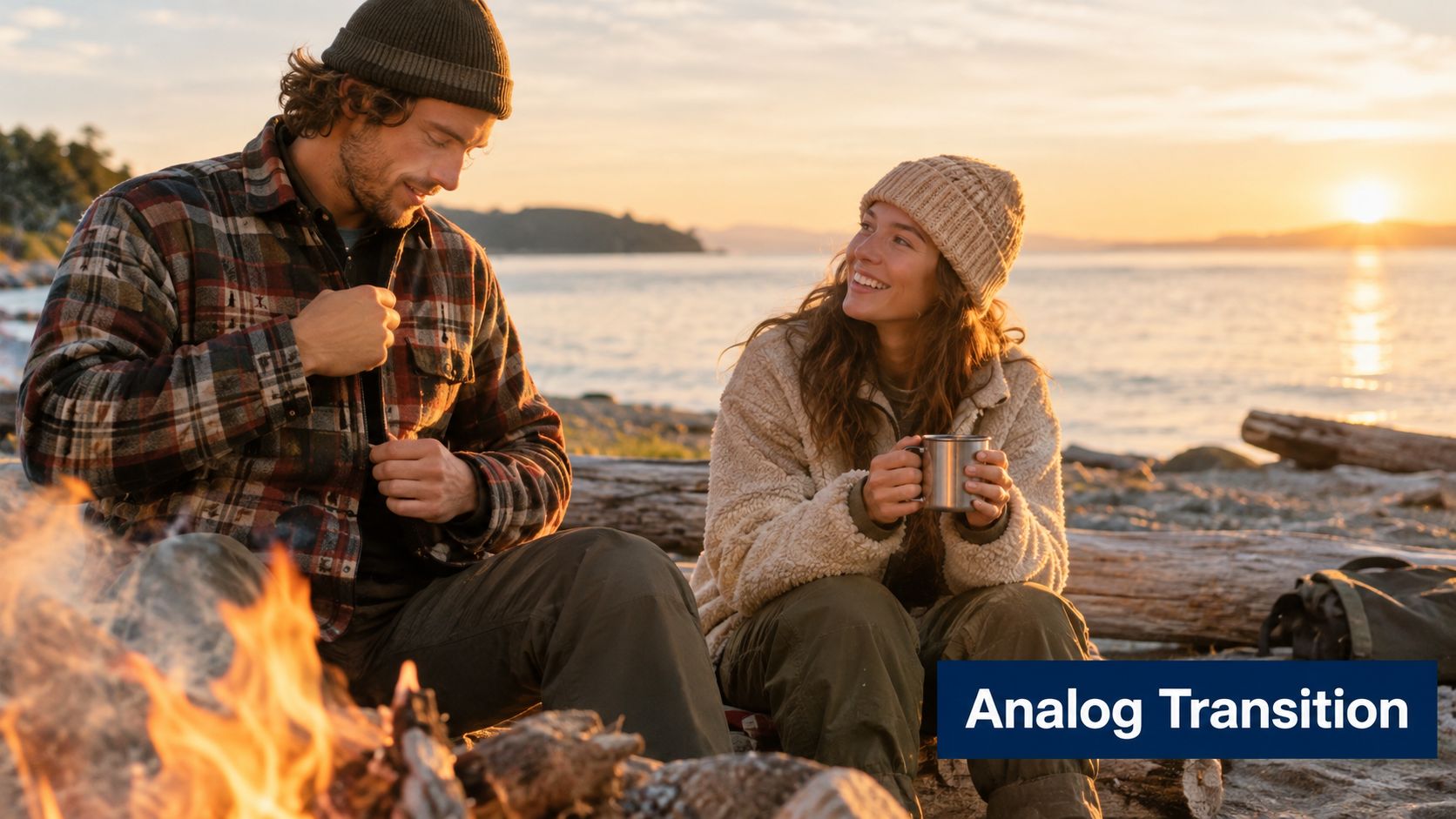
A conventional button-down can work, but cold fingers and small buttons aren't a charming combination. A waterproof shell can protect you from weather, yet it often keeps the social temperature somewhere around “gear closet.” The full zip offers a faster answer. Close it for warmth, open it for ventilation, and keep your hands available for a mug, a chair, or the person telling the story about the run that went sideways.
What social technical actually means
Social Technical apparel treats practical details as part of the gathering rather than as a reason to look ready for a rescue helicopter. Useful storage, easy ventilation, comfortable lining, and approachable texture all support the same outcome: you can holster your tech, stay warm, and remain available for serendipitous encounters.
That philosophy sits at the heart of Life Offline lifestyle gear, where clothing is treated as equipment for being around people. A good layer should make you feel socially confident, not over-engineered.
Practical rule: If you need to stop the conversation to figure out your clothing, the clothing has already failed the transition.
Eight Decades of Hardware and Heavy Cotton
A zip-up flannel joins two older ideas that developed separately. Brushed flannel creates a soft, textured surface with a familiar warmth. The slide fastener turns the front opening into a quick control for heat and airflow. Together, they make a shirt-jacket that feels relaxed but behaves with useful precision.
The zipper story began with Elias Howe Jr.’s 1851 patent for an “automatic, continuous clothing closer,” an early attempt to join garment edges. Whitcomb Judson patented the more practical “Clasp Locker” in 1893 and helped establish the Universal Fastener Company in Chicago that same year. In 1913, Swedish-American engineer Gideon Sundback developed the “Hookless Fastener,” using opposing rows of teeth controlled by a slider, a design much closer to the modern zipper. DW's history of the zipper traces how the closure moved from experiment toward everyday utility.
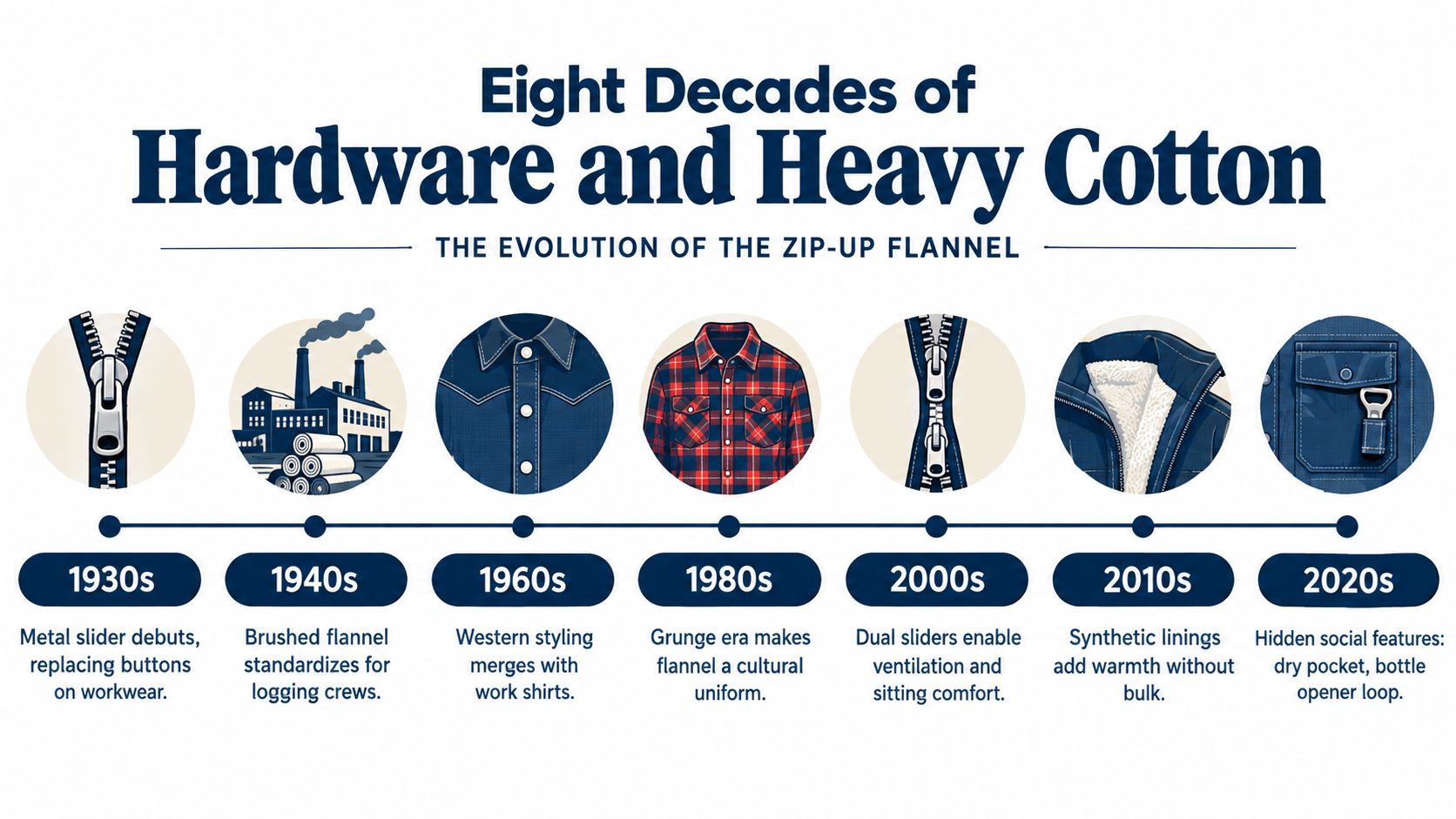
The zipper first appeared selectively in footwear and military equipment rather than as a universal fashion detail. Clothing adoption accelerated during the 1930s, when designers and manufacturers began treating the zipper as both a practical closure and a visible part of apparel. That long path explains why a full zip feels intuitive today. It carries decades of utility history in one quick pull.
Why the pairing works
Buttons create a series of small openings. A zipper creates one continuous adjustable opening, so you can change airflow in seconds. That difference becomes obvious in a snowy parking lot, where gloves, cold hands, and impatient friends make button-by-button ventilation a poor life choice.
The flannel side brings a different advantage. Its brushed surface gives the garment tactile warmth and a cabin-friendly appearance, while its plaid or solid texture avoids the anonymous look of technical outerwear. The result fits naturally into luxury thermal layers, cabin wear, and casual après-ski style.
Flannel also has a substantial existing market, although estimates vary widely because analysts define the category differently. One 2025 estimate placed the global flannel-shirt market at approximately $4.23 billion, with a projection of $5.8 billion by 2035 and a 3.2% compound annual growth rate, while another valued it at $18.4 billion in 2025 and projected $28.7 billion by 2033, with cotton flannel representing 58.3% of that estimate. These figures are directional, not interchangeable, as explained in the market discussion on the zipper reference page.
For custom group shirts, event apparel, or coordinated cabin gear, fabric choice also affects the final visual result. Anyone preparing artwork for decorated cotton garments can use this guide to getting flawless DTF results as a practical production reference. The broader point is simple: the material and the hardware both deserve attention.
More context on why durable construction survives trend cycles appears in heritage brand clothing, where utility and identity share the same garment.
Evaluating Warmth by Construction Details
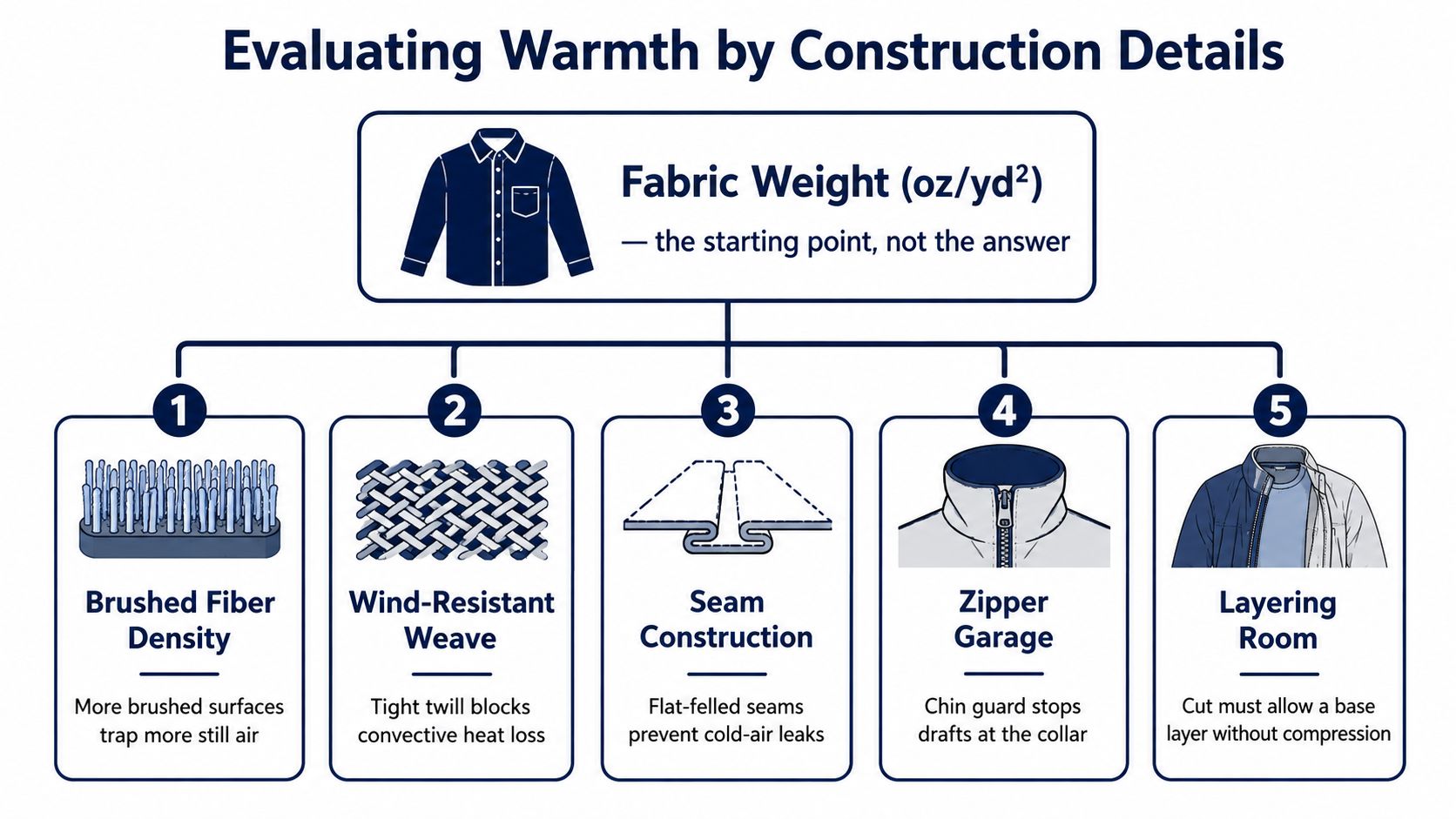
A heavier shirt isn't automatically a warmer shirt. Weight tells you something about the material, but it doesn't tell you whether the sleeves restrict movement, whether the collar blocks drafts, or whether the lining becomes clammy after a brisk walk from the beach to the bar.
Cold-wet testing makes the problem clear. In controlled experiments using cotton flannel, heat loss stayed nearly constant, within approximately 10%, while the fabric retained moisture. After drying, heat loss fell abruptly by 48%, and evaporation produced an additional 633 calories of heat loss per gram. The findings, documented in this cold-weather heat-transfer report, show why damp flannel can feel much colder than its dry hand suggests.
Read the garment from the inside out
Start with the shell, then inspect what happens beneath it. A brushed face can feel warm against the hand, but warmth depends on the whole system.
- Brushed fiber density: A raised nap can trap still air, but a thin or uneven brush may flatten quickly.
- Lining coverage: Check whether fleece, terry, or another lining extends through the sleeves. A warm torso paired with slick, chilly sleeves is a classic design ambush.
- Layering room: The cut should accommodate a close-fitting base layer without compression. Too much compression reduces room for air, while excessive volume can let drafts circulate.
- Collar protection: A structured collar or chin guard can reduce cold exchange at the neck when zipped closed.
- Seam and cuff design: Secure seams and cuffs help limit unwanted air movement during walking, driving, or leaning over a fire.
A full-length zipper is the central control. Open it before you start sweating, close it when the wind shifts, and adjust the top section without removing the garment. That speed is especially useful during après-ski transitions, when you may move from a sunny tailgate into a shaded lodge within minutes.
Moisture changes the decision
For beach use, absorbency can be welcome after swimming or surfing, but wet fabric shouldn't be mistaken for reliable insulation. NOAA reports that cold water removes body heat up to 25 times faster than cold air, and identifies water below 70°F as a risk, with danger rising sharply below 60°F. Its safety guidance also states that approximately 20% of people who fall into cold water experience shock and die within 60 seconds, while even strong swimmers can lose muscle control in about 10 minutes. Read the NOAA cold-water safety guidance before treating a post-surf layer as a substitute for water safety.
For a more deliberate specification, compare dry and conditioned-moist fabric, inspect lining coverage, and test zipper ventilation. The men's lined shirt collection offers a useful example of why lining and construction deserve equal billing with fabric weight.
Comparing the Zip Up to Button Downs and Hardshells
A zip-up flannel isn't trying to replace every layer in your closet. It has a narrower, more useful job. The button-down wins when you want an easy overshirt with classic structure. The hardshell wins when rain, wind, or serious exposure becomes the main event. The zip-up earns its place between those extremes, where comfort and social ease matter as much as protection.
| Feature | Zip Up Flannel | Button Down Overshirt | Technical Hardshell |
|---|---|---|---|
| Ventilation speed | Fast, continuous adjustment | Slower, individual openings | Fast, often highly adjustable |
| Social aesthetic | Soft, approachable, cabin-ready | Classic and familiar | Technical and activity-focused |
| Post-adventure comfort | Warm texture and easy layering | Relaxed, but less immediate to open | Protective, though sometimes stiff or noisy |
| Best transition | Après bar, beach drive, cabin deck | Mild evening, casual dinner | Active weather exposure |
| Main trade-off | Can retain moisture when damp | Less convenient with cold hands | Less tactile and less relaxed |
The button-down case
A button-down overshirt works beautifully when the temperature is stable and you want a traditional shirt silhouette. It also layers easily over a tee. The weak spot arrives during rapid changes, especially when you're carrying gear, wearing gloves, or trying to open the front while holding a coffee.
A retro button-up shirt can still be the right choice for a dry afternoon or an indoor gathering. Don't force the zipper into a role it doesn't need to play.
The hardshell case
A technical hardshell is built around weather resistance. That's exactly what you want on exposed terrain or during sustained precipitation. It isn't always what you want beside a fire, in a crowded bar, or during a long drive when the material feels louder than the conversation.
The zip-up flannel bridges that gap. It offers rapid temperature regulation without making every social stop feel like a transition into expedition mode. Keep the shell for the mountain's serious weather. Reach for the flannel when the adventure has become the story.
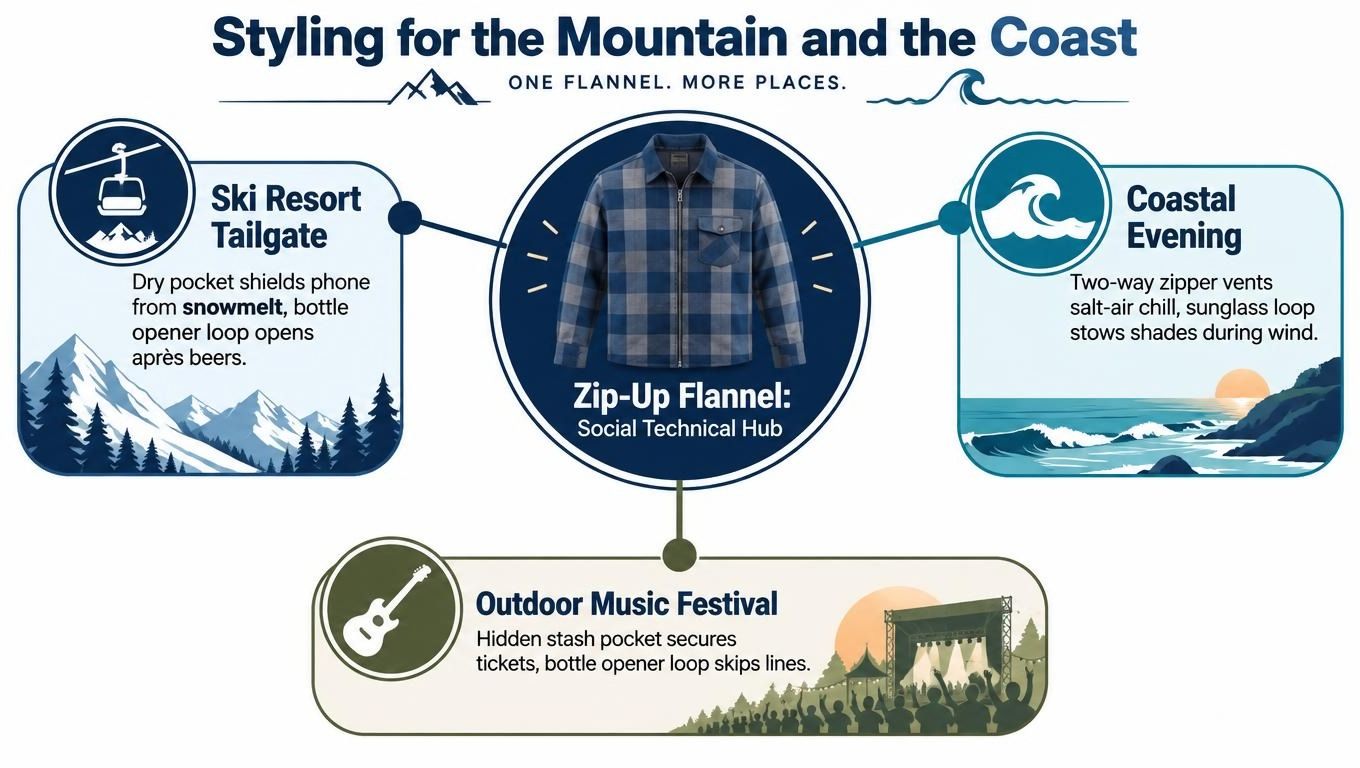
Styling for the Mountain and the Coast
At a ski-resort tailgate, the zip-up flannel earns its place during the awkward handoff between activities. You are changing out of boots, balancing coffee, and deciding whether the group wants pizza, cocktails, or one more questionable run. A good layer lets you join the conversation instead of digging through a backpack for the next piece of gear.
Wear it over a base layer, leave the collar open while the sun is high, then close it when the parking-lot shadows stretch across the snow. A dry pocket keeps a phone away from snowmelt, while a bottle opener loop handles the small but important job of opening a drink without recruiting a stranger. Those details stay quiet until the moment they matter.
Three places where the layer makes sense
At the resort: Pair a plaid zip-up with durable trousers, a warm cap, and boots that can handle slush without looking borrowed from ski patrol. The outfit needs to work through boot changes, crowded lodge stops, and the walk back to the car. It also leaves room for the social part of the day, when a technical apparel contest has given way to stories and second rounds.
On the coast: A salty breeze sharpens quickly after sunset, especially when you are still damp from a swim or paddle. A terry-lined shirt or absorbent layer helps after water time, and a two-way zipper lets you release heat without opening the whole front. The approach fits the broader idea of coastal comfort clothing, where practical texture matters as much as appearance. Keep sunglasses accessible. A calm beach walk can turn into a face-level weather system with very little warning.
At a music festival: Hands-free clothing matters once you are moving through a crowd, carrying a drink, or dancing badly with confidence. Hidden storage can hold tickets or cards, and a bottle opener loop cuts down on the errands that pull you away from the group. The zip-up flannel becomes Social Technical apparel here, built for the transition from stage, to food line, to the conversation that lasts after the music stops.
Event behavior supports that social-first instinct. An Eventbrite survey of 1,999 consumers aged 18 to 54 across the United States, the United Kingdom and Ireland, and Australia and New Zealand found that seven in ten attendees prioritized the experience at music events over making it “Gram worthy.” Among Australian and New Zealand respondents, 78% preferred food that tasted amazing over food that looked photogenic, according to the Eventbrite trends report.
The social spec: A dry pocket protects the thing you need, a bottle opener loop saves a small negotiation, and a sunglasses loop keeps your shades from vanishing into the bonfire zone.
The offline shift appears in event reporting too. Phone-free events reportedly increased 567% worldwide from 2024 to 2025, attendance rose 121%, and participating countries expanded from five to twelve. The same report says half of surveyed Gen Z and Millennial attendees wanted less performative events, while 79% sought spontaneity over experiences curated for an audience, as reported by Euroluminant's offline culture analysis.
Practical storage supports that choice. Put the phone away, keep the essentials close, and let the bonfire, shoreline, or parking-lot conversation become less documented and more memorable.
The mountain audience is substantial too. U.S. ski areas recorded 61.5 million skier visits during the 2024 to 2025 season, the second-highest total on record and a 1.7% increase over the previous season. The Rocky Mountain region represented 42.9% of national visits, while season-pass holders accounted for 49% and standard day lift tickets for 32%, according to the National Ski Areas Association release. That mix includes repeat mountain regulars and day guests heading directly from the slopes into après-ski. Both groups benefit from a layer designed for the handoff between outdoor effort and real-world connection.
Care and Repair for Long Term Value
A zip-up flannel can collect stories quickly. Smoke at the cuff, salt near the hem, and a little road dust from the cabin drive are part of the deal. The zipper, however, doesn't care about your memories. It needs clean alignment, sensible washing, and a refusal to be forced when fabric catches in the slider.
ASTM guidance identifies differential shrinkage between zipper components and surrounding textile as a selection risk. It recommends washing or dry-cleaning prototype garments through the intended care process before approval, so the zipper can be evaluated after the fabric changes. The same guidance treats slider force as an indicator of serviceability and addresses zipper-chain and component holding strength. See the ASTM zipper guidance for the testing framework.
Wash the fabric without punishing it
Follow the care label first. For brushed flannel, a gentler approach usually protects the raised surface better than aggressive heat and friction.
- Close the zipper: This helps protect the teeth and reduces opportunities for the slider to catch other garments.
- Use a mild cycle: Excess agitation can flatten the nap and increase distortion at the zipper tape.
- Avoid unnecessary heat: Heat can encourage shrinkage, while the zipper and surrounding textile may respond differently.
- Dry with patience: Reshape the garment while damp and let it finish drying without treating it like a towel.
- Store it clean and dry: Smoke, salt, and perspiration become harder to remove when left sitting in the fabric.
Treat hardware as replaceable
If the slider resists, stop pulling. Check for trapped fabric, bent teeth, or a twisted tape. A tailor or repair specialist may be able to replace a slider, realign the tape, or reinforce a seam without sacrificing the whole garment.
Repairability also changes the sustainability conversation. Research summarized by the European Environment Agency identifies durable and repairable products as leading sustainable purchase behaviors, and repair studies note that zippers can be designed for replacement or modification. European Repair Cafés reported that 94% of coats and jackets brought in for repair were successfully repaired in 2025, according to the European Environment Agency's repairability overview.
Don't discard a good flannel because the slider had a dramatic afternoon. Hardware is often the fixable part.
A durable garment earns its place through repeated use, not a heroic first impression. Wash it carefully, respect the zipper, and find a repairer before a small mechanical problem becomes an excuse to buy another replacement.
Complete the Look and Join the Vital Few
At an après-ski tailgate, the useful outfit appears in layers. Start with a soft tee under the zip-up flannel, add durable trousers and warm socks, then grab a cap for low sun on the cabin deck. An insulated koozie keeps a drink cold while both hands stay available for a guitar, beach chair, or an important high-five.
Post-surf, keep the fit relaxed enough to move from boardwalk to bonfire without changing clothes. At a bachelor party, wedding weekend, or cabin gathering, coordinated colors and custom embroidery create a shared look without turning the group into a walking uniform. A luxury flannel shirt can carry the outfit, provided the rest stays practical.
Accessories should support the gathering. Choose a pocket for essentials, fabric that still feels good after activity, and a silhouette that works beside a fire or at a bar. The zip-up flannel becomes Social Technical apparel here, built for the offline handoff between adventure and conversation. Put the phone away. Let the evening run long.
Join the Vital Few newsletter for product drops, community updates, and invitations into the offline side of the brand. It offers updates on après-ski apparel, coastal layers, group outfitting, and gear designed for time away from the screen.
California Cowboy makes shirts, robes, outerwear, tees, hats, and accessories for post-adventure comfort and real-world connection. Choose a zip-up flannel for your next tailgate, beach bonfire, or cabin morning, then give your phone a quiet evening.

