


The lifts have stopped, your boots are off, and the parking lot smells like woodsmoke and wet pine. You've got a drink in one hand, a phone buzzing somewhere, keys in a jacket you already took off, and sunglasses hooked to a collar that's tugging sideways. That's the transition moment clothing with secret pockets is built for. Not the product photo. The sit, the lean, the dance, the drive home from the beach with salt still on your skin. Judge a hidden pocket by what it holds while you're living in it, and you'll stop buying invisible storage that fails the first time you bend over a cooler.
Types of Clothing With Secret Pockets at a Glance
Golden hour at the trailhead sorts people fast. Somebody's digging through a tote. Somebody else just zips a chest pocket, loops their shades, and walks to the fire with both hands free. That second person isn't carrying less. They're carrying smarter.
Here's the map before the marketing. You'll meet six families again and again, and most garments do one or two jobs well rather than six jobs badly.
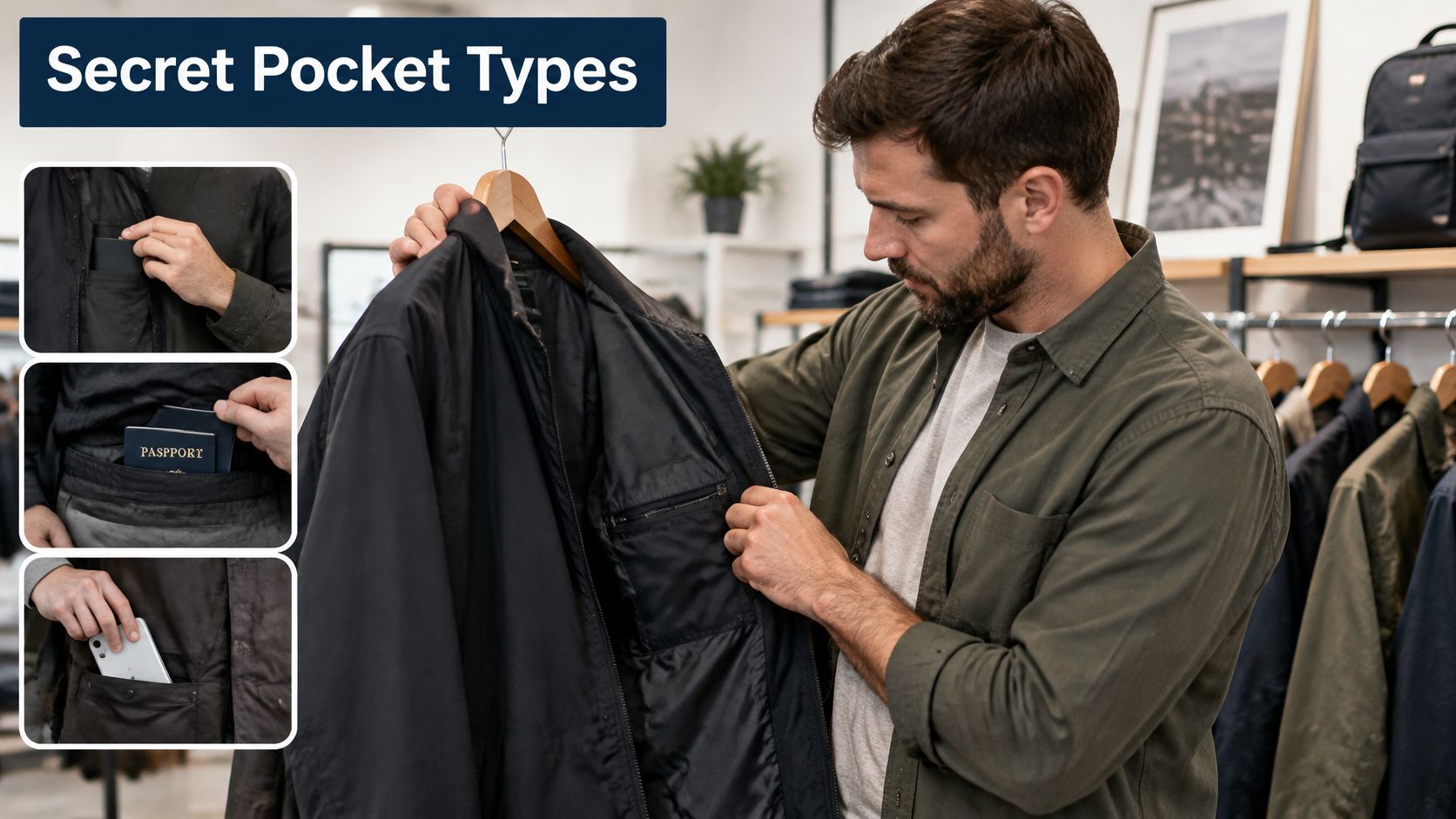
The Six Families You'll Actually Shop
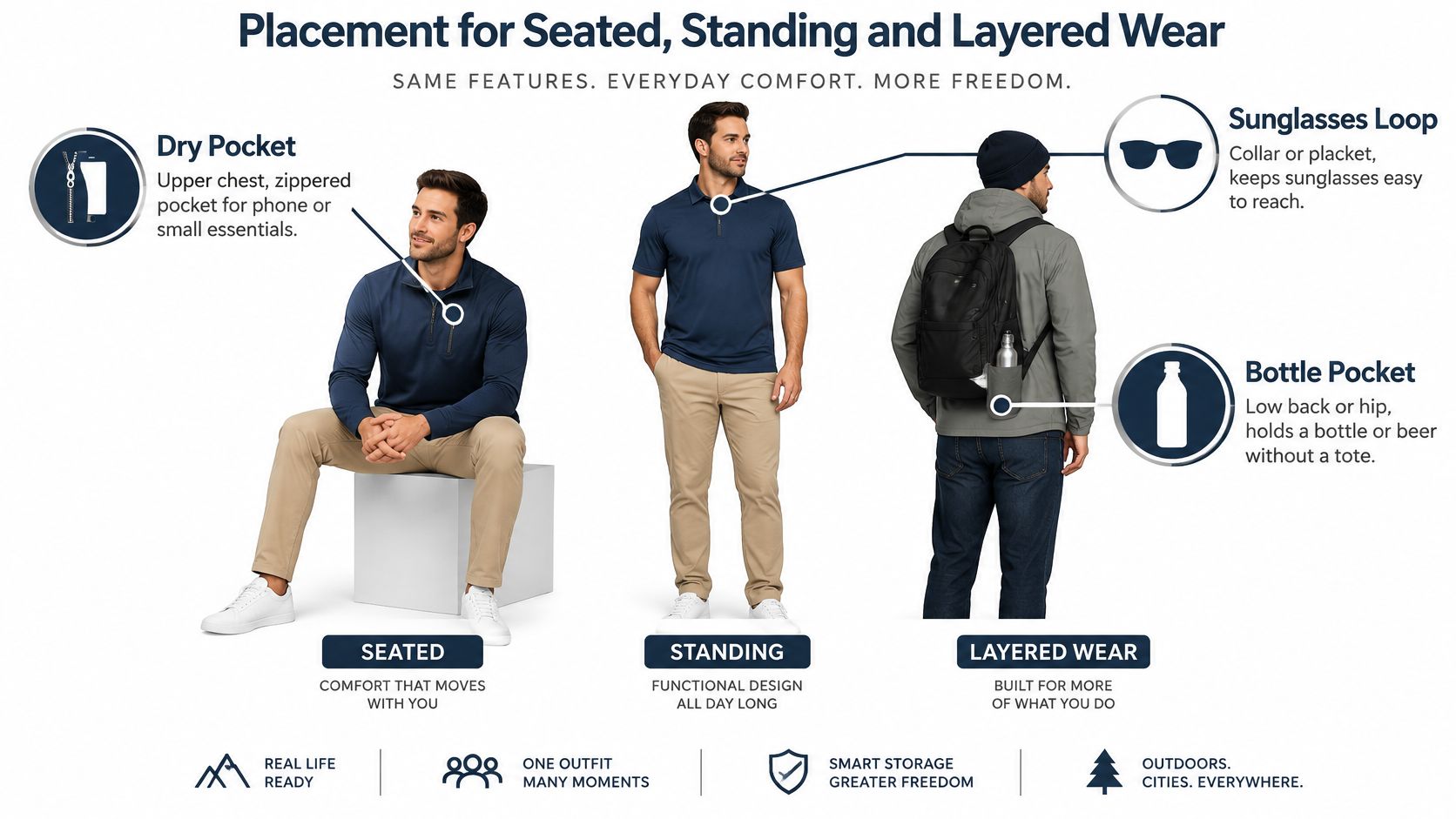
The zip dry pocket is the workhorse, built for a phone you want holstered and ignored. The bottle pocket carries a beer without a tote or a balancing act. A sunglasses loop lives on a placket or collar so your shades aren't on your head, in your hand, or lost in the sand.
Then it gets quieter. A hidden welt pocket tucks into robes and jackets for a key or card. A double-layer hoodie hides a secret pen pocket in an inner layer. A detachable pouch clips into a garment's dry pocket and moves with you between outfits.
Hidden pocket types, where they sit and when they work
| Pocket type | Typical garment | Where it sits | Best setting |
|---|---|---|---|
| Zip dry pocket | Thermal or flannel shirt | Upper chest, zippered | Après-ski and cabin nights |
| Bottle pocket | Plaid shirt or robe | Low back or hip | Tailgates and beach-to-bar nights |
| Sunglasses loop | Shirt placket or hoodie collar | Chest or collar | Surf days and sunny patios |
| Hidden welt pocket | Robe or lightweight jacket | Inside seam with flap | Travel and wedding weekends |
| Secret pen pocket | Double-layer hoodie | Inner chest layer | Layered mountain days |
| Detachable pouch | Clip-in pouch for a dry pocket | Inside the garment | Festivals and hands-free nights |
A single flannel can stack a zip phone pocket, a loop, and a bottle pocket, while a robe might only offer one welt for a room key. Both can be right. A mountain lodge asks for different storage than a festival field or a wedding reception, so match the build to the day ahead.
Rule of thumb: Pick the family that matches the day, not the one with the most pockets.
Start your scan with the hidden pockets hoodie guide if layered storage is your use case, and use it as your first check on how a zip dry pocket should sit and close. A shirt with a proper zip pocket is basically a second pair of hands that doesn't ask for attention. That's the whole point. You stay socially confident, your tech stays holstered, and nobody has to hold your stuff while you go say hello to someone new.
Why Hidden Pockets Matter More Than You Think
Every time you grab a handbag, borrow a companion's jacket, or clamp a phone under your arm to carry a plate, your hands are busy and your evening shrinks a little. You can't shake a hand properly. You can't toast without a shuffle. You're managing objects instead of meeting people, and life offline gets oddly logistical.
That's not a styling complaint. It's measurable.
The Gap Isn't in Your Head
In 2018, The Pudding measured 80 pairs of jeans from 20 leading brands and found women's front pockets were, on average, 48% shorter and 6.5% narrower than men's, a finding detailed in a 2025 university honors study. An iPhone X fit completely into 100% of men's front pockets examined but only 40% of women's. More than half of women's pockets couldn't accommodate a wallet, cellphone, or pen.
The behavioral side lands harder. That same university study of 127 participants found 66% felt consistently restrained when their clothing lacked pockets, while 33% felt restrained some of the time. Restrained is the right word. You're holding your life in your fist.
What Hands-Free Actually Buys You
At a tailgate, hands-free means a plate in one hand and a drink raised with the other. On a dance floor, it means you're not guarding a bag in a corner. At a wedding, it means you can hold a friend's hand, fix a boutonniere, or catch the bouquet without first negotiating where your phone goes.
- You stay present: Your phone is holstered, not glowing in your palm every ninety seconds.
- You move independently: No asking a partner with bigger pockets to carry your card and keys.
- You look cleaner: A flat, concealed pocket beats a bulging hip pocket or a tote banging against bar stools.
The central trade-off in this whole category is simple, and I'd tattoo it on a fitting room mirror if stores allowed it. Concealment only helps if the pocket is still easy to reach. A pocket so secret you need two hands, a mirror, and mild yoga to open it isn't clever. It's a hiding place you'll stop using by the second wear.
That's why the useful questions are practical ones. What fits, with a case on it. What stays put when you sit. What you can open one-handed while holding a drink. If you want the shirt-specific version of that logic, the hidden pocket shirts breakdown is the natural next read. Get those answers right and a hidden pocket stops being a novelty feature. It becomes the reason you reach for that piece every time the plan involves other humans.
What Each Hidden Pocket Can Safely Carry
Forget invisible. Ask this instead: will it hold my actual stuff, in its actual case, while I sit on a cooler, climb into a truck, and cross a dance floor? Sizing is where secret pockets either earn trust or betray you.
The Working Rule Before You Buy
Anything taller than the pocket opening, or sharp at the corners, needs a loop, a bottle sleeve, or a pouch. Not a deeper wish. A different carrier. Measure the item with its case on, because the bare device is a fantasy measurement. Case thickness and brand dimensions change the answer, so run a tape over your phone as you carry it, then compare that number to the flat opening, not the stretched one.
Common items, sizes and fit in hidden pockets
| Item | Typical size | Safe in zip dry pocket? | Watch out for |
|---|---|---|---|
| Smartphone in case | Up to about 6.5 in tall | Yes, if the zip closes over it | Cases that bulge past the opening |
| Passport | About 4.9 x 3.5 in | Yes | Stiff covers can strain a welt |
| Credit card | About 3.4 x 2.1 in | Yes, in a zipped pocket only | Slides out of unsealed open pockets |
| Keys | Small set on a fob | Yes, with a fob | Jingling and snagging on fabric |
| Folded sunglasses | About 5.5 in long | Better in a loop | Hinges can scratch lenses |
| Earbud case | About 2.5 in wide | Yes | Falls through open pockets |
| Small bottle (12 oz) | About 8 in tall | Only in a bottle pocket | Too tall for a dry pocket |
Seated Secure Isn't Moving Secure
A zipped phone at a fire pit isn't going anywhere. That same phone, in that same pocket, can shift and press when you dive for a wave, lunge for a cornhole bag, or get pulled into a group photo crouch. Sitting tests pressure. Moving tests migration. You need both answers.
And here's the contrarian bit nobody puts on a hangtag. A deep but open pocket loses small items, while a shallow zipped pocket holds them. Depth feels safe. Closure is safe. Cards and earbud cases are escape artists, and they'll prove it the first time you lean back in a camp chair.
Pro-tips for travelers
- Passport in the zip pocket: Flat against the torso, zip fully closed, nothing stacked on top of it.
- Cards in a secondary layer: A pouch or inner layer keeps a smooth card from sliding out during a reach for your phone.
- Keys on a fob: The fob stops teeth snagging linings and gives your fingers something to find fast.
- Sunglasses on the loop: Hinges stay out of the pocket, lenses stay off your keys.
If moisture is part of your carry problem, from surf spray to a spilled drink, the water resistant pocket apparel guide covers which pocket builds handle damp transitions best. Match the item to the closure, not to the nearest hole in the garment, and your essentials will still be on you when the night ends.
Placement for Seated, Standing and Layered Wear
Placement is a trade-off you feel in your shoulder and see in the mirror. The pocket has to stay reachable while adding as little motion, pressure, and visible distortion as possible. Get one side wrong and you'll either stop using it or spend the night smoothing a mystery lump.
Start with the Social Anatomy map below, then test each zone in your own clothes.
Flat Zones Carry Quietly
Wearable design research described in an ACM wearable technology study found a built-in pocket over a relatively flat area of the rib cage preserved range of motion and was judged comfortable, secure, and accessible. That principle transfers directly. A flatter torso zone keeps a phone, passport, or small wallet stable and less conspicuous than a loose outer pocket.
But flat can't mean far. The opening still needs to sit where your hand naturally lands, without extreme shoulder rotation or taking the garment off. If you have to shrug out of a layer in a bar to reach your card, the design failed, however invisible it looks on a hanger.
Check Five Positions, Not One
Test placement standing, sitting, walking, bending, and layered. A chest pocket that's perfect upright can dig when you sit in a low camp chair. A low back bottle pocket that's genius at a tailgate needs a clear hand path when you're wearing a jacket over it. Layering cuts both ways. An outer layer can hide a pocket beautifully, then trap its opening completely.
Watch the loaded drape, too. An overfilled compartment creates local compression, pulls the fabric, and reveals exactly where your valuables live. Subtle, it is not.
If you're curious how designers document decisions like pocket bag depth, opening width, and reinforcement placement before a garment is sewn, the tech pack sections explained resource from Genpire lays out how those specifications get recorded. For a shopper, the store-ready version is simpler:
- Low-profile pocket bag: It shouldn't balloon or swing when loaded.
- Opening on the natural hand path: Your hand should find it without looking.
- One-handed closure: You should open and close it while holding a drink.
Run those three checks in a mirror and in a chair. The short clip below is a useful visual for watching how a loaded pocket behaves once a body, not a mannequin, starts moving in it.
How to Test Pocket Security in Motion
The hike ends. You sit. Someone hands you a drink, the music comes up, and the phone that rode in a hidden pocket now has to stay put while you lean, stand, and fish it out with one hand. Judge that pocket by what it still holds after the switch from trail to party.
Use the visual sequence here as your quick reference, then run the fuller six-step version in the store or at home before you commit to a purchase.
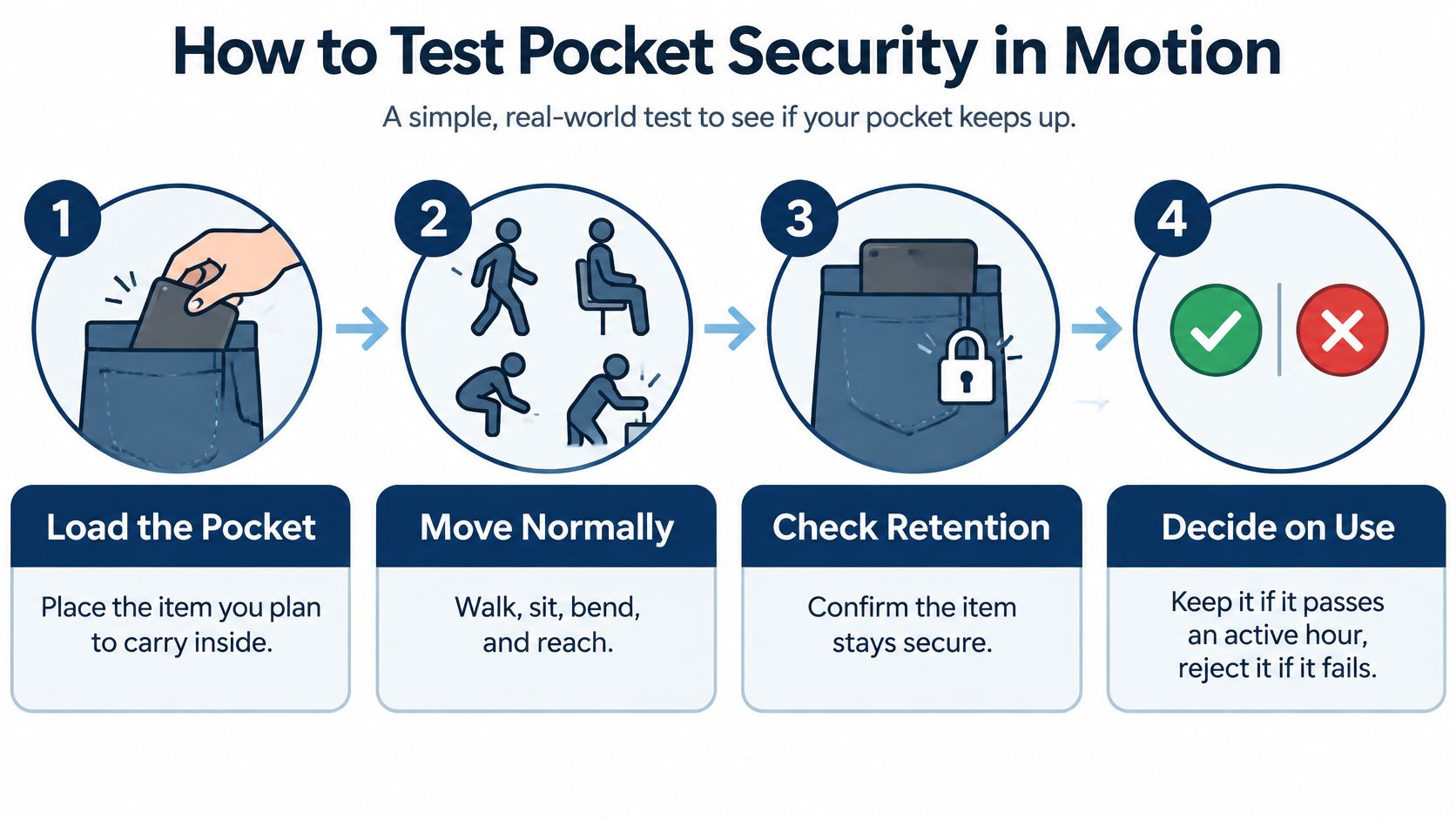
The Six-Step Motion Test
- Load the actual item: Phone in its case, card in its sleeve, keys on their fob. A stand-in weight only tells you the pocket can hold weight.
- Close it fully and stand still for thirty seconds: Watch whether the closure stays shut and the load stays centered before you add motion.
- Sit on a bench or cooler and lean forward to pick something up: Seated pressure opens weak mouths and pushes contents toward the lip.
- Walk fifty steps, then hop or jog in place ten times: Dance floor, trail jog, incoming wave. Anything that migrates shows up here.
- Reach in one-handed while holding a drink: If you cannot open, take, and close it mid-conversation, that pocket goes unused once the night starts.
- Recheck after repeated loads and wash cycles: Look for thread pull, fraying, and corners that have started to curl or loosen.
Sitting asks whether the load stays inside under pressure. Hopping asks whether it shifts. The one-handed reach asks whether you can still use it after you stop moving and start socializing.
Why the Seam Outranks the Fabric
For concealed pockets, the seam decides durability more than the pocket fabric does. The ASTM D7506/D7506M pocket reinforcement standard evaluates localized pocket reinforcement by clamping the pocket area in a tensile tester and pulling until the bar-tack region or surrounding fabric breaks, reporting both breaking force and failure location. In store language, stress piles up at narrow openings and pocket corners, the exact spots your fingers yank.
Look for bar tacks at the corners and zip ends, not random extra bulk. Reinforcement belongs where you pull. Test the garment as worn, because a hidden welt changes once it carries weight against a moving torso.
If a corner flexes and the stitching strains on your first firm tug, believe it. It will not get stronger at a festival.
Failure fixes, quickly
- Loose corner: Needs better reinforcement. Pass, or budget for a tailor.
- Shifting item: Needs a deeper bag, a loop, or a pouch to stop migration.
- Stiff, stingy opening: Needs a longer zip. Do not train your knuckles to suffer.
One care note for terry-lined pieces you plan to wear after a swim. Recheck pocket feel and how the lining grabs contents after repeated wash cycles. Loop fabrics change with laundering, and a lining that starts snagging changes how cleanly a pocket loads and unloads when you move from water to a chair. Festival days stack hours of standing, sitting on grass, and moving through crowds, which is why the music festival gear with hidden pockets guide is a smart final look before you commit. See reinforced openings in use on that page, then run the hop test yourself. An active hour that keeps the load where you put it is the standard. Anything less is a costume.
Champagne Pockets and Concealed Storage in Premium Pieces
Social Spec: Why a champagne pocket changes the tailgate game. A concealed interior sleeve keeps a small bottle or valuables close while both hands stay free for a toast, a handshake, or catching the friend who's had one toast too many.
A champagne pocket, in plain terms, is a discreet interior or hidden sleeve sized for a bottle, a card, or a small pouch, placed where a garment layer hides it. It's the premium end of secret storage, and premium here doesn't mean more pockets. It means better openings, cleaner linings, and stitching that survives being used in public, repeatedly, by a person holding other things.
Walk the Checklist Row by Row
Premium pocket features and what to check
| Feature | What to check | Why it matters |
|---|---|---|
| Champagne pocket | Interior sleeve sized for a small bottle or valuables | Keeps both hands free at toasts |
| Zippered dry pocket | Full-length zip with a cover layer | Protects a phone from sweat and spills |
| Reinforced opening | Bar tacks at pocket corners and zip ends | Prevents tearing under load |
| Thermal or modal lining | Soft lining behind the pocket | Stops contents from snagging or showing |
| Bottle pocket | Double-stitched, nylon-lined pouch | Holds a bottle without sagging |
| Detachable storage pouch | Fits the garment's dry pocket | Moves essentials between outfits |
| Hidden welt pocket | Flap or welt with a secure closure | Adds storage without visible bulk |
Start at the top. A champagne pocket that's too loose lets a bottle swing against your hip with every step, and one that's too tight turns retrieval into a wrestling match. You want a sleeve that holds its shape empty and releases cleanly full.
The zippered dry pocket earns its premium label with a full-length zip and a cover layer. Short zips force you to angle a cased phone in like you're parking a truck. A cover layer keeps the zip line from announcing itself across your chest and adds a buffer against sweat and spills.
Reinforced openings are where I'd spend money first. Corners and zip ends take every pull you'll ever give that garment. Then feel the lining. A soft thermal or modal layer behind the pocket stops contents snagging on the way in and keeps a phone's hard rectangle from printing through the outer fabric. Nobody needs to read your carry by silhouette.
Two Checks That Take Ten Seconds
- Pull the opening corners: Look and feel for dense bar tacks. Sparse stitching at a stress point is a future tear with a date on it.
- Load it and turn sideways: If the contents show through or drag the front down, the lining and pocket bag aren't doing their jobs.
The bottle pocket and detachable pouch close the system. Double stitching with a nylon lining keeps a bottle carried low from sagging into a pendulum, and a pouch that fits the dry pocket lets you move phone, card, and balm between a shirt, a hoodie, and a robe without repacking your life each time. When you find a premium piece that passes the corner pull, the sideways load test, and a one-handed zip, you've found engineered storage rather than a hidden hole with good copywriting. That's the difference worth paying for, and it's visible in about ten seconds once you know where to put your fingers.
Styling Secret Pockets and Picking Your First Piece
Style secret pockets by scene, not by outfit grid. The right pocket disappears into a moment so completely that all anyone notices is that you're relaxed, hands free, and weirdly easy to talk to. Three scenes cover most of the calendar.
Three Transitions, Three Right Answers
Après-ski style, lifts closed, deck calling. The mountain day ends and cabin wear takes over. A thermal shirt with a zip dry pocket is my pick here. Phone holstered against a warm layer, card zipped in with it, hands free for a mug and a fireside chair. Luxury thermal layers earn their place in this window because you're cooling down fast and still socializing, and High Sierra gear built for exactly this handoff beats re-wearing a damp base layer to dinner.
The parking lot tailgate. You win this one without trying hard when a plaid shirt carries a bottle pocket and a sunglasses loop. Plate in one hand. Bottle parked at your hip, not warming in your fist. Shades on the loop, not on the truck roof where they'll live forever. You're the person who can help carry the cooler, which makes you instantly more popular than the person guarding a tote.
Beach-to-bar, salt still on you. Terry lined shirts and a loose overshirt with a sunglasses loop handle the post-surf comfort problem, damp skin, sandy feet, and a patio that expects a shirt. This is beach lifestyle apparel doing a real job, the absorbent lining managing moisture while your phone stays zipped away from wet trunks. California casual works when the function is invisible and only the ease shows.
In all three scenes the move is the same. Holster your tech, keep the screen out of sight, and let serendipitous encounters happen because you're looking up. That's the social return on a well-placed pocket.
Pick Your First Piece by Your Calendar
- Mountain-first buyer: Start with the thermal shirt and zip dry pocket. It's the most forgiving first buy for après-ski and cabin nights.
- Coastal buyer: Start with the bottle pocket shirt and sunglasses loop. Surf days will test both before lunch.
- Festival and wedding buyer: Start with a double-layer hoodie. Group days run long, layers come on and off, and you need storage that survives all of it.
That hoodie spec is worth knowing precisely. The double-layered hoodie has a zip dry pocket, a secret pen pocket, and a double needle-stitched bottle pocket with nylon lining. The Out of Pocket Pouch fits into the zippered dry pocket of all technical apparel, so your festival kit moves into wedding-weekend layers without a rebuild. For bachelor party outfit ideas, unique groomsmen gifts, and coordinated group gear, that kind of shared, useful spec beats matching novelty tees everyone donates by Tuesday. Wedding robes and group layers with real pockets get worn long after the photos.
For more scene-by-scene combinations, the festival outfit ideas guide is a solid planning pass before a big weekend.
What to Pack
- Phone in its case: Zipped in the dry pocket, screen forgotten.
- Sunglasses: On the loop, never loose in a pocket with keys.
- Bottle opener: Small, flat, and endlessly borrowed.
- Card: In the pouch or secondary layer, not floating free.
- Lip balm: The item everyone requests by hour two outdoors.
- Key on a fob: Findable by touch, gentle on linings.
When the day is finally over, the El Garibaldi Robe is the piece to wear for morning coffee on the cabin deck, pockets handling a phone and a key while you do absolutely nothing at a professional level. Join the Vital Few newsletter for first access to drops, since the good sizes in seasonal pieces don't linger.
Complete the Look
Finish the tailgate kit with a hat for low sun and chair-nap hair. Layer a tee under the hoodie so you can shed the outer layer when the fire gets going and still have a clean base. Add a koozie to keep the bottle in that low pocket cold and your hand dry when you finally claim it. Then holster the tech, step away from the tote, and get out into the world where the evening is happening.
Ready to carry less in your hands and more of the moment? Explore technical shirts, robes, and hoodies with zip dry pockets, bottle pockets, and sunglasses loops built for après-ski decks, surf-to-sand afternoons, and long group weekends at California Cowboy, then run the sit, hop, and one-handed test on your first piece before its first big night out.

