


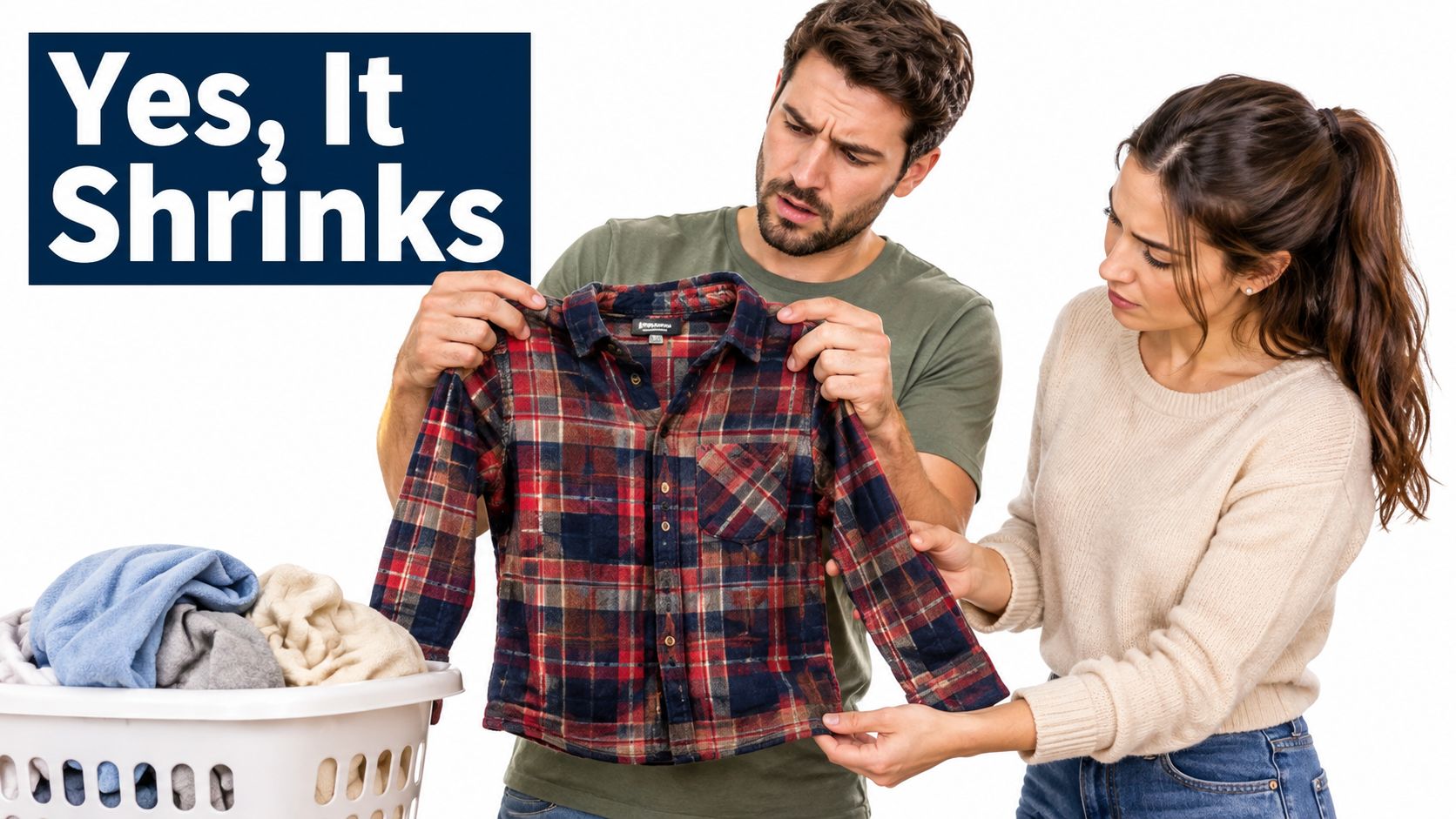
Yes, flannel can shrink in the wash. Most of the change lands in the first cycle, and the reported range runs from about 3% to 10%, with untreated cotton and loose weaves at the top of that band and cold washing followed by flat drying at the bottom.
The more useful question isn't whether flannel shrinks. It's which flannel, by how much, and how you find out before the sleeves end up above your wrists. A shirt that comes out of the dryer an inch shorter is a bad afternoon. A shirt you measured, washed cold, and dried flat is still the shirt you bought.
You know the scene. Woodsmoke worked into the cuff, a little salt dried into the shoulder, the fire down to coals and the shirt still on your back. That shirt has to survive tomorrow morning's wash. Here's how to know exactly what it will do.
Does Flannel Shrink and by How Much
How much length and width might a flannel lose in its first wash? Published estimates vary with the fabric and washing conditions, so treat these figures as a planning range, not a promise about your particular shirt.
| Flannel type or condition | Reported first-wash shrinkage | Source or condition |
|---|---|---|
| Untreated 100% cotton flannel | 3–5% in length and width | Standard hot wash and tumble dry (Fabric Fits guide) |
| Cotton flannel, general | 5–10% | Sewing With Ease fabric guide |
| Loosely woven flannel | 10% or more | Sewing Patterns Explain care notes |
| Mixed fiber average, first wash | 6.8% (±0.7%) | 2024 laundering study across its tested substrates |
| Wool flannel | No clean percentage reported | Heat, moisture and agitation can cause felting |
| Pre-shrunk or polyester-rich blend | No figure reported here | Results depend on the fabric and finishing |
Use the table to set expectations, then let your own shirt supply the useful number. Measure it before washing, repeat the same measurements after each of three wash-and-dry cycles, and compare. That gives you a shirt-specific record rather than a guess based on fiber content alone.
Individual garment reports can show why measurements matter. A customer review of an L.L.Bean Scotch Plaid flannel on Zappos described nearly 5 inches of lost length and roughly 3 to 4 inches of lost width after washing. That is one report, not a typical result.
Fiber content, weave density and drying heat all affect shrinkage. Check the care label and fabric notes before washing; if you're considering a California Cowboy High Sierra shirt, read its fabric notes too. For your own baseline, record the shirt's length from the highest shoulder point to the hem, its chest width across the garment, and its sleeve length. Keep the shirt flat and use the same points each time.
Fiber, Weave and Relaxation
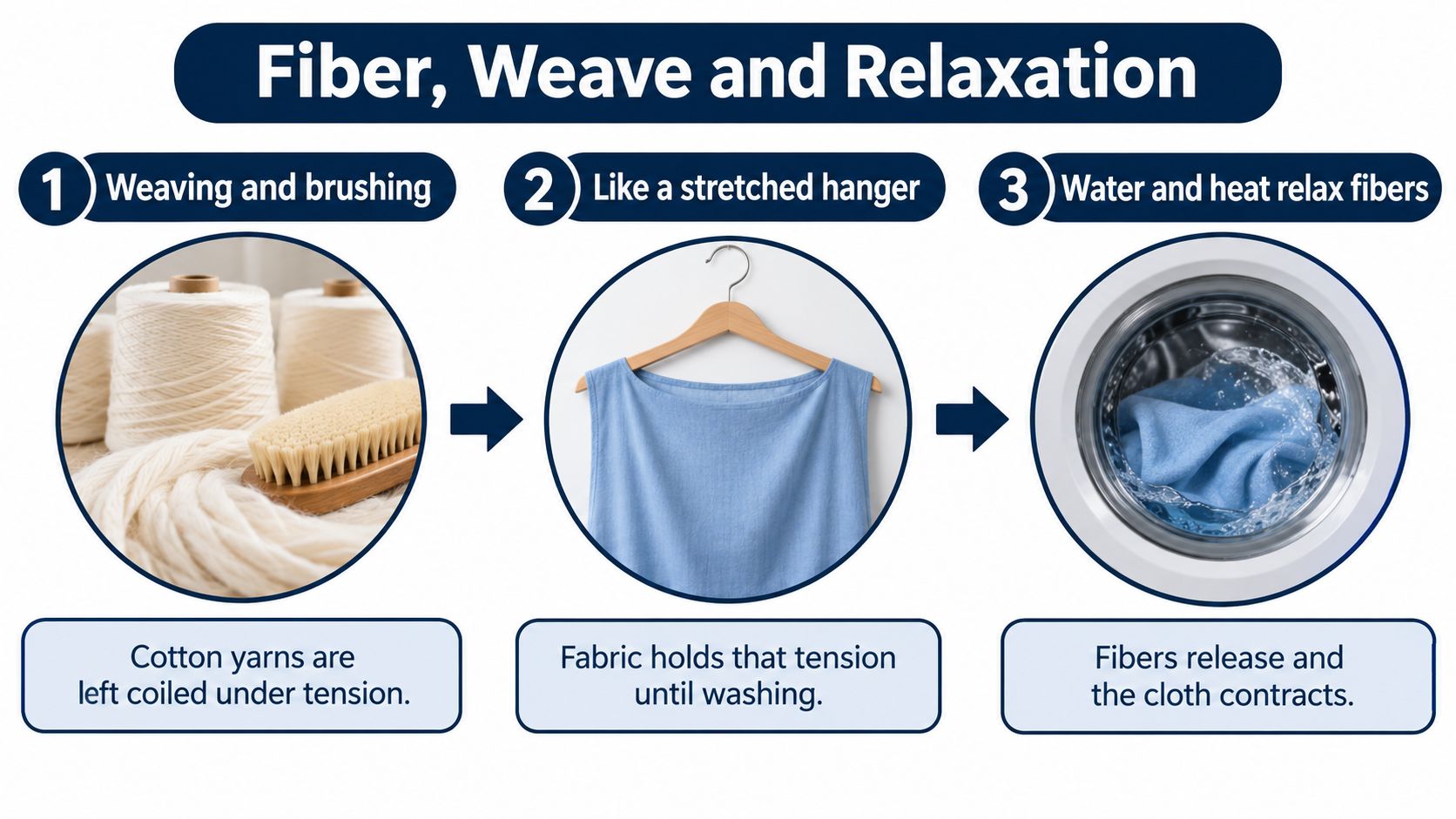
A flannel shirt can change shape because weaving and finishing leave yarns under tension. During washing, cotton fibers swell and yarns shift toward a more relaxed position. The cloth contracts. A Cotton Incorporated guide to cotton fabric shrinkage reports that one wetting-and-drying cycle can remove about 90% of a fabric's total available shrinkage, while fully relaxed dimensions may take around five cycles. It also describes extra drying shrinkage as moisture drops below roughly 20%.
Dryer temperature alone does not predict the final change. In a controlled test of 100% cotton interlock, drying at approximately 100°F (38°C), 150°F (66°C) and 200°F (94°C) produced identical shrinkage curves and total shrinkage. Fabric construction and remaining tension mattered more.
Why Length Moves More Than Width
Length often changes more than width because warp yarns carry much of the tension from weaving. That is why shrinkage tests measure both directions. AATCC TM135 evaluates fabric after home laundering under controlled conditions, while TM150 applies similar principles to finished garments. A single figure such as “4% shrinkage” is incomplete unless it states the direction measured and drying method.
What the Tag Tells You in Ten Seconds
- Fiber content. Cotton can shrink as its yarns relax. Blends may behave differently, so check the percentages rather than relying on the word “flannel.”
- Pre-shrunk. Some relaxation has already happened during manufacturing, but the label does not mean the fabric cannot change further.
- Brushed or tightly woven. Brushing describes the raised surface; weave density describes how closely the yarns sit. Neither word alone gives an exact shrinkage figure.
- Dimensional results. Measurements that report length and width separately make it easier to compare fit changes.
Flannel names a fabric type, not a fiber. It has been made from wool, cotton and blended fibers, as the history of flannel fabric describes. Wool needs different care: heat, moisture and agitation can cause felting, rather than the yarn relaxation associated with cotton.
For your own reference, men's plaid flannel shirts offer one place to compare fabric descriptions before buying. A product description can help identify the fabric, but measuring your shirt before and after washing gives you the fit information that matters.
Sizing Up Flannel Before You Buy
Do the arithmetic before you spend the money. A 22-inch sleeve loses about 1.1 inches at 5% and about 2.2 inches at 10%. A 30-inch body length gives up roughly 1.5 to 3 inches across that same band. That's the gap between a shirt that hits your hip and one that rides above your belt.
Anything marked pre-shrunk or garment-washed shrinks the allowance. Brushed, loose-weave cotton pushes you toward the high end, so buy for the shirt you'll have in a month rather than the one on the hanger.
Four things to check before you click buy:
- The fiber line. Cotton and cotton-rich blends need the allowance. Poly-rich blends rarely do.
- A pre-shrunk or garment-washed callout. If it's there, trust the fit as marked.
- The weave description. "Brushed" and "loose" mean more movement than "tight" or "dense."
- Published measurements. Chest, sleeve and body length, taken after washing, ideally.
If you want a refresher on where a shoulder seam should land before you start comparing size charts, this guide to fitting dress shirts properly covers the fundamentals without the fluff. Our own guide to measuring for a shirt walks through the tape-measure version.
Social spec: a zippered dry pocket is a laundry feature as much as a bar feature. The phone goes in the pocket, the pocket stays out of the drum, and nothing ends up swimming in the wash.
Wool-containing flannel is the exception to all of this. Don't size up to compensate, because felting is a one-way change rather than a percentage you can plan around. Use the cool hand-wash plan in the next section instead. When you're ready to buy a cotton shirt that holds its cut, the Men's High Sierra shirt is the one to look at first.
Wash, Dry and Measure Your Flannel Before the First Wash
Start with the method, ranked from the gentlest on fit to the most punishing.
| Method | Water temperature | Drying | Fit risk | Best for |
|---|---|---|---|---|
| Cold machine wash, gentle cycle | Up to 85°F (29°C) | Line or flat dry | Lowest | Keeping exact chest and sleeve length |
| Cold machine wash, gentle cycle | Up to 85°F (29°C) | Low tumble, if the label allows | Low | Routine washing for most flannel |
| Hand wash, cool water | Cool | Flat dry | Low | Wool-blend and delicate shirts |
| Warm or hot wash | Above 85°F (29°C) | Low tumble | Moderate to high | Only when the label requires it |
| Hot wash with high-heat tumble | Hot | High heat | Highest, and the combination behind the worst reported numbers | Avoid for any fit-critical flannel |
Read the sewn label before anything else. The Federal Trade Commission's Care Labeling Rule requires manufacturers and importers to state whether a garment is hand or machine washed, to give a water temperature when hot water could harm it, and to specify a drying method with a temperature when high heat could cause damage. That label is the garment-specific instruction. Generic flannel advice is not.
"Cold" also has a definition. The federal rule's appendix sets cold tap water at up to 85°F (29°C), per the FTC care-label guidance, so a cold wash isn't an unlimited-temperature instruction.
The Measurement Routine That Settles It
- Measure the shirt flat, before washing. Chest width at the armpit, sleeve from shoulder seam to cuff, body length from the high shoulder point to the hem. Use centimeters for finer resolution.
- Read the label for all three variables. Wash method, water temperature, drying method. Write them down if the tag is faint.
- Wash cold, gentle cycle, inside out. Close the pockets, empty them first, and don't stuff the drum. Friction does damage that temperature can't.
- Dry flat or line dry if the label permits. Low tumble only when the label names it, and pull the shirt out the moment the cycle ends.
- Re-measure only when fully dry. Damp fabric reads short and wide, which sends you chasing a problem you don't have.
- Repeat for three cycles and compare each result to the baseline. Measuring after one wash and again after three is what separates a real trend from dryer-day noise, and it's the protocol behind proper garment-shrinkage reporting, as this CottonWorks care Q&A sets out.
The most common mistake is comparing a tumble-dried shirt against a line-dried baseline. Different drying method, different number, and the shirt gets blamed for the test.
A normal result looks like this: most of the change on cycle one, then very little movement. If a measurement moves beyond the 3 to 5% you planned for, stop high-heat tumble drying and switch to flat drying for the rest of the shirt's life.
Wool is the exception again. Hand wash in cool water, dry flat, no agitation and no heat, because that combination is what drives felting. Our own care guidance is deliberately plain: machine wash cold on a gentle cycle, then tumble dry low or dry flat. Heavy cotton on the same routine rewards the same patience, and this guide to keeping blanket colors from fading is a good companion read if you launder thick cotton regularly. If you're still deciding between two cold-weather layers, our comparison of flannel versus fleece covers which one shrugs off washing better.
Flannel Robes and Hem Length After the Wash
Robes are the high-stakes case. The hem is long, the fabric is heavy, and a few percent of loss is visible every time you sit down. A 40-inch robe drops about 1.2 to 2 inches at 3–5% and around 4 inches at 10%. On a knee-length robe, that's the difference between a robe and a long shirt.
Four steps, in order:
- Measure hem length from the shoulder seam to the bottom edge before the first wash. Note it somewhere you'll find it again.
- Wash cold on a gentle cycle with the belt tied off. An untethered belt cord wraps, twists and stresses the seams.
- Dry flat or hang over a rail, away from radiators and direct sun. Heat is the enemy here, not air.
- Re-measure once fully dry, then compare against the baseline. Anything inside a few percent is normal relaxation.
A wool-blend robe follows the hand-wash rule instead of the machine routine, because agitation and heat felt the fibers and no amount of reshaping brings that back.
For the long, heavy versions built to sit by a fire rather than in a laundry basket, look at the men's house robes we make first. Then pick up the El Garibaldi Robe when you're ready to commit.
Recovering a Shirt That Already Shrank
The fit you lost usually sits in the fabric's tension, not in the fibers themselves. Tension can be coaxed back. Felted wool cannot.
That distinction decides everything that follows.
What you can recover: perceived fit, drape and softness. A woven cotton shirt can be reshaped while damp and dried flat, and drying pulls the gear back a bit, while wovens and knits can stretch out again after a couple of wears.
What you can't: felting in wool-containing flannel, which heat and agitation lock in permanently, and heat-set compression of the fabric itself.
The procedure for the recoverable half: soak the shirt in cool water with a spoonful of gentle detergent, lay it flat on a towel, and ease it gently back toward your recorded measurements with your palms rather than pulling at seams. Then dry it flat, away from heat, and leave it alone until it's completely dry.
Then there's the quieter problem. Repeated hot drying may not take much more off the tape, but it degrades the napped surface, drives pilling and dulls softness, as this fabric shrinkage by fiber guide points out. The shirt can feel smaller and stiffer even when the numbers barely move.
Set your expectations. Cold washing, reshaping while damp and flat drying can bring a shirt back partway. It won't restore a garment that lost four inches. Prevention is the cheaper repair.
Refresh Pockets, Confirm the Label and Shop the Look
Before washing a shirt, empty its pockets and check the sewn care label. A bottle cap or other forgotten item can damage fabric in the wash, while the label gives the garment-specific instructions to follow.

For a small mark, dab with cold water and mild soap, rinse, and dry flat. If the shirt smells of smoke, airing it outdoors may help. Rinse salt from the fabric with cool fresh water before it dries.
The Out of Pocket Pouch fits into the zippered dry pocket of technical apparel. Clean the pouch by wiping it with a damp cloth, then let it air dry. Do not microwave it.
Why the dry pocket matters: It keeps your phone separate from the wash. Remove the phone and pouch before laundering, then follow the pouch's wipe-clean instructions.
Use this checklist before laundry day:
- Read the sewn label and follow its care instructions.
- Measure before washing and after three cycles to track how your shirt changes.
- Compare the measurements with your fit target. If the shirt shrinks more than you planned for, avoid high-heat tumble drying.
Complete the Look
- Layer it over a tee. A tee gives you an easy base layer under flannel. Browse men's tees.
- Add a hat. California Cowboy's collection includes hats and accessories.
- Choose the right shirt for the setting. California Cowboy's High Sierra shirts are designed for après-ski comfort, while High Water styles suit après-surf wear.
For practical layering ideas, see the guide to wearing men's flannel shirts. The Vital Few newsletter offers first access to product drops. For laundry, use a cold, gentle cycle and tumble dry low or dry the shirt flat.
California Cowboy designs men's and women's shirts, robes, and outerwear for social living and post-adventure comfort. Its High Sierra shirts include thermal lining and a zippered dry pocket, while High Water styles include a soft modal lining, a beer bottle pocket, and a sunglass loop. Browse the California Cowboy collection to compare styles.

