


The lifts have closed, the snow is turning blue in the parking lot, and your base layer is staging a damp little rebellion under a ski jacket. Ahead, a crowded lodge smells of woodsmoke, wet wool, and the sort of winter candle that makes a room feel warmer before the fire gets going. You need a layer that can handle the walk inside, the first drink, and the stranger who becomes your new best friend before dinner.
That's where luxury flannel shirts earn their keep. Not as costume lumberjack gear, and not as another technical shell with the personality of a printer manual. The right après-ski shirt manages temperature, carries the small objects that usually vanish, and helps you look socially confident while you holster your tech and join the room.
The Art of the Après-Ski Transition
The transition starts when the activity ends, not when the day is over. You're standing beside the car with cold fingers, a helmet under one arm, and a friend asking whether anyone packed the bottle opener. The lodge door opens. Heat rolls out. Suddenly, the layer that felt sensible on the mountain feels like a portable sauna.
A standard cotton button-down won't solve the problem. Neither will a synthetic ski jacket that traps every bit of exertion you built up on the final run. Social Technical apparel sits in the useful middle ground. It's designed for the minutes after sport, when you're moving between cold air, heated interiors, damp gear, bar stools, and spontaneous conversations.
The Welsh history of flannel helps explain why the fabric still belongs in cold-weather wardrobes. The term appears in a merchant notation from 1503, and flannel became increasingly common during the 16th and 17th centuries. Its traditional appeal was practical, warmth, durability, and comfort in Wales's cold, wet climate. You can find more context on the fabric's heritage in this guide to après-ski wear for men.

Luxury, in this setting, isn't a decorative label or a button that requires a jeweler. It's functional comfort that keeps your hands free. A well-built shirt lets you carry essentials, regulate your temperature, and move through a lodge without fussing with your outfit every thirty seconds.
The après test: If your shirt makes you think about your shirt, it failed. If it lets you notice the fire, the music, and the person beside you, it's doing the job.
The sensory details matter too. Woodsmoke, pine, hot chocolate, and a good winter fragrance can turn a crowded lodge into a place where people linger. For ideas on creating that atmosphere at home or in a cabin, explore these best cozy scents for winter. Then put the phone away. The best part of après-ski is usually the conversation you didn't schedule.
Decoding Premium Fabrics and Weave Construction
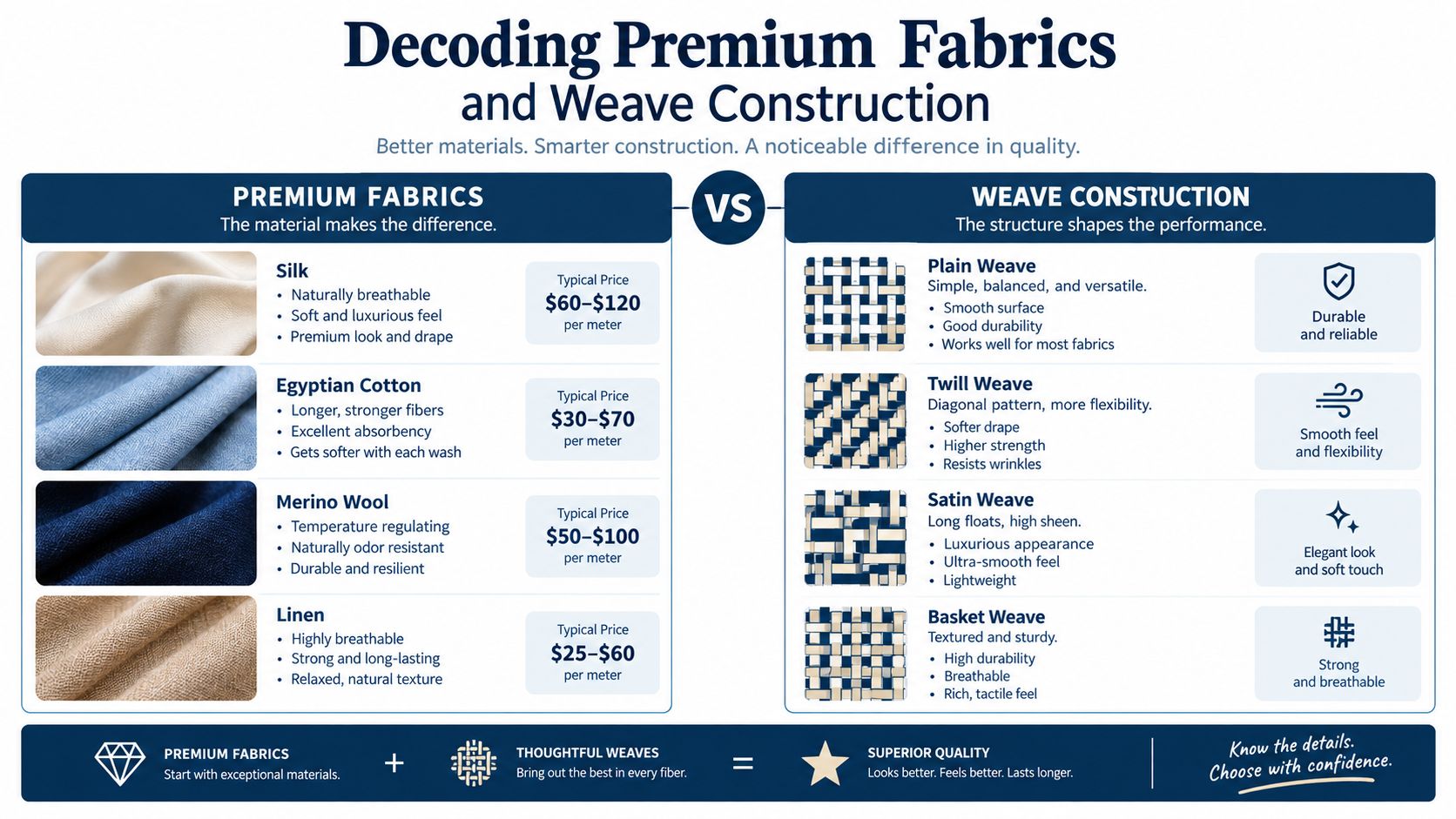
Most shirts called premium are just brushed cotton with better photography. Ignore the marketing fog and inspect the fiber architecture, surface finish, and construction. Flannel traditionally uses carded wool or worsted yarn, while modern versions may use fine cotton, merino wool, or blended fibers. The label matters, but the blend and finishing determine how the garment behaves after the first cold walk and the first crowded bar.
A controlled cotton-textile study found that a 40/60 cotton-wool blend delivered greater thermal resistance, thermal resistivity, and warmth-to-weight performance than 100% cotton, while also showing lower water-vapor resistance, which indicates better breathability. The study is available in this cotton and wool textile research paper. For stop-and-go après-ski use, that combination makes sense. Wool helps retain warmth while the blend can reduce the clammy feeling that pure cotton often develops when damp.
Read the surface, then inspect the spec sheet
A brushed surface feels soft because loose fibers have been raised. That softness can be lovely, but it can also disguise weak fiber anchoring. Pilling begins when abrasion pulls fibers to the surface and entangles them into visible balls. Backpack straps, car seats, bar tops, and repeated washing are not theoretical threats. They're the regular itinerary.
Standardized testing gives buyers something more useful than the word “luxurious.” ASTM D3512 evaluates random-tumble pilling, while ASTM D4970 supports Martindale abrasion and pilling evaluation. Results commonly use a five-point scale, with Grade 5 indicating no visible pilling and Grade 1 indicating severe pilling. The textile quality reference from Herman Miller's textile standards explains the framework.
Ask for the method, cycle count, and resulting grade. A sensible product specification is Grade 4 or higher for visible body panels after abrasion, followed by separate checks for shrinkage, colorfastness, and seam durability.
The practical buying rule
Choose a medium-weight wool and cotton flannel when you expect repeated changes between outdoors and heated interiors. Choose cotton-only flannel when softness and easy layering matter more than moisture buffering. In either case, don't buy based on brushing alone. Ask what the fabric contains, how it was tested, and how the maker expects you to care for it.
That's the difference between a shirt that feels impressive under store lighting and one that still looks composed after a season of real mountain living. For a broader look at construction and use, see these men's performance flannels.
The Social Anatomy of a High Sierra Flannel
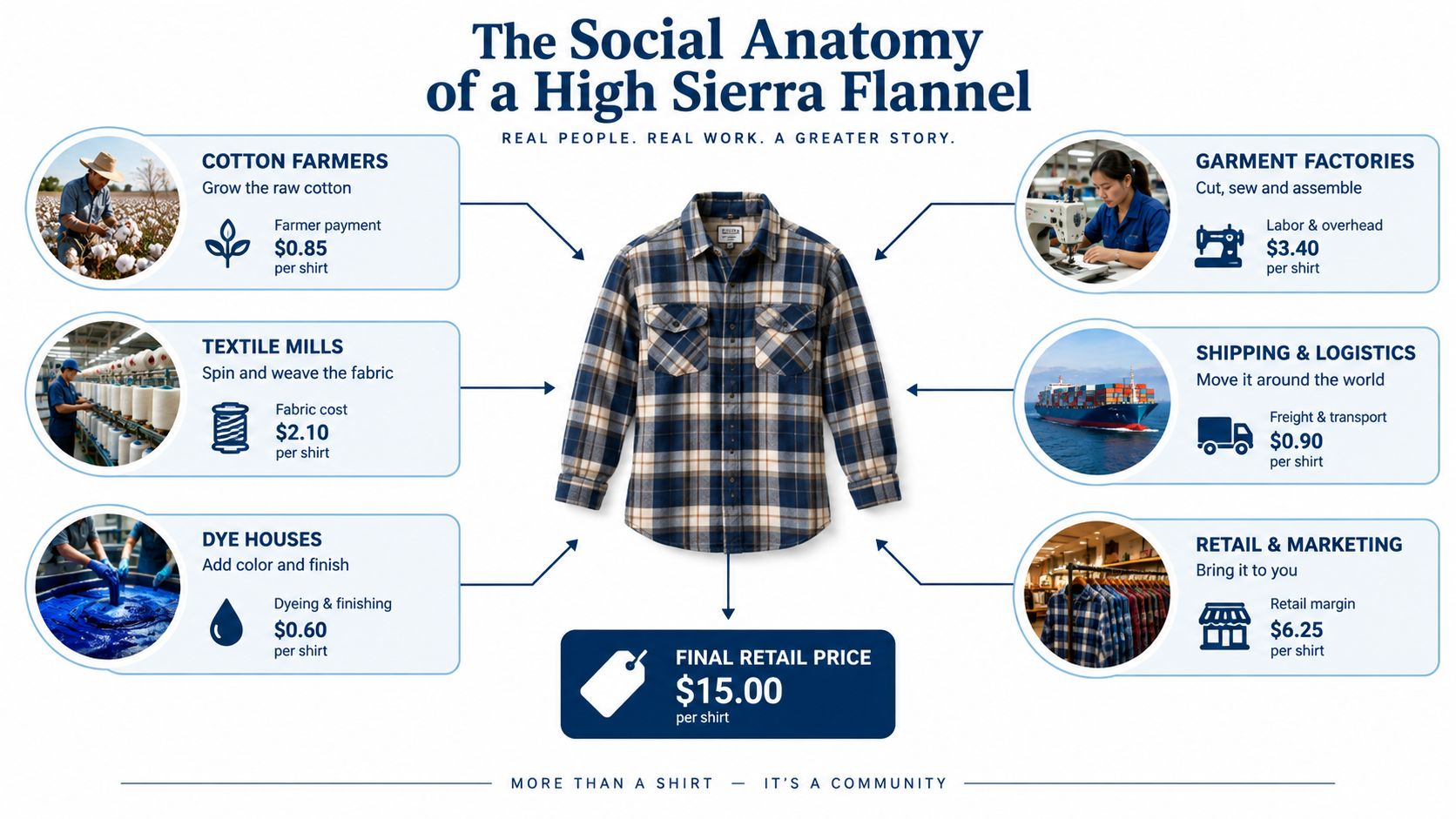
A good après shirt works like a discreet social utility belt. It doesn't advertise its tricks. It prevents the small failures that derail a good evening, such as a lost phone, a wet wallet, or a bottle that refuses to open while six people watch.
Start at the chest. A dedicated beverage or champagne pocket keeps the drink close without forcing you to balance it on a windowsill. That matters in a parking lot tailgate, where one hand is already carrying gloves and the other is busy introducing you to someone who knows the best late-night bar in town.
Map the useful details
- Dry pocket: Use it for a phone, cards, or keys when the surrounding environment includes melting snow, spilled drinks, or a damp bench.
- Bottle opener loop: Keep the opener attached to the shirt instead of relying on the person who always says, “I had one somewhere.”
- Sunglasses loop: Move your glasses out of your face when the sun drops behind the ridge, then retrieve them when the glare returns.
- Conversation-starter cards: Carry a small prompt for the moments when everyone has exhausted their opinions about snow conditions.
These features support hands-free socializing. They don't replace good manners, and they won't rescue a boring story. They remove the minor logistical annoyances that make people reach for their phones.
Why placement beats pocket count
A pocket only helps if you can reach it without interrupting the interaction. Chest placement works for a small beverage. A protected inner pocket suits a phone. A loop should sit where your hand naturally finds it, not somewhere requiring the dexterity of a watchmaker in ski gloves.
California Cowboy's Men's High Sierra Shirt combines Portuguese cotton, thermal lining, and dedicated storage for a phone, bottle opener, and beverage. The design belongs to a wider category of men's flannel shirts and styling ideas, where clothing has to survive the transition from mountain weather to real human company.
The same logic works beyond the lodge. A hidden dry pocket helps at a beach bonfire. A sunglasses loop earns its keep on a coastal drive. The point isn't to turn your shirt into camping equipment. It's to make the garment more useful during the messy, social parts of life.
Choosing the Right Weight for Mountain and Coastal Climates
The warmest shirt isn't automatically the most comfortable shirt. A fireside layer that feels perfect on a cabin deck can become oppressive inside a packed lodge, while a light surf shirt may feel pleasant after swimming and useless during a windy drive home.
Match the construction to the transition you make. For stationary fireside wear, insulation matters most. For active après-ski layering, moisture buffering and airflow matter more. For beach-to-bar use, absorbency and laundering deserve the attention usually reserved for color and pattern.
| Environment | Ideal Fabric Blend | Key Feature Priority |
|---|---|---|
| Fireside cabin wear | Wool-rich or medium-weight wool and cotton flannel | Insulation and soft hand |
| Active après-ski layering | Medium-weight wool and cotton blend | Thermal stability and breathability |
| Beach-to-bar transition | Cotton terry construction | Water absorption and practical laundering |
| Coastal evening drive | Lighter cotton flannel or terry-lined layer | Comfort, airflow, and easy layering |
Mountain use
For cabin wear and fireside outfits, a medium-weight wool-backed or wool and cotton flannel is the clear choice. Wool provides useful warmth without requiring a bulky coat indoors, and the blend discussed earlier can offer better warmth-to-weight performance than cotton alone. Keep the fit roomy enough for a tee underneath, but not so generous that the shirt turns into an accidental blanket.
Wool also has a practical heritage in workwear. By the 1890s, more than 250 woollen factories operated in west Wales, including 23 in and around Dre-fach Felindre. Welsh flannel became popular among coal and iron workers because it was hard-wearing, absorbed sweat, and offered wool's natural fire-retardant advantage. The historical account from Amgueddfa Cymru on Welsh flannel makes the point better than another glossy gear slogan.
For cold-weather comfort beyond clothing, readers may also find these winter pain relief tips useful. Keep the advice practical. Good layers help, but they don't excuse poor preparation.
Coastal use
Terry is the smarter post-surf option when residual water is the problem. Its looped pile is designed for absorption, but construction still matters. A study of 100% cotton terry fabrics found that yarn count and fabric density affected water absorption and durability after repeated washing. The research measured absorption, drying rate, air permeability, tensile strength, tear strength, abrasion resistance, and pile-loop extraction resistance, so “terry-lined” should never be treated as a complete performance specification.
Cotton terry's behavior also changes with laundering. An FAO-indexed study tested 11 undyed cotton terry towels weighing 9.7 to 14.8 ounces per square yard through as many as 100 washes. Absorption improved markedly through approximately the first 10 laundering cycles, then the gains became slight. Fabric weight correlated with total absorption, while absorption speed behaved differently. In plain language, a terry layer can become more absorbent with use, but it won't dry by magic.
Cotton fibers themselves can hold approximately 24 to 27 times their own weight in water, according to this peer-reviewed cotton moisture review. A finished garment behaves differently depending on its structure, lining, and air circulation, so treat fiber capacity as context, not a promise.
For a mountain-specific construction, explore lined flannel shirts for men. Choose by environment, not by the fantasy that one shirt should handle every climate on earth.
Evaluating Repairability and Long-Term Value
A high price doesn't guarantee a long life. The true luxury test begins when a cuff catches on a tailgate latch, a snap fails, or a pocket tears after a season of carrying more than a phone.
Repairability deserves a place beside softness, fiber content, and brand prestige. A 2025 European Repair Café dataset recorded a 95% textile-repair success rate across 3,157 items, including a 94% success rate for coats and jackets. The figures come from the European Environment Agency's repairability research. Repair success isn't the same as repair convenience, but it does challenge the lazy assumption that damaged clothing belongs in the bin.
A separate 2025 study of 3,211 textile items leaving Norwegian households found that only 107 items, or 3.3%, had been repaired or altered before disposal. That contrast suggests a practical problem. People may discard garments because repair pathways, costs, and construction details aren't clear.
Inspect the garment before purchase
Look for:
- Reinforced seams: High-stress areas should show deliberate stitching rather than decorative confidence.
- Replaceable closures: Buttons and snaps should be standard enough for a tailor or repair shop to source.
- Patchable panels: A torn body panel is easier to save when the fabric allows a clean patch or replacement.
- Accessible construction: Linings and pocket bags should not make basic repairs unnecessarily difficult.
- Care clarity: Shrinkage prevention and stain treatment instructions should be specific, not a vague “wash with care.”
Stains need prompt treatment, especially on brushed surfaces where residue can settle into the nap. Avoid aggressive scrubbing that damages the raised fibers. For tears, take the shirt to a professional when the damage reaches a seam, pocket opening, or stressed closure. A neat repair can preserve the shirt's character. A rushed home fix can turn a small problem into a crooked souvenir.
The long-life rule: Don't ask only whether a shirt feels luxurious on day one. Ask whether someone can fix it on day one hundred.
A well-made flannel should collect memories, not merely pilling. A little wear from a cabin bench is honest. A failed seam that nobody can access is bad design wearing a premium price tag.
Care Instructions and the Complete Outfit Builder
Care starts before the washing machine. Read the fiber composition and follow the maker's instructions, especially when wool appears in the blend or the shirt uses a thermal lining. Turn the garment inside out, use a gentle cycle where appropriate, avoid harsh agitation, and don't treat high heat as a shortcut to adulthood.
Drying deserves more attention than most give it. Excess heat can distort the fit, tighten natural fibers, and roughen a brushed surface. Reshape the shirt while damp and let it dry with enough airflow. Store it clean, folded or on a suitable hanger, and keep heavy objects from crushing the nap.
Build the outfit around the transition
For a Tahoe arrival, start with a plain tee beneath a High Sierra flannel, dark denim or durable trousers, and boots that can survive slush without looking like they were issued by a government agency. Add a wool cap for the parking lot, then remove it when the lodge heats up.
For a coast drive, pair a terry-lined shirt with swim shorts, a clean tee, and slip-on shoes. The shirt handles the damp interval between water and bar while the tee gives you a dry base once the sun drops.
For a group weekend, keep the core shirt consistent and let accessories create variation. Coordinated doesn't have to mean identical. A shared color palette looks intentional without making the wedding party resemble a touring acapella group.
The complete look
- Tee: Choose a breathable base in a neutral shade that doesn't fight the flannel pattern.
- Hat: Pack a low-profile cap or warm knit hat for the drive, then use it as an easy conversation starter.
- Koozie: Keep a beverage cold without sacrificing a hand, especially during tailgates and outdoor arrivals.
- Robe: For a beach or cabin morning, the El Garibaldi Robe creates a relaxed layer before the day's first serious decision.
- Personal detail: Monogramming or embroidery can turn group apparel into a useful keepsake rather than another disposable costume.
The best outfit is the one that lets you stop adjusting it. Put it on, holster your tech, and get back to the people who drove up with you.
Join the Vital Few and Live Offline
A luxury flannel shirt is only the vehicle. The destination is a life with more fireside conversations, unplanned introductions, and mornings that begin with coffee on a cabin deck instead of notifications.
That philosophy has roots in the fabric itself. Welsh flannel moved from household production toward centralized mills during the 18th century, helped by mechanization such as a water-powered carding machine introduced in 1780 and the spinning mule. By the 19th century, Welsh mills exported distinctive checked and striped fabrics to London, Europe, and other markets. A shirt that carries that heritage into modern social life should earn its place through use, not nostalgia alone.
The same standard applies to group outfitting. Pre-wedding trips are built around repeated social moments, including arrival, dinners, pool or beach time, and departure. A 2026 Forbes analysis covering more than 32 million group trips reported average spending of $410 per attendee, excluding individual airfare and travel costs, with 92% of trips lasting at least two days and an average duration of three days. The U.S. median per-person spend was reported as $360, compared with a global median of $289. Those figures describe the broader trip, not clothing alone, but they support buying apparel that works across a full weekend rather than a single staged photograph. See the Forbes reporting on pre-wedding trip spending.
Join the Life Offline lifestyle and make the next gathering about movement, warmth, and actual company. The Vital Few newsletter offers access to product drops, group outfitting opportunities for weddings and corporate events, and invitations to real-world pop-ups.
Subscribe, then put the phone away before the first drink arrives. The best story from the weekend probably won't fit in a post anyway.
California Cowboy makes social apparel for the moments after the adventure, from luxury flannel shirts and High Sierra layers to terry-lined coastal pieces, robes, and accessories. Visit California Cowboy, choose the layer that fits your next mountain, surf, or group weekend, and go meet somebody offline.

