


A medium-weight men's terry cloth robe with open loops is the practical sweet spot for post-surf, pool, and shower use. Aim for a balanced construction rather than maximum bulk, so the robe can absorb water without becoming excessively heavy, slow to dry, or awkward to pack.
Salt dries white on your shoulders as you leave the beach. Your hair is still wet, the wind has teeth, and someone in the parking lot is already cracking open a drink beside the tailgate. You could pull on a T-shirt and spend the drive home feeling clammy, or you could step into a robe that turns the cold transition into part of the day.
That's the job of a mens terry cloth robe when it's designed as social equipment, not sleepy-time decoration. It moves you from surf to sand, ski boots to cabin deck, shower to first drink. Your phone can stay holstered. Your hands stay free. You look prepared for the next encounter instead of stranded between activities.
The Moment After Adventure Starts
At the beach, the hardest part often begins after the wave. You towel off, find your keys, and feel the coastal air slide under your waistband. The group is heading to a taco stand, but your skin still carries salt water and your shoulders are tightening against the breeze. A robe gives that in-between moment a shape. It dries, covers, warms, and lets you walk toward the next plan without performing discomfort.
The same transition plays out in the mountains. The lifts close, gloves disappear into pockets, and wet base layers meet the sharper air outside the lodge. Someone suggests a first drink at the cabin. A robe layered over swim shorts, training gear, or a base layer turns the walk from locker room to fireside into an easy social entrance.

From athlete to guest
The best post-adventure clothing handles three jobs at once:
- Dry the body: Looped terry catches surface moisture rather than just covering it.
- Restore confidence: Secure coverage means you can join the group before you're fully dressed.
- Keep movement easy: A relaxed cut lets you walk, sit, carry a mug, or open the car without wrestling the garment.
That's where California Cowboy's Life Offline attitude becomes useful. You don't need to narrate every step through a screen. You need a dry pocket for essentials, a place for sunglasses, and enough ease to accept an unexpected invitation to the parking-lot tailgate. Serendipitous encounters rarely wait for a full outfit change.
Social spec: A robe earns its place when it makes the transition smoother. The goal isn't to look overdressed by the fire. It's to feel socially confident enough to stay.
A terry robe also creates a small ritual. The drive home from the beach becomes warmer. The first drink after the lifts close feels less rushed. Morning coffee on the cabin deck starts with damp hair and ends with a plan for the day. That's why post-surf comfort clothing belongs in the same conversation as cabin wear for men and après-ski apparel.
For more ideas on building that surf-to-social transition, explore post-surf comfort clothing. The useful question isn't whether a robe looks luxurious on a hook. It's whether it helps you enter the next scene without friction.
Understanding Terry Cloth Performance
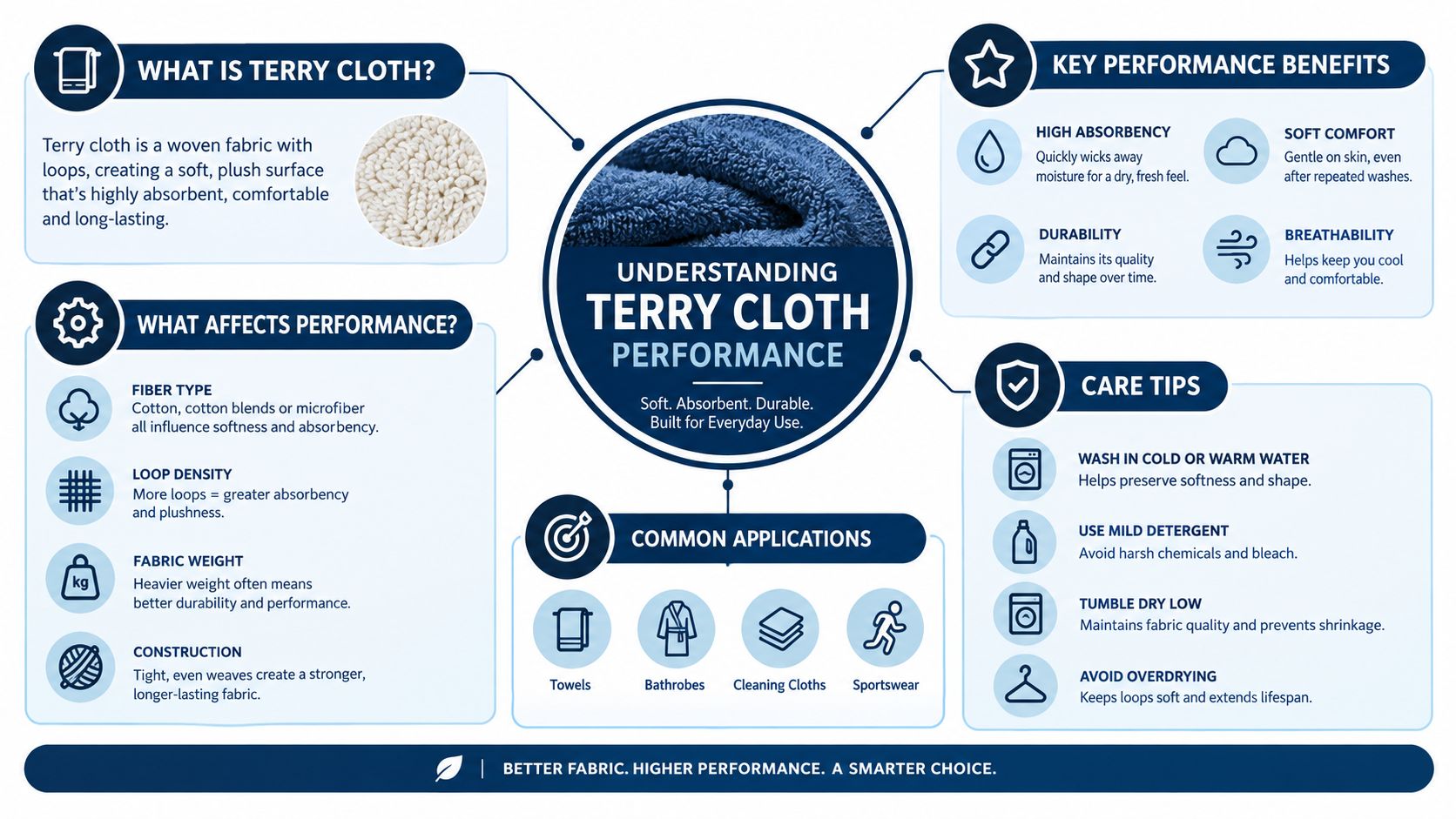
Terry cloth works because its surface is built from loops. Those raised loops increase accessible surface area and create small capillary spaces that draw water away from skin and hold it in the pile. Cotton supplies a washable, relatively durable base, while the loop structure provides the towel-like behavior.
That construction has a long history. Early looped fabrics have been reported in ancient Egypt and pre-Columbian Peru, and linen terrycloth has been dated to approximately 4000 BCE, showing that looped-pile textiles predate modern bathrobes by thousands of years. The modern Western terry industry emerged during the mid-19th century, and the English towel company Christy began industrial production in 1850 after drawing on observations of handwoven terrycloth from Turkey, with the process associated with employee Samuel Holt (terry cloth history).
Why density can mislead
A heavier robe can feel plush in your hands, but weight alone doesn't prove faster drying or better moisture management. Textile-performance research found that increasing thread density reduced absorbency, overall moisture-management capacity, drape, softness, and smoothness. In other words, a dense heavyweight can hold plenty of material while giving water fewer efficient pathways through the surface.
Pile geometry offers a more useful lens. Research on terry construction reports that greater pile height increases GSM, thickness, and tensile properties while reducing sinking time, an indicator of faster wetting and water uptake. Longer loops create more yarn surface and larger capillary pathways, but they also add bulk, laundering time, and wet garment weight (ASTM terry-performance guidance).
What to request from a supplier
ASTM D4772 measures how rapidly terry fabric absorbs and retains surface water, and it applies to bathrobes, beachwear, and related terry products (ASTM D4772 testing standard). That matters because decorative terry isn't automatically functional terry.
Ask for comparisons made under the same prewash condition, including:
- Water-flow absorption: How quickly the sample takes up surface water.
- Drying time: How long the robe remains damp after use.
- Fabric mass and thickness: Useful context for warmth and wet weight.
- Dimensional change: Whether laundering alters the garment's shape.
- Post-wash performance: Whether the loops retain their practical behavior after repeated care.
A medium-weight robe with open, resilient loops may outperform a denser robe after a swim because it absorbs efficiently without becoming a soggy traveling blanket. That's the technical reason to evaluate the whole construction instead of trusting “luxury” or “heavyweight” on a product page.
A visual guide can make the structure easier to read. This terry robe explainer connects the looped surface to everyday use, from the shower to the pool deck.
Choosing Weight, Weave, and Material
Choose the robe by the place where it will dry, not only by the place where you'll wear it. A beach house with salt air, a Tahoe cabin with limited hanging space, and a hotel bathroom each create different demands.
A waffle robe usually prioritizes airflow and low bulk. Chenille brings a plush handfeel but may not offer the same practical loop structure as a functional terry. Blended fabrics can alter softness, resilience, drying behavior, and weight, so the fiber label should be read alongside the construction. Cotton remains commercially important, representing 35.2% of global bathrobe-market revenue in 2025, or approximately $2.92 billion, while terry cloth bathrobes represented 12.9%, or about $1.07 billion, in the same estimate (bathrobe market estimates).
A useful weight map
GSM means grams per square meter. It provides a fabric-mass reference, but it shouldn't be treated as a complete performance score. The table below uses practical targets for different transitions.
| GSM Range | Best For | Absorbency | Drying Time | Packability |
|---|---|---|---|---|
| 300 GSM | Travel, beach, quick post-surf changes | Efficient with an open loop structure | Generally easier to manage | Better for duffels and carry-ons |
| 350 to 400 GSM | Cabin wear, après-ski, mixed shower and lounge use | Balanced moisture pickup and warmth | Moderate, depending on pile and density | Reasonable for weekend travel |
| 450+ GSM | Luxury lounging and colder indoor settings | Plush potential, but not automatically superior | Often slower because more material can retain moisture | Bulkiest option |
The 350 to 400 GSM range makes sense for a robe that has to move between functions. It can bring warmth to a cabin deck without becoming a chore after a shower. For tropical travel or beach-to-bar use, a lighter open terry may be more practical. For a robe that stays beside a deep soaking tub, greater bulk can feel welcome.
Match the weave to the activity
After-surf use rewards fast recovery from moisture and salt. Choose open loops, manageable weight, and a hem that won't drag through sand. Après-ski use adds warmth and layering, so a hood, longer sleeve, or more substantial collar may matter more than the lightest possible construction.
A robe for luxury lounging can prioritize drape and softness. A robe for travel needs to survive the unglamorous parts, including being hung in a humid bathroom, folded into a duffel, and used again before it has enjoyed a perfect drying environment.
The plushest robe is not automatically the smartest robe. The right weight is the one you can dry, pack, and put back into service.
Seams, cuffs, and lining deserve attention too. Reinforced seams support repeated movement. Secure cuffs keep sleeves out of coffee and shampoo. A lining can add warmth, but it also changes drying behavior and packed volume. The best choice depends on whether your robe is primarily a towel you wear, a warm layer, or a bridge between the two.
For a closer look at a relaxed, towel-forward silhouette, see the men's terry cloth hoodie guide. It's a useful reference when you want post-water comfort without committing to a full-length robe.
Fit, Length, and Functional Features
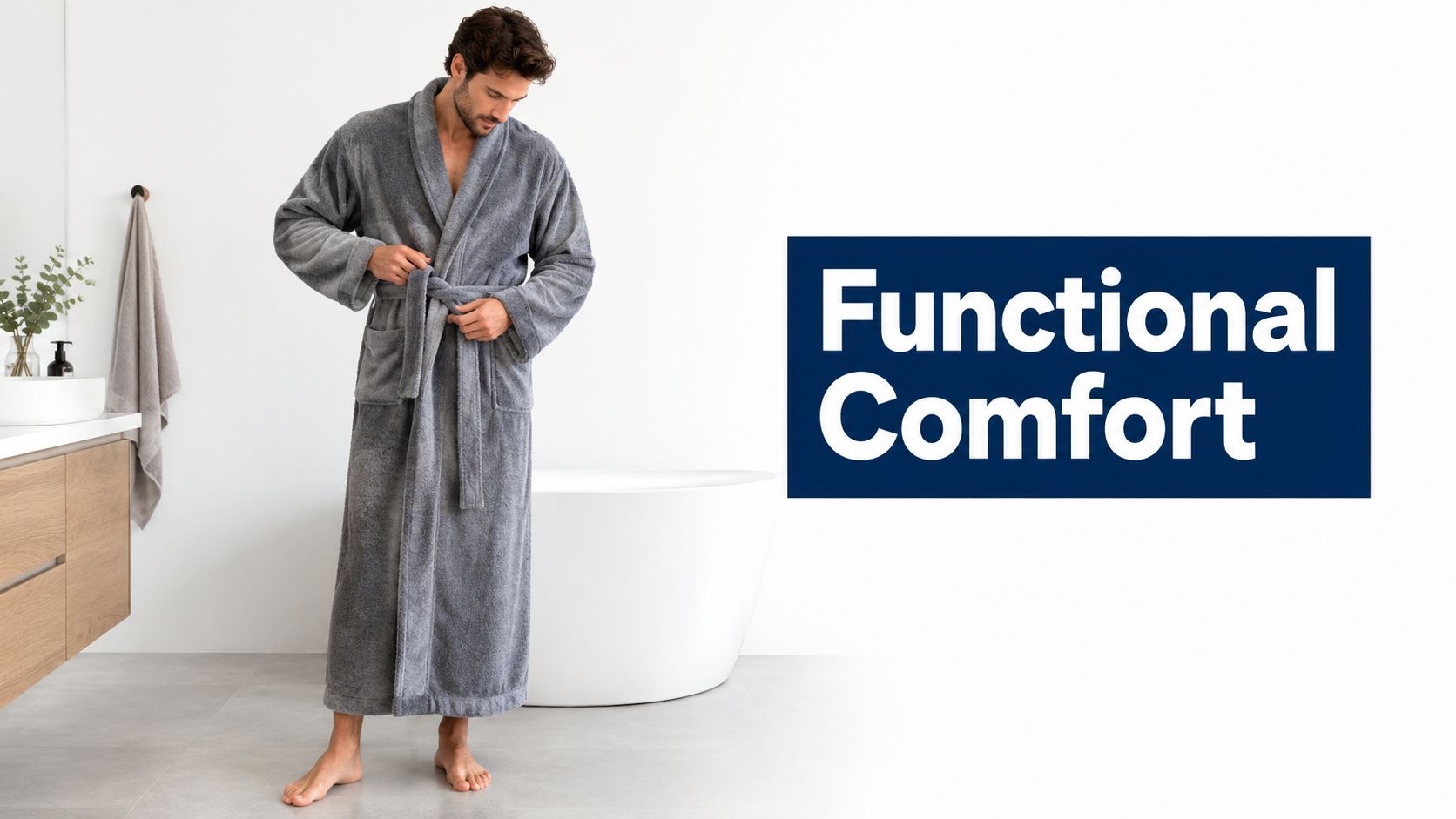
A robe should give you room to move without turning into a fabric parachute. Start with the chest and shoulders, then check the sleeve and hem. You'll want enough overlap to sit down, reach for a mug, or bend toward a boot without the front falling open.
Build the silhouette around the transition
Full-length robes hold more warmth and privacy, which can suit cold cabins and slow mornings. Hip-length or above-the-knee cuts feel quicker and lighter for beach paths, pool decks, and changing areas. An oversized fit layers easily over swim trunks or a thermal base layer, while a more fitted cut can feel neater when guests are already gathered.
Use these checkpoints:
- Chest: The front panels should overlap comfortably without constant belt adjustment.
- Shoulders: The seam shouldn't pull when you reach for a car door or lift a bag.
- Sleeves: Cuffs should leave your hands functional for coffee, grooming, and keys.
- Length: The hem should provide coverage without catching around stairs or wet sand.
- Belt placement: A stable belt loop keeps the tie at the natural waist instead of drifting.
Treat pockets as social hardware
The pocket conversation changes after adventure. A standard kangaroo pocket can carry a phone or keys, but separate storage helps when one item is wet, warm, delicate, or likely to scratch another. A dry pocket protects essentials from the robe's damp exterior. A bottle pocket keeps a drink stable. A sunglasses loop prevents the familiar parking-lot search through towels and seat cushions.
A hood gives wet hair and the neck extra coverage. A shawl collar feels more classic and can sit comfortably around the shoulders. Neither is universally better. Choose a hood for exposed post-water warmth, and a shawl collar for cabin lounging and indoor recovery.
Social spec: Concealed storage lets you holster your tech without losing access to the essentials that keep a gathering moving.
Monogramming and embroidery can add a ceremonial layer for wedding robes, groomsmen gifts, and group weekends. Keep the personalization visible enough to identify the garment, but not so loud that it turns the robe into a uniform you can only wear once.
A practical fit guide can help translate body measurements into the right amount of ease. Use this men's robe fit guide before choosing between a close wrap and a looser cabin-ready layer. The aim is simple: cover the body, preserve mobility, and leave your hands available for the next good idea.
Care, Drying, and Longevity Science
Terry cloth changes in use. Early laundering can improve cotton terry's absorption rate and total water uptake, but performance generally begins declining after roughly eight to ten wash cycles (terry laundering research). That makes care part of the robe's engineering, not an afterthought.
A post-surf robe deserves a quick freshwater rinse when salt or chlorine is present. Hang it fully open rather than leaving it in a heap on the floor of the car. Cabin lounging is less demanding, so airing between wears can preserve freshness without treating every quiet coffee on the deck like a full laundry event.
Reduce friction and excess heat
Fabric softener can coat loops and reduce absorbency. High heat can stress cotton, flatten texture, and make drying feel faster at the expense of long-term handfeel. Cold or cooler washing, measured detergent, and air-drying where practical give the loops a better chance to stay open.
Research has also measured microfiber shedding from cotton and wool at approximately 165 ± 44 milligrams per kilogram per wash, while another comparison found that all tested fabrics released microfibers during laundering. Detergent and higher temperatures increased shedding, and cellulose-based fibers were more likely than polyester to biodegrade in aerobic aquatic conditions (microfiber laundering study).
Use the robe's actual life as the schedule
- After ocean or hot-tub use: Rinse promptly, hang wide, and wash when salt, chlorine, odor, or body oils remain.
- After showers: Let the robe dry completely before returning it to a hook or hamper.
- During cabin weekends: Air it between wears and avoid packing it while damp.
- For regular laundering: Use a cool cycle, modest detergent, and air-drying or low heat when available.
A filter-equipped machine can help capture released fibers, but the simplest longevity move is also the least glamorous. Don't wash a heavy robe more often than its use requires, and don't leave it wet in a closed bag. The robe should come back from each season with its loops useful, its shape stable, and its drying habits under control.
Gifting, Group Outfitting, and Brand Positioning
A terry robe becomes a stronger gift when it marks a shared transition. Wedding morning, bachelor-party recovery, a bachelorette weekend, a cabin reunion, and a spa arrival all contain the same useful moment: people are moving from preparation into celebration.
For a wedding group, matching robes can make the getting-ready room feel organized without forcing everyone into identical formalwear. For groomsmen, embroidery can turn a practical layer into a keepsake. For a bachelor weekend, a robe can handle the unphotogenic hours before breakfast, the post-sauna walk to the deck, and the first round of drinks without demanding another outfit change.
Group gear should work after the photo
The strongest coordinated apparel keeps its usefulness after the event. Choose a shared color or monogram treatment, then let each person select a compatible size and silhouette. A robe with functional pockets can move from wedding suite to hotel pool. A hood can make sense for a surf trip. An above-the-knee cut can suit a warm-weather group better than a sweeping hotel-style hem.
That practical side matters at concerts and festivals too. A 2024 Verizon survey found that 85% of live-music attendees expected venue connectivity for calls and texts, while 62% frequently took photos during events (Verizon live-music survey). People may want to stay present, but they still need access to communication, documentation, and payments. A dry pocket or discreet storage feature makes it easier to holster your tech without turning the phone into the centerpiece of the outfit.
Make the buying process as intentional as the gift
Hospitality and event buyers should evaluate supplier consistency, customization, minimums, fulfillment, and care requirements before placing a group order. Avistar's supplier selection framework offers a useful way to think through those operational questions, especially when robes need to arrive together and perform consistently across a group.
A good group brief should specify:
- Use setting: Beach, pool, spa, cabin, wedding suite, or event venue.
- Construction: Terry weight, loop structure, lining, and drying expectations.
- Fit range: The available size spread and preferred amount of ease.
- Personalization: Monogram, embroidery placement, shared color, or individual name.
- Aftercare: Washing instructions that every recipient can follow.
California Cowboy's approach fits this category through robes and apparel built around post-adventure comfort, concealed storage, and social use. The El Garibaldi Robe is one option, with towel lining, a dry pocket, bottle pocket, sunglasses loop, and interior-tie belt. It's available in sizes S/M, L/XL, and 2XL/3XL, with a loose fit and above-the-knee length.
For wedding-specific planning, browse the custom bridal party robes guide. The same logic works for bachelor party outfit ideas, unique groomsmen gifts, coordinated group gear, and personalized apparel for corporate retreats. A robe is most convincing when it keeps working after the group photo has been posted.
Complete the Look
Start with the robe, then add pieces that support the next scene. A cap keeps wet hair and bright mountain light manageable. A soft tee gives you an easy base layer once the robe comes off. A koozie keeps the drink cold while the group argues about the best run, wave, or parking-lot playlist. For a mountain weekend, pair it with High Sierra gear and relaxed cabin wear. For the coast, build around beach lifestyle apparel and post-surf comfort.
California Cowboy offers robes and social apparel designed for the stretch between adventure and gathering, including functional storage, towel-forward comfort, and customization for group occasions. Visit California Cowboy to choose a robe for your next surf-to-sand drive, ski-to-tailgate evening, wedding weekend, or cabin-deck coffee, then join the Vital Few newsletter for first access to new drops and group-focused offers.

