


Salt dries tight on your forearms. Wax clings to the tailgate. Your wetsuit is peeled to the waist, the wind has found the gap at your ribs, and someone is already asking whether the crew is heading for coffee, tacos, or the first drink. The session ended, but the day hasn't. That awkward, chilly stretch between water and civilization is where a good surf dressing gown earns its keep.
It should dry you, cover you, warm you, and hold the small gear that otherwise gets abandoned on a car roof. Better still, it should help you stay present. Holster your tech, look socially confident, and leave room for serendipitous encounters instead of rushing home in a damp towel.
What Is a Surf Dressing Gown and Why It Matters
A surf dressing gown is a wearable changing room, towel, warmth layer, and casual outer garment in one. You throw it on as soon as you exit the water, change underneath it, and keep wearing it through the drive home, the coffee queue, or the parking-lot conversation that somehow becomes dinner.
The category makes more sense when you understand where robes came from. Western dressing gowns developed from Asian-influenced banyans, loose T-shaped robes introduced to Europe through trade during the 17th century. By the 1670s, London had at least five merchants specializing in “morning gowns,” evidence that the garment had become an established luxury and leisure category rather than a novelty. The later smoking jacket shortened the form to protect clothing from tobacco odors, while the bathrobe took on the post-bathing job. The term “bathrobe” appears in English from 1894, while “dressing gown” had acquired its modern meaning by 1854. The history of men's dressing gowns and bathrobes traces that progression in useful detail.
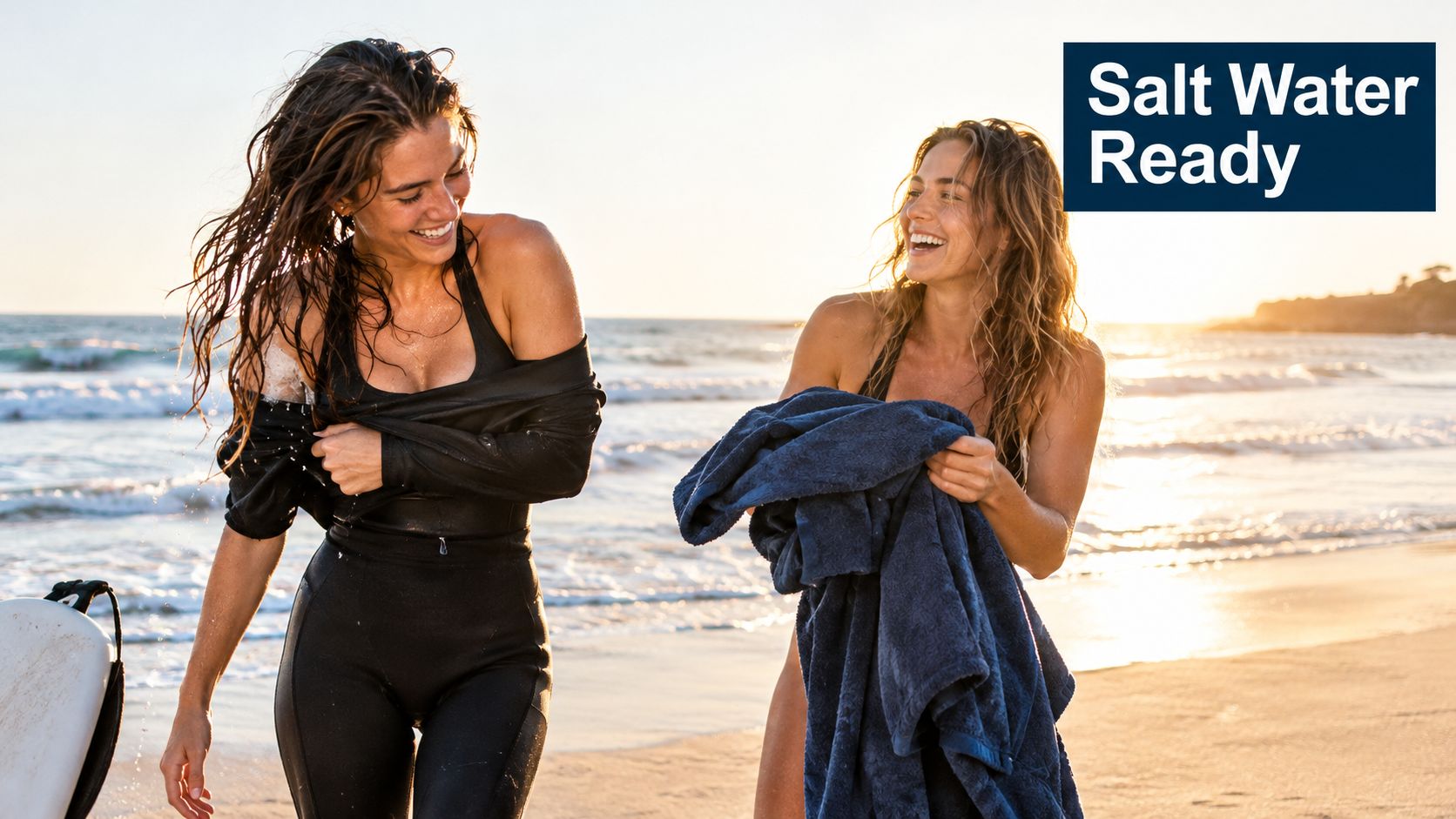
From private robe to public transition layer
The modern surf version sits closer to a bathrobe than a conventional dressing gown. A traditional dressing gown mainly provides coverage and warmth over sleepwear or clothing. A surf dressing gown has to handle seawater, wind, changing privacy, and rapid movement from water to land without looking like bedroom attire.
That shift followed improvements in bathing and the growth of recreational swimming. In New York City, only about 3% of apartments had baths or showers in the early 1890s, compared with 89% by the 1930s, an 86-percentage-point increase and nearly thirtyfold expansion in household access. This history of the robe's association with bathing shows how greater bathing access, beach leisure, and the need for modesty pushed robes into practical post-water use.
Practical rule: The robe isn't the end of the surf day. It's the piece that lets the rest of the day happen.
That's the Social Technical idea. Clothing should solve physical problems while supporting real-world connection. A towel can dry you, but it can't always carry your phone securely, cover you while you change, or make a beach-to-bar stop feel intentional. A surf dressing gown can do all four without asking you to disappear from the group.
For a closer look at the garment's material heritage, read this guide to what a terry robe is. If your day includes saltwater, metal accessories, or wet hands, a practical ocean jewelry buying guide can also help you avoid pairing coastal gear with pieces that don't handle the environment well.
The Social Technical Features That Define Quality
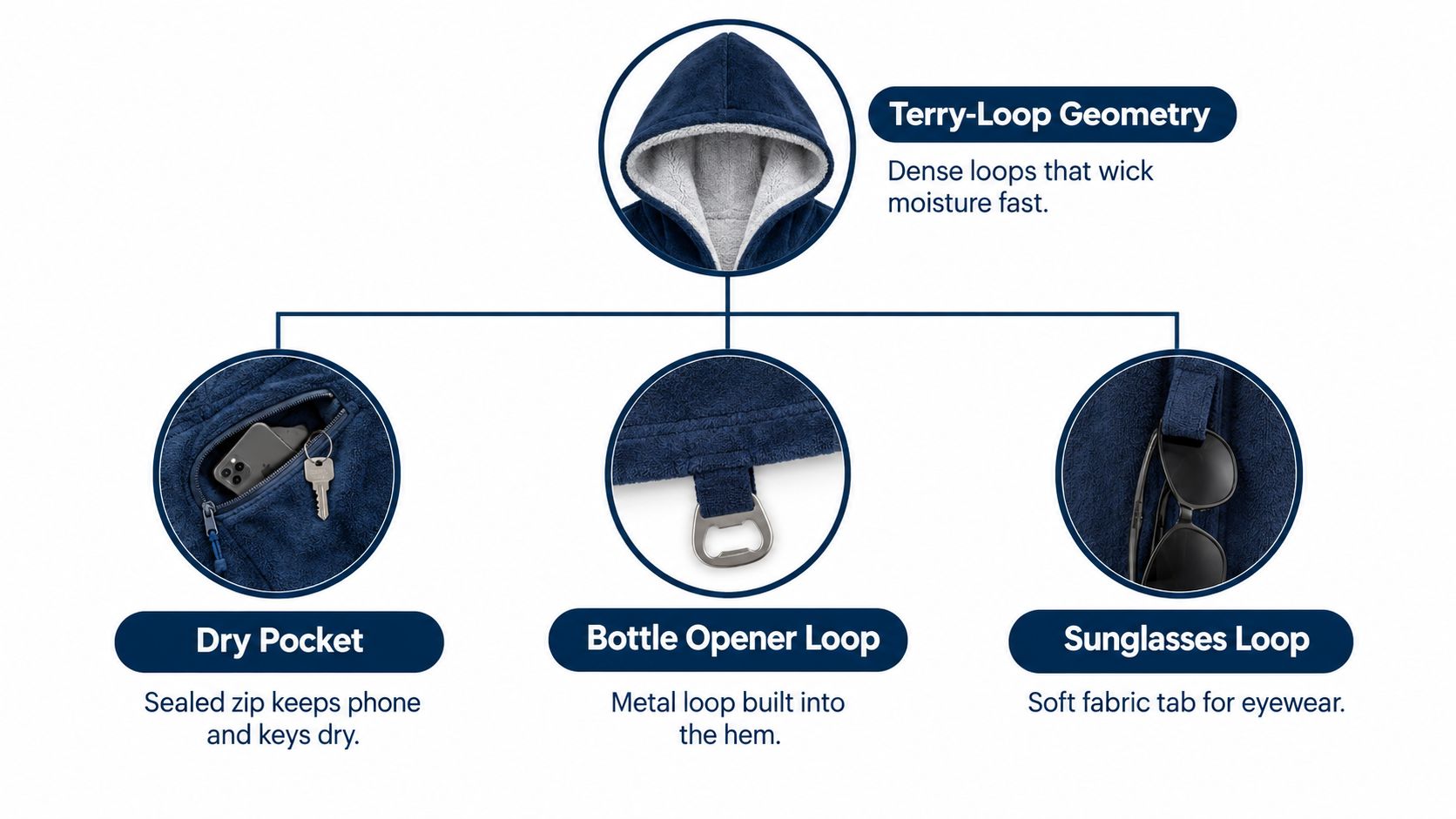
Not every towel-lined hoodie deserves to be called technical. Some are little more than a cotton shell with a vague promise of absorbency. The meaningful work happens inside the fabric, at the level of terry-loop geometry, fiber composition, pocket construction, and coverage.
A peer-reviewed terry-fabric study found that a construction around 500 g/m² with 3.5 mm twisted loops delivered a strong combination of water absorption and durability. Two tested fabrics reached 324% water absorption relative to dry mass, meaning they absorbed roughly three times their dry weight under the study's test conditions. The terry-fabric research also highlights the unavoidable trade-off. More fabric can absorb more water, but it adds bulk, mass, and drying demand.
Fabric details worth asking about
Cotton matters, but cotton alone isn't a specification. Research comparing terry constructions found that 100% cotton samples generally absorbed more effectively than blended versions, while finer micro-cotton fibers produced the highest measured absorbency in the tested group. Ask about the fiber content, lining weight, and loop construction instead of accepting “towel-lined” as the whole story.
Loop density changes the experience. Dense, substantial loops can pull residual water from skin and swimwear quickly. They can also make the robe slower to dry between sessions. A lighter construction may be easier to pack and more practical for tropical travel, but it won't provide the same immediate towel-like feel.
The outer face deserves equal attention. A clean, structured shell helps the garment read as beach lifestyle apparel rather than emergency changing equipment. That distinction matters if you're heading from the surf shop to a café, or from the beach house to a market without changing twice.
Functional features that earn their space
- Dry pocket: A sealed or zipped compartment keeps a phone and keys away from wet terry and sandy surfaces.
- Hood coverage: The hood should protect your head and neck without blocking peripheral vision while you walk, change, or carry a board.
- Sunglasses loop: A soft external tab gives eyewear a predictable home instead of burying it in a pocket.
- Bottle opener loop: A metal loop built into the hem is useful when the parking lot tailgate becomes the evening plan.
- Pocket placement: Pockets should remain accessible while the robe is closed and while your hands are occupied with a wetsuit.
A feature only matters if you can use it without interrupting the conversation. That's the test. If you're still babysitting your phone, shades, and drink, the garment hasn't finished the job.
For another technical look at premium construction, see this guide to luxury terry cloth robes.
How to Choose Your Perfect Surf Dressing Gown
Choose by the transition you make, not the fantasy version of your surf life. A robe for a cold, windy beach and a robe for a warm-water swim may share a silhouette, but they shouldn't necessarily share the same fabric weight or outer construction.
Start with the conditions. Cold water and exposed wind favor greater coverage, absorbent terry, and a protective hood. Warm water and a short walk to a beach bar may favor a lighter robe that packs easily and releases moisture faster. If you drive a long way after surfing, bulk becomes more important than it is for a robe that hangs at a beach house.
Match the garment to the scene
Your intended destination changes the specification:
- Parking-lot changing: Prioritize generous length, secure closure, roomy arm openings, and enough volume to change underneath without wrestling the garment.
- Beach-to-bar use: Look for a shaped outer face, restrained color, functional pockets, and a fit that doesn't swallow your frame.
- Cabin or house weekend: Choose warmth, relaxed layering room, and a construction comfortable enough for morning coffee after the gear is dry.
- Travel between sessions: Favor manageable weight, fast airflow, and a design that doesn't occupy half the luggage.
Fit is less about a tight size chart and more about movement. You need room through the shoulders to pull off a wetsuit, enough sleeve length to cover your wrists, and a hem that protects the upper legs while you change. A robe that's too narrow turns changing into a shoulder workout. One that's excessively oversized can catch wind, drag through sand, and feel awkward once you leave the beach.
A buyer's inspection checklist
Before buying, check the following:
- Stress points: Inspect shoulder seams, sleeve joins, pocket openings, and the belt or closure attachment.
- Terry exposure: Confirm that the absorbent lining reaches the areas that contact wet skin, not just the hood.
- Pocket operation: Test zips and openings with one hand. Wet fingers aren't a friendly environment for fiddly hardware.
- Hood visibility: Put it up and walk. If it blocks your view, it fails a basic safety and comfort test.
- Packability: Consider whether the robe will live in a car, beach bag, cabin, or checked luggage.
A robe built purely for beach changing can be excellent at that narrow job. A Social Technical robe goes further, carrying you through the beach-to-bar-to-cabin continuum. The right choice depends on which handoff matters most.
You can compare the silhouette and coverage of a hooded robe before committing to a particular use case.
Fabric Performance Across Different Climates
A surf dressing gown doesn't perform in a vacuum. Wind, humidity, sunlight, water temperature, and the distance to the next dry surface all change what “comfortable” means.
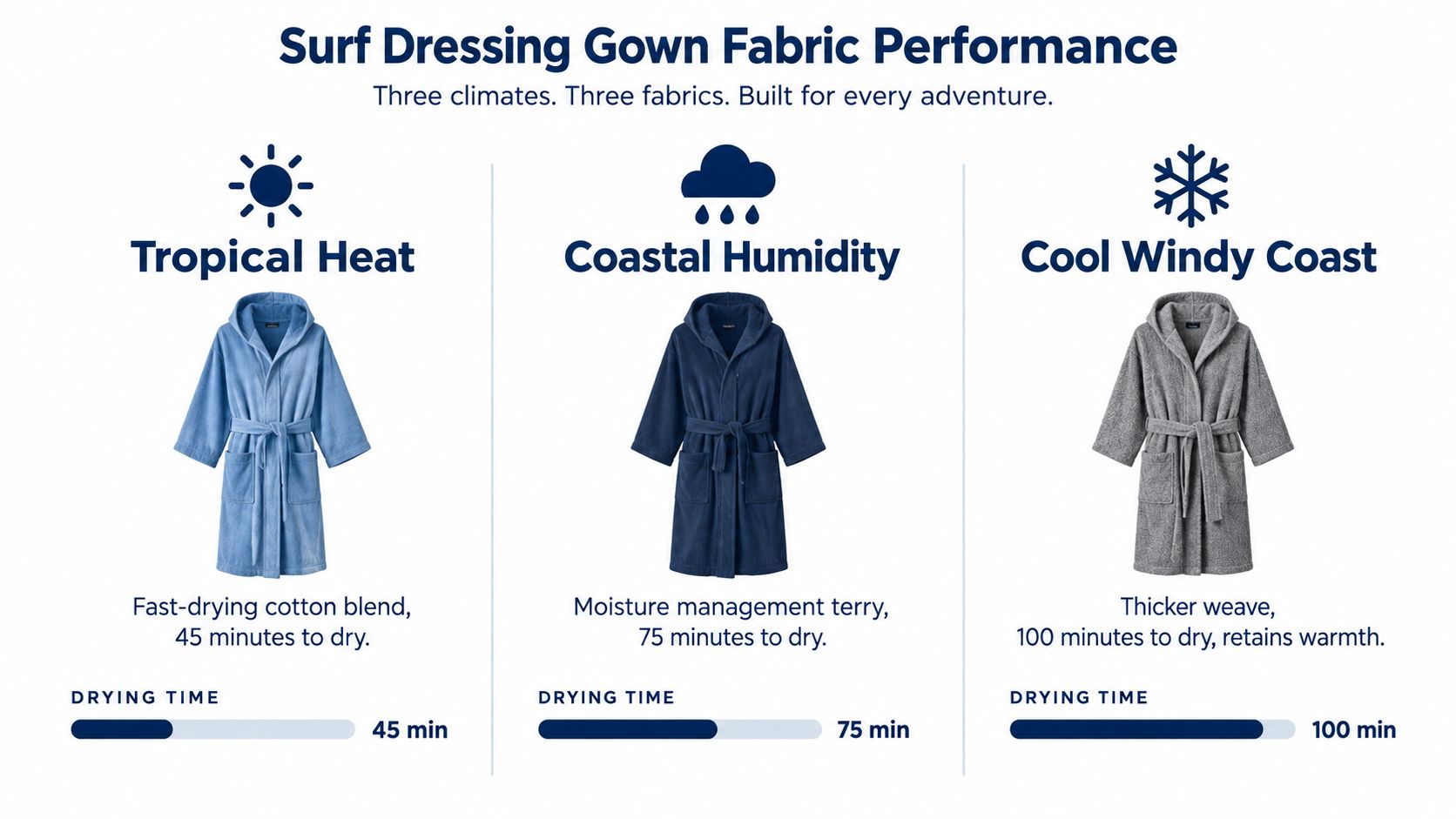
A heavy terry robe makes sense on a cool, exposed coast. It pulls moisture from the body and gives you coverage while you change. In tropical heat, that same density can become a damp load you carry around for the rest of the afternoon. A lighter construction may feel less luxurious at the water's edge but become more useful once you're walking, driving, and storing it between sessions.
The heat-loss problem
Medical guidance for cold-water surfing identifies evaporative heat loss as a meaningful contributor to cooling when wind accelerates evaporation from wet skin and clothing. Put the robe on immediately after exiting the water. It should cover the torso and upper legs while you change, reducing the exposed wet surface area and limiting convective airflow. Cold-water surfing and hypothermia guidance supports treating the robe as a changing and warmth-management layer, not a replacement for dry insulation in severe conditions.
Thickness has consequences
A dense lining can retain warmth while holding more water. That means it may feel better immediately after a cold session but take longer to become ready for the next one. A lighter or blended construction can reduce the load during travel, though it may sacrifice some absorbency.
Environmental impact adds another layer. Research indicates that some textiles release dramatically more fibers than others, with certain materials shedding over 800 times more fibers than comparable alternatives. The same research notes that thickness can correlate positively with shedding in nylon and polyester. This overview of microfiber pollution and textile choices makes the practical point clear: thicker isn't automatically better.
For surf clubs and group trips, hang the gown fully open in moving air. Don't leave it compressed in a vehicle or buried in a beach bag. Drying depends on exposed surface area and retained moisture, not optimism.
Styling Your Surf Robe From Beach to Bar
The best post-surf outfit doesn't look like a costume change. It looks like the next logical layer. You finish changing behind the robe, pull on clean trunks or relaxed trousers, and keep the same piece on while the group decides whether the day ends at the beach house, the coffee counter, or a patio with a view.

A robe worn open over swimwear reads coastal and relaxed. Fully closed, it becomes a private changing room and a stronger warmth layer. Over a tee with drawstring trousers, it can move toward cabin wear without looking like you wandered out of bed by mistake.
Build around one anchor piece
Keep the rest simple. A clean tee under the robe gives you an easy base. Boardshorts work for the first stop, while washed denim or relaxed cotton trousers make the outfit more convincing in town. Slides suit the beach. Sneakers or simple boots make more sense when the day extends into shops, dinner, or a drive along the coast.
Color does quiet work here. A deep navy, washed olive, sand, or charcoal robe can carry brighter swimwear without making the entire outfit shout. Add one useful accessory, such as a cap, sunglasses, or a koozie. The goal is to look ready, not overproduced.
For a practical packing reference, this beach bag buying guide is useful when you're deciding how to carry a robe, dry layers, and small essentials without turning the day into luggage management.
The same logic works beyond surfing. A robe can cover the drive home from the beach, the first drink after the lifts close, or the morning coffee on a cabin deck. Après isn't only a ski term. It's the social life that starts when the main activity ends.
If the day includes a longer coastal hang, the ideas in coastal weekend outfits help keep the layers relaxed without losing shape. A good surf dressing gown should support that ease. It lets you stay in the conversation rather than retreating to a car for a full reset.
Customization and Group Gifting Opportunities
A personalized surf dressing gown turns a useful layer into a record of a particular trip. Add a name, initials, date, or small group mark, and the garment becomes easier to identify in a house full of wet towels while also carrying the memory of the weekend forward.
That makes customization especially practical for wedding mornings, surf retreats, bachelor weekends, and bachelorette weekends. Coordinated robes create belonging without forcing everyone into identical novelty outfits. The better approach is a shared color family, a restrained mark, or a detail that looks good after the event has ended.
Group budgets make that restraint important. A 2025 budget analysis reports average per-person spending of about $1,300 for bachelorette events and $1,500 for bachelor parties, increases of approximately $600 and $440 compared with 2019. Activities and experiences account for 35% of total budgets, up from 20% in 2019. The bachelorette budget analysis also reports that about 52% of guests incur credit-card debt, so reusable group apparel should justify its place rather than becoming disposable event clutter.
Coordinated doesn't mean loud
A good group order should work after the weekend. Consider:
- Subtle embroidery: Initials or a small date keeps the robe wearable beyond the celebration.
- Shared palette: Matching tones create a group look without turning the beach into a uniform inspection.
- Useful placement: A chest, cuff, or hem mark is less intrusive than a giant back graphic.
- Early confirmation: Custom work can affect sizing, quantities, and delivery timing, so settle the roster before ordering.
Destination choice changes the pressure on the group budget. Reported average costs are about $2,000 per person when guests fly and roughly $900 when they drive. Short bachelor weekends of one to two days average around $1,300 per person, while three- to four-day events rise to approximately $1,650. Comparable bachelorette costs are about $1,135 for one to two days and $1,630 for three to four days. This comparison of bachelor and bachelorette party costs makes a practical case for items that travel from beach to dinner to the next morning.
For custom group options, personalized group gifts are a useful place to start. The winning robe isn't the one that photographs loudly for one night. It's the one people keep reaching for when the next adventure arrives.
Care, Storage, and Long-Term Performance
Saltwater care starts before the washing machine. Rinse the robe with fresh water after a session, especially if it has metal hardware, a zipper, or dense terry loops. Remove sand from pockets and seams, then hang the garment fully open where air can move through both sides.
Don't store it damp overnight if you can avoid it. A compressed robe in a car, closed beach bag, or humid bathroom gives odor and microbial buildup a head start. If immediate washing isn't possible, rinsing and open-air drying are far better than sealing the garment wet and hoping tomorrow solves it.
A lower-impact care routine
Hotter washing isn't automatically more hygienic for this kind of garment. A shorter, cooler, lower-friction cycle followed by thorough air drying can reduce fabric stress and may reduce fiber release compared with harsher laundering. Textile laundering can release between 0.1 million and 6.3 million microfiber pieces per kilogram of wastewater during an initial wash, while tumble drying can add airborne fiber emissions. Research on microfiber release from textile care also indicates that longer cycles, higher temperatures, and greater water volumes can increase shedding.
Use mild detergent, avoid unnecessary wash cycles, and follow the garment's care label. Tumble-drying may be acceptable for some cotton constructions, but excessive heat can stress loops, trims, elastic, and closures. Air drying is the safer default when you have the space.
Hang it open, rinse salt early, and don't make the robe live in the trunk. Those three habits do more for longevity than heroic washing ever will.
Storage should preserve the loops and the shape. Fold only when the robe is completely dry, keep heavy objects off it, and leave pockets empty. A surf dressing gown earns its place through repeated transitions, from cold water to warm conversation, from beach parking lot to bar, and from the last wave to whatever comes next.
California Cowboy offers terry-lined robes and other social apparel built for post-adventure transitions, with practical details for drying off, carrying essentials, and staying comfortable beyond the water. Visit California Cowboy to find a surf-ready hero layer, then join the Vital Few for product drops and ideas for living more of the day offline.

