


Your boots are finally off. Woodsmoke hangs in the cold air, someone's working on dinner, and your phone keeps buzzing from the jacket you abandoned by the door. You're not getting back on the mountain. You're deciding whether that first drink happens inside or out on the deck.
That's where a men's quilted flannel shirt jacket makes sense. Not during the heroic part. During the good part afterward, when you want something comfortable enough to settle into and sharp enough to keep the evening going.
The Transition Moment After the Adventure
The tailgate drops. Somebody produces a bag of chips that's mostly crumbs. Your friend who swore they were heading straight home has suddenly found a chair.
This isn't a performance test. It's the transition moment, that wonderfully unscheduled stretch between doing something outside and spending time with the people who did it with you. Your ski shell has earned a rest. Your damp base layer needs changing. Nobody needs another conversation about vertical feet.
Dress for the invitation you haven't received yet
A shirt jacket belongs in the passenger seat, ready for the unplanned stop. Pull it over a dry tee before the first drink after the lifts close. Leave it beside the cabin door for morning coffee. Bring it when the beach parking lot starts smelling less like sunscreen and more like somebody's dinner.
The appeal isn't complicated. You want comfortable warmth, easy movement, and an outfit that doesn't require a wardrobe change in a restaurant bathroom. You also want to look socially confident without looking like you packed a costume for being outdoors.
Holster your tech. Leave a hand free for the person handing you a coffee.
That's the life offline approach to getting dressed. The layer should help you stay present, not become the evening's main subject. Serendipitous encounters rarely arrive with a packing list.
Your after-adventure brief
Choose the garment around the moments you enjoy:
- The mountain stop: Enough room for the dry layer you change into after skiing.
- The coastal detour: A lining suited to your moisture needs, rather than an assumption that every soft shirt works like a towel.
- The cabin morning: A comfortable collar, usable pockets, and sleeves that don't fight your coffee-making routine.
For more outfit context, the guide to men's après-ski wear focuses on that shift from mountain equipment to off-duty clothing.
A worthwhile purchase comes down to what this hybrid is, how its layers are built, how warm it runs, and whether the fit suits your plans. Styling and care matter, too. The goal is a familiar companion, not another expensive object living permanently in your trunk.
What Is a Men's Quilted Flannel Shirt Jacket
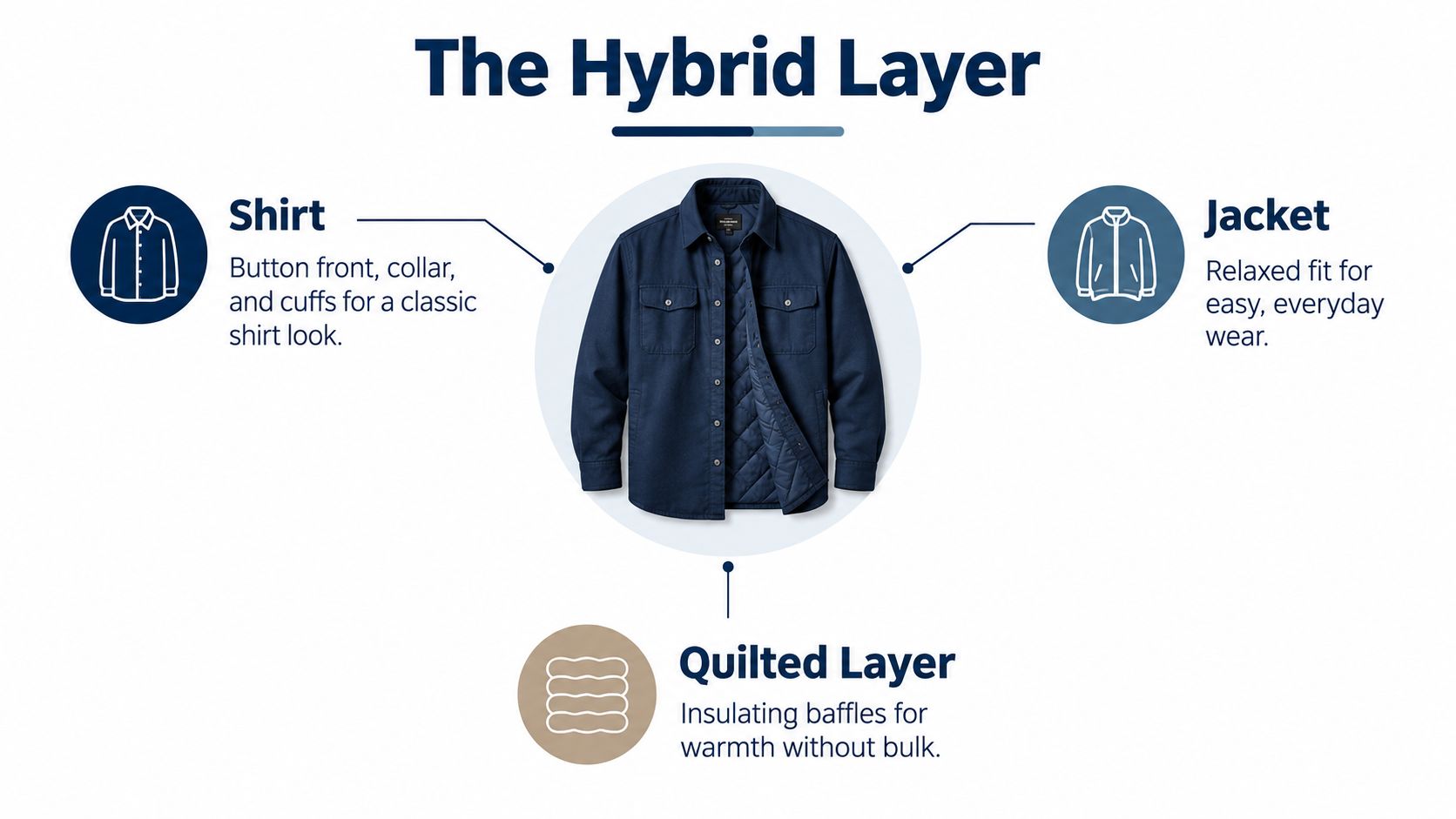
Take a button-front shirt. Give it enough room to wear over another layer. Add an insulated, quilted construction. You're looking at a shirt jacket, sometimes called an overshirt, with a little more cold-weather ambition.
Its identity comes from the combination. The collar, cuffs, and front fastening keep the shirt-like appearance. The outer-layer fit makes room for clothing underneath. Quilted sections hold the layered assembly together.
This visual breaks down the hybrid.
A textile history older than your cabin playlist
Flannel didn't begin as shorthand for checked weekend shirts. The Newtown Textile Museum's history of flannel traces its name to the Welsh word gwlanen, meaning wool, and describes the original fabric as plain- or twill-woven cloth made from wool yarn.
The same museum documents its appearance in Shakespeare's The Merry Wives of Windsor by the early 17th century, giving the word roughly four centuries of documented English-language use in that account. That's a substantial backstory for something you might wear while debating whether the fire needs another log.
Heritage, however, isn't a specification. A historical connection doesn't tell you how a modern garment fits, what its filling contains, or whether its seams can tolerate your weekend habits.
Where it belongs in your wardrobe
An ordinary uninsulated flannel shirt is the simpler option when you want a shirt, not outerwear. A quilted version adds another construction layer and a different wearing role. A technical puffer belongs to a separate comparison, where you should evaluate the garment's actual protection and insulation specifications.
| Garment | The purchase question |
|---|---|
| Regular flannel shirt | Do I want a comfortable shirt to wear alone or underneath outerwear? |
| Quilted flannel shirt jacket | Do I want an insulated overshirt for relaxed, changeable plans? |
| Technical outerwear | What protection does my activity and forecast require? |
Keep activity clothing separate from after-activity clothing. If your weekend also includes riding, Rider 18's premium road cycling jacket is a useful category comparison to consider alongside a social overshirt, rather than treating both purchases as interchangeable.
Different assignment. Different jacket.
Materials and Construction Explained
Turn the garment inside out before falling in love with the plaid. The inside often gives you more useful buying information than the photograph of somebody leaning against a vintage truck.
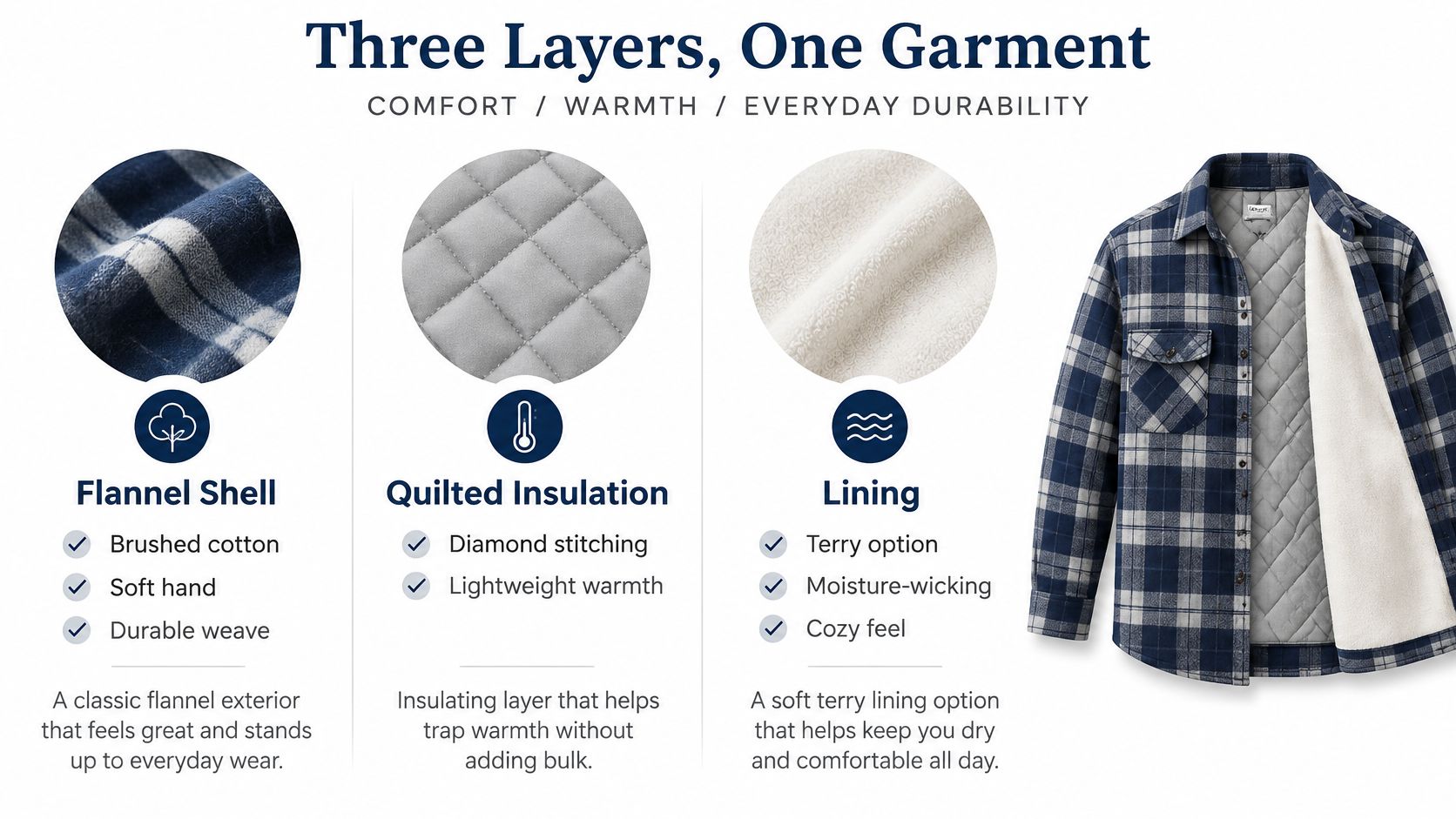
You're evaluating the shell, the insulation assembly, and the lining. Each deserves its own question. What touches the outside world? What supplies insulation? What sits against your clothes or skin?
Use this layered illustration as a starting point, then check the actual product description.
Read beyond the soft-focus adjectives
For the flannel shell, look for disclosed fiber content and fabric weight. Compare how the fabric bends at the elbow, sits across the shoulders, and feels against the neck. Don't substitute “substantial” or “premium” for information the seller hasn't provided.
For the quilted assembly, ask what's inside. Look for the filling material, batting weight where available, and an explanation of the intended use. Diamond stitching and straight channels describe appearance, but the pattern alone doesn't establish performance.
For the lining, decide what you need it to do. A lining chosen for slipping over a sweater answers a different need from terry selected for post-water comfort. Not every quilted flannel contains terry, and a terry-lined shirt isn't automatically quilt-insulated.
The guide to men's plaid flannel shirts offers another starting point for comparing the shirt side of the category. Keep the construction questions beside the style questions.
Terry is an engineered fabric, not a magic word
Research on looped terry construction and liquid uptake identifies fabric weight, thickness, pile-yarn twist, pile height, and pile density as important absorbency variables. Its loops increase the surface area available to capture moisture, while cotton and flax are hydrophilic fibers that attract and retain water.
That supports the logic of a terry-lined après-surf layer. It doesn't establish that every cotton lining will handle a wet shoreline equally well.
- Ask about structure: “Cotton” identifies fiber content, not the complete absorbency behavior.
- Separate uptake from drying: Absorbing water and becoming dry again are different jobs.
- Match the lining to the outing: A cabin layer doesn't need to double as your beach transition layer.
Testing of terry fabrics with different fiber compositions found surface absorbency more closely related to structural parameters than composition alone, while drying was closely connected with fiber composition.
Buy the construction you need, not the adjective you like.
How Warm Is It Really
“Quilted” isn't a temperature rating. Neither is “cozy,” although it does look excellent next to a photograph of a fireplace.
A peer-reviewed study of five outdoor-clothing quilted fabrics measured thermal resistance ranging from 0.026 to 0.120 square meters-kelvin per watt. The highest-performing sample provided more than four times the thermal resistance of the lowest-performing sample in that test set.
Those results describe the tested materials, not the jacket in your shopping cart. They demonstrate why you can't assign a universal warmth level to the word quilted.
Use a range as a starting point
Coverage of lightly insulated quilted jackets places them broadly in the 40–60°F range, while treating them as mid-layers rather than primary winter protection below freezing. That's a general shopping guideline, not a tested rating for a particular flannel.
Your movement, exposure, humidity, wind, and clothing underneath change the practical decision. Walking toward dinner and sitting outside through dinner aren't the same assignment.
Warmth Scenarios for a Quilted Flannel Shirt Jacket
| Scenario | Temperature Range | Recommended Layering | Verdict |
|---|---|---|---|
| Stationary beside a fire | Within the cited mild-weather band, conditions permitting | Dry merino layer or sweater underneath; heavier outerwear available | Treat the fire as atmosphere, not your complete warmth plan |
| Walking through a village | Within that same guideline, adjusted for exposure | Tee or merino base; add a hoodie if needed | A practical use when the garment suits the forecast |
| Moving from beach to bar | Mild conditions, with wind and dampness assessed separately | Change into a dry tee; choose lining deliberately | Don't ask the jacket to compensate for wet clothes |
| Extended winter exposure | Below-freezing conditions | Appropriate winter outerwear, with the shirt jacket as a possible mid-layer | Not a substitute for a parka or technical shell |
The warmer option isn't always the better option
For social indoor-outdoor wear, my preference is adjustable comfort over maximum bulk. You should be able to open the front, remove the layer, or change what's underneath without rebuilding your outfit.
Practical rule: Plan for the coldest part you'll actually sit through, not just the warmest part you'll walk through.
Quilting also doesn't establish wind or water protection. Look for explicit product specifications before relying on either. For a fuller clothing system, use the guide to thermal layering for ski trips.
Choosing the Right Fit and Features
Try it on over the clothes you'll wear. A jacket that fits beautifully over bare arms in a fitting room may feel very different over your favorite hoodie.
Start with your measurements and compare them with the seller's size chart. Check whether the chart gives body measurements or finished-garment measurements. The guide to how to measure for a shirt helps establish a useful baseline.
Run the cabin-deck test
Reach forward as though you're taking a mug from someone. Sit down. Fold your arms. Fasten the front over your intended base layer.
You're looking for usable room without excessive fabric gathering around your middle. Check that the collar feels comfortable closed and that the cuffs work with your wrists, watch, and preferred sleeve position.
- Shoulders and back: Reject obvious pulling when you reach forward.
- Front closure: Compare buttons and snaps by handling them, not by assuming either is automatically better.
- Pockets: Try the openings with the items you carry, while avoiding overloading them.
- Hem and sleeves: Sit down and move naturally before deciding the proportions work.
Coastal shoppers can also compare the outfit context in Blitz Surf Shop's guide to casual shirts for coastal living. Use it as a style reference, then make the fit decision on your own body.
Make Social Technical features earn their space
Social Technical is a useful idea when the detail solves a real problem. A champagne pocket, hidden storage, or bottle-opener loop should have a job beyond looking clever in a product description.
The Social Spec
A dedicated pocket can keep a useful item accessible during a gathering. Before buying, confirm the pocket's intended contents, closure, position, and care requirements. Champagne pockets, dry pockets, sunglasses loops, and bottle-opener loops are model-specific features, not standard equipment on every shirt jacket.
Don't treat “hidden” as “secure” or “dry” as a waterproof certification. Ask for the actual specification.
Finish by inspecting the quieter details. Look for tidy quilting, intact lining seams, secure fastenings, and reinforced-looking pocket attachment points. Ask about repairs and replacement hardware if those services matter to you.
For mountain cabin weekends, prioritize your layering fit. For coastal evenings, scrutinize the lining. For social events, choose storage you'll use without turning your torso into a cluttered utility drawer.
Styling for Après-Ski, Coastal, and Social Living
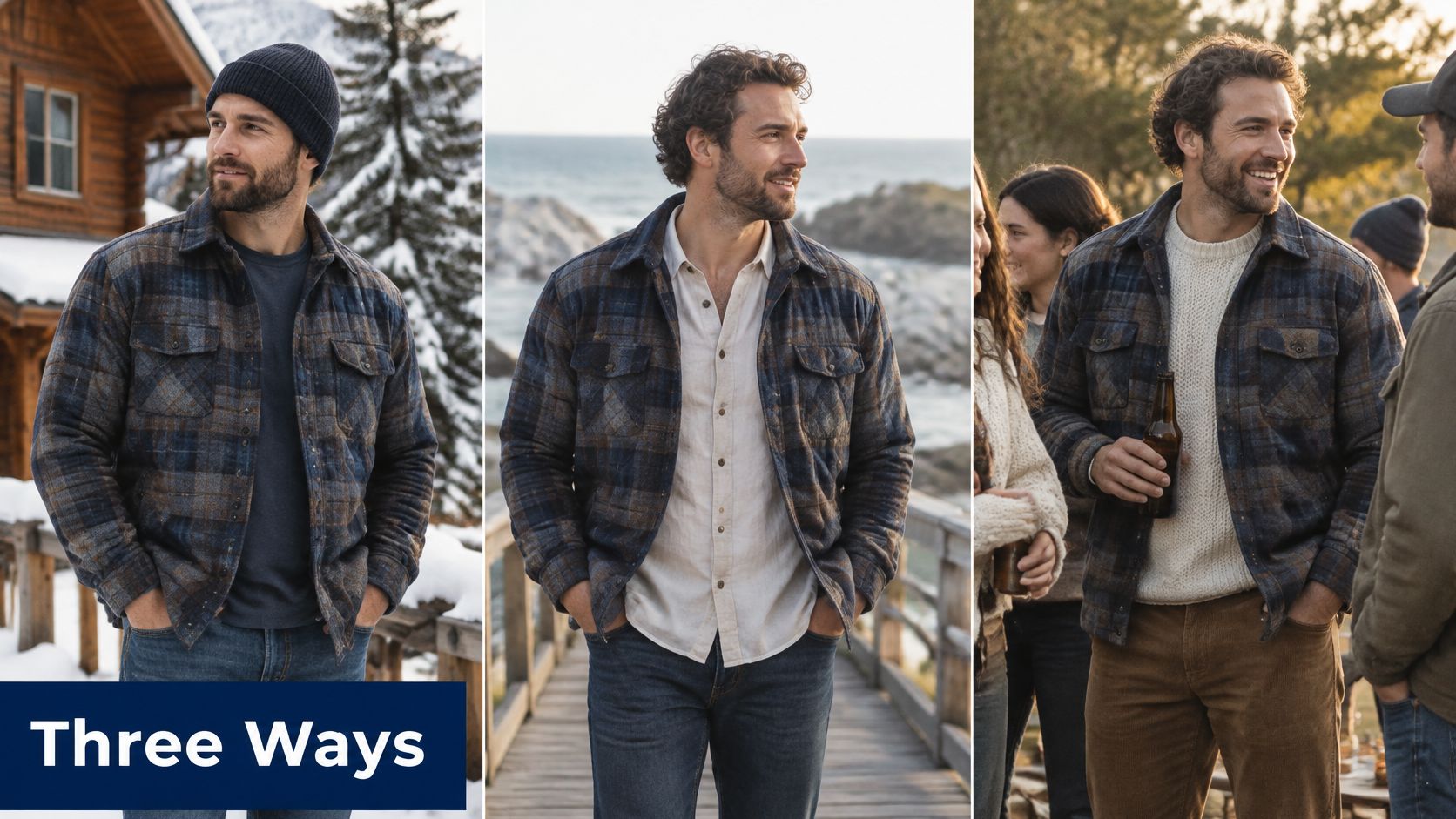
The same overshirt can join very different plans. The trick is to change the supporting clothes rather than asking a mountain outfit to impersonate beachwear.
These combinations show how the silhouette can shift.
After the lifts close
You've changed out of your ski clothes. There's a table outside, and someone's already ordered fries for everyone. Wear the shirt jacket over a dry merino tee, with cords or jeans and a beanie.
If the fit allows a hoodie underneath, keep the rest uncomplicated. Let the flannel provide the pattern. You don't need to dress like every item in the gear cupboard won an argument.
- Base: Dry merino tee or a comfortable hoodie.
- Bottoms: Jeans or cords you can sit in comfortably.
- Accessories: Beanie and a koozie for the gathering, not another technical harness.
From the water to somewhere with chairs
For coastal plans, choose a terry-lined version when that construction suits your needs. Wear it with swim shorts during the initial changeover, then switch into a dry linen tee and chinos when dinner becomes a possibility.
The guide to coastal comfort clothing gives that beach-to-bar wardrobe its own context. Terry-lined shirts and quilted flannel shirt jackets overlap in lifestyle, not necessarily in construction.
A cap, plain tee, and simple shorts keep the outfit relaxed. Leave the sand at the beach when possible. Your friend's passenger seat has been through enough.
For another visual interlude, this video fits the off-duty mood.
The tailgate and the dinner invitation
For a casual dinner or festival meet-up, try a solid tee beneath the shirt jacket and dark trousers below. If your chosen model includes a champagne pocket, follow its intended use rather than improvising with unsecured glass.
For bachelor party outfit ideas, coordinate a color family instead of insisting everyone wear identical layers. Unique groomsmen gifts work better when the recipient can keep wearing them after the group photograph.
A hat or personalized accessory can provide the shared detail. Keep the shirt fit individual. Coordinated doesn't have to mean conscripted.
Complete the Look
Pair the overshirt with a plain tee, a hat suited to the setting, and a koozie for the social hour. Choose accessories you'll reach for again, not props that only make sense during the weekend you bought them.
Keeping Your Quilted Flannel Shirt Jacket Alive
A loose button isn't a retirement notice. Neither is a small lining tear. Before replacing the whole garment, identify what actually failed.
Quilting presents a trade-off. It can help stabilize the insulation, but the stitching compresses the assembly and introduces additional construction points to inspect and repair.
Preserve the structure you bought
Technical testing discussed in research on quilted batting assemblies found that a standard polyester composite lost 52% of its thickness and 35% of its thermal resistance after quilting. Experimental composites lost 19–25% of loft and 30–33% of thermal resistance. These are construction-test results, not predictions of what washing will do to your particular jacket.
- Read the care label: Treat the shell, insulation, and lining as one garment with specific instructions.
- Avoid unnecessary high heat: Use only drying methods the label permits.
- Check after laundering: Inspect seams, closures, and insulation distribution before the next outing.
- Store thoughtfully: Don't leave the garment unnecessarily compressed between trips.
Repair the failure, not your entire wardrobe
Patch a shell tear before it spreads. Replace a missing button with compatible hardware. Have damaged snaps assessed rather than forcing a mismatched replacement through the fabric.
Pocket openings and lining seams deserve early attention. An insulated garment may require a repairer to work around the filling, so explain the construction before they begin.
European Repair Café textile repair data recorded 3,157 items across 168 Repair Cafés in eight countries in 2025, with 95% successfully repaired. Coats and jackets, together with trousers and pants, accounted for 45% of repaired textile products.
That doesn't guarantee any individual repair. It does give you a good reason to ask before giving up.
The Final Word on Your Next Layer
The right men's quilted flannel shirt jacket is a comfort-management piece for the hours after the adventure. Choose it for your actual habits, whether that means a cabin deck, village dinner, or an impromptu stop on the drive home.
By now, the useful distinctions should feel practical. Read construction details rather than relying on the word quilted. Try the fit over your intended clothes. Choose lining and storage for the way you spend time, then maintain the garment before a small repair becomes a larger one.
Buy for the next ordinary good evening
You don't need to be on vacation to wear cabin wear for men. An outdoor dinner, a neighborhood gathering, or morning coffee can justify the same comfortable layer. The better purchase is the one that fits those recurring moments, not only the ambitious trip on your calendar.
If your real destination is the sofa after a hot shower, an overshirt might not be the answer. SEYANTE's luxury robe guide for men offers a different category to consider for dedicated lounging. Choose for the moment, not the label.
Complete the Look
Finish with a tee you already love, a hat you'll wear, and a koozie if the evening calls for one. For gifting, ask about available monogramming or embroidery rather than assuming every garment can be personalized.
Then make the plan. Invite the friend who always says they're too busy. Put something warm by the door.
California Cowboy offers shirts, robes, outerwear, and accessories designed around post-adventure comfort and social living. Visit California Cowboy to explore High Sierra layers and El Garibaldi robes, ask about personalization for gifts, and join the Vital Few newsletter for first access to product drops. Pick your next layer, then give it somewhere good to go.

