


The wetsuit is half-off, the parking lot wind has found every inch of exposed skin, and the car seat looks less like transportation than a cold, damp punishment. Salt dries tight across the shoulders. Wet hair drips down the neck. Somewhere nearby, a friend is already talking about coffee, tacos, or the first drink of the afternoon, while everyone else performs the awkward towel dance beside the tailgate.
That's the transition zone, the stretch after the adventure and before the next social scene. A hooded terry robe belongs there. It's not quite a towel, not quite loungewear, and definitely more useful than standing around in a wet swimsuit pretending the wind feels refreshing. For surfers, skiers, swimmers, cabin regulars, and anyone who likes life offline, the right robe turns the drive home, parking lot hang, and deck-side cooldown into part of the day instead of dead time.
The Vibe-Check Moment After the Waves
The best part of a surf day can arrive after the waves are finished. The board is waxy under one arm, the sand has migrated into places sand should never go, and the ocean smell follows everyone back to the cars. Then the sun slips behind a cloud. The breeze sharpens. Goosebumps rise before the hands do anything useful.
That's when a towel starts to feel like a small, optimistic suggestion. It covers the obvious areas, but it doesn't stay put, warm the shoulders, or give wet hair anywhere to go. A hooded terry robe handles the entire awkward window, from salt-water skin to dry clothes, without demanding a private changing room.

The hood earns its keep
A hood isn't decorative fabric perched on the back of the neck. It traps warmth around a wet scalp, blocks wind coming off the water, and keeps a tired face out of circulation until coffee has done its work. The first few minutes after a session can feel surprisingly exposed, especially with wet hair and a wetsuit peeled down to the waist. Pulling up the hood gives the body a warmer pocket of air and gives the face a little privacy. Both are valuable.
The same logic applies to post-ski afternoons. The lifts close, gloves come off, and the walk across the village suddenly feels colder than the run down the mountain. Après-ski style works better when the outer layer can handle the unglamorous part, the damp base layer, the chilly parking lot, and the first round by the fire.
For a wider look at clothing built around the hours after a session, California Cowboy's guide to post-surf comfort clothing gets the transition-zone problem right. The robe is the unofficial uniform of that gap because it solves a practical problem while still looking socially confident enough for the parking lot.
Social Spec: A hooded terry robe keeps the head, neck, and shoulders covered while the wearer moves from water to car, car to shower, and shower to the first coffee or drink.
The useful test is simple. If a robe lets someone stop hiding behind a towel, holster their tech, and join the conversation while still drying off, it's doing more than covering skin. It's helping the day continue.
How Terry Cloth Works
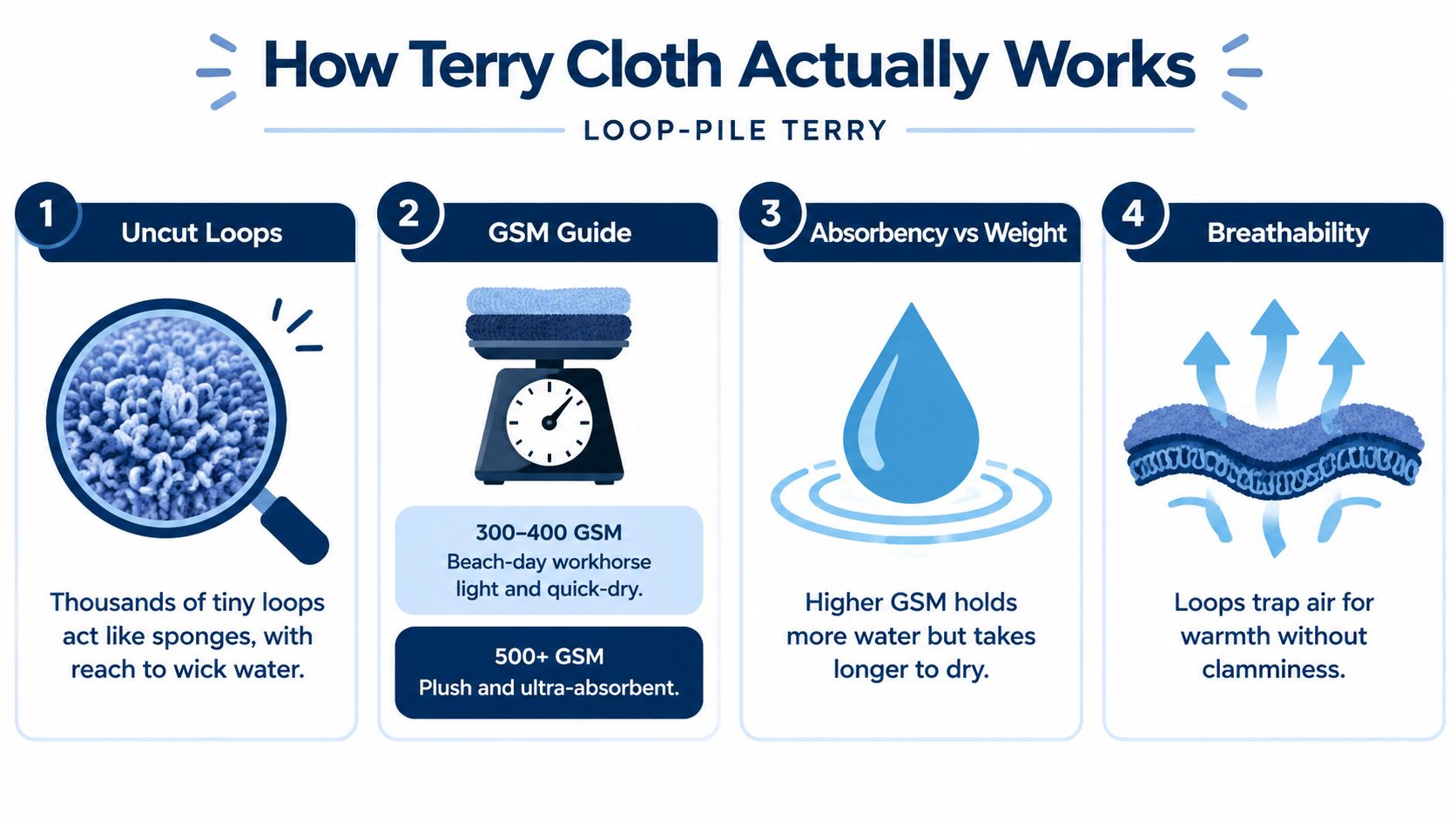
The first clue appears when a surf towel slides off a wet shoulder and a terry robe keeps working. Its surface is made from uncut loops, not a flat sheet of yarn. Each loop rises from the base fabric, creating extra surface area and small pathways that draw water away from skin. After a shower, swim, or cold rinse, that looped pile is doing the drying instead of merely covering you.
Textile guidance places loop density between 300 and 800 loops per square inch, with denser coverage generally bringing a softer hand and stronger absorbency (Richard Haworth's terry guidance). The number is less useful than the fabric in your hands. Even, compact loops tend to outperform a robe that looks fluffy in a product photo but feels thin at the cuff.
Read GSM as a tradeoff, not a trophy
GSM means grams per square meter. It describes how much fabric occupies a given area, giving you a useful hint about warmth, drape, absorbency, and bulk. A heavier robe can feel comforting on a cold deck, yet it also stores more water and needs more time and space to dry.
A technical textile reference reports conventional terry absorbing about 2 to 3 times its dry weight in water, while loop-terry constructions can reach roughly 7 to 8 times their weight (Wazoodle's terry reference). A separate terry guide describes cotton fabric around 450 GSM absorbing approximately 800 milliliters per square meter in under 10 seconds (Seyante's terry robe guide). That difference becomes tangible when a robe goes from damp skin to a wet bundle in the back of the car.
Use the fabric weight against the day you have:
- Lighter terry suits quick beach changes, warm weather, and limited drying space.
- Heavier terry brings more warmth for cabins, cold mornings, and fireside sitting.
- Dense loops matter more than a fuzzy finish because the loops capture moisture.
- Fabric mass and drying space should match the routine, especially if the robe travels home wet.
Don't confuse French terry with towel terry
French terry usually places loops on one side and a smoother surface on the other. That construction shows up in sweatshirts, joggers, and casual layers because it feels soft without the bulk of a towel. Traditional towel terry exposes a more pronounced looped pile, built for moisture capture.
Fiber changes the hand and the dry-down too. Combed cotton loops can feel smooth against skin. Twisted polyester blends may dry differently and may not absorb like a cotton-heavy pile. Run your fingers over both sides before buying. A robe meant to dry you should reveal a real loop structure, not just a fuzzy brushed surface.
A spa-style benchmark sits around 472 to 500 GSM, with approximately 3.5 millimeters of twisted loop height. Heavier terry above roughly 500 to 600 GSM generally feels warmer and more absorbent, but dries more slowly. The useful rule is plain: judge the loops first, then decide how much weight your lifestyle can tolerate.
For a plain-language look at the garment before comparing cuts and weights, read this guide to what a terry robe is. It helps place the fabric in the wider transition from wet gear to ordinary clothes.
Hood, Length, and Fit Decisions That Matter
A robe can have excellent fabric and still fail in the parking lot. The hood may slide backward. The sleeves may end above the wrists. The body may stop at the thighs when someone is trying to change out of a wetsuit beside the truck. Fit decisions become obvious the moment the robe meets real weather.
Choose the hood for wet hair and actual wind
A beach hood needs enough room to cover wet hair without flattening it into a cold helmet. A structured shape helps it stay up when the coastal breeze arrives, while a lined interior can reduce the irritating drip-drip that otherwise runs from the scalp onto the shoulders. For ski weekends, deeper coverage matters because the hood has to work over damp hair, a beanie, or a base layer collar.
A simple hooded towel can make sense for fast beach changes, and Blitz Surf Shop's hooded towel guide offers useful context on that more minimal format. A robe, however, needs to do more than provide privacy. It has to support sitting, driving, lingering, and moving between rooms.
Match the length to the transition
Mid-thigh length works well for the truck bench or driver's seat because it keeps the legs covered without bunching under the steering wheel. Knee length offers a practical beach compromise, especially when the robe gets tossed on quickly after a swim. Mid-calf coverage suits parking-lot changes and cool cabin decks. An ankle-grazing cut leans toward cabin wear and true après-ski warmth, but it can feel cumbersome during movement.
Closure matters just as much. A shawl collar with a hidden tie gives the chest a stable wrap, while an inside tie keeps the lap closed when the wind starts testing the belt. A floppy exterior belt looks relaxed until it drags through sand or catches on a car door.
Let the shoulders breathe
Room through the shoulders matters when a damp base layer sits underneath. Sleeves should reach far enough to cuff, wipe condensation from goggles, or brush sand from a knee without exposing the wrists. The robe shouldn't fit like a structured jacket. It should wrap securely while leaving room for the ordinary, slightly chaotic movements of changing outdoors.
| Feature | Beach / Surf | Cabin / Après-Surf | Cold-Weather Retreat |
|---|---|---|---|
| Hood | Quick coverage for wet hair and wind | Deep, comfortable, easy to keep up | Generous enough for layered headwear |
| Length | Knee or mid-thigh for fast movement | Mid-calf for deck lounging | Longer coverage for retained warmth |
| Closure | Simple tie for quick changes | Shawl collar with inside tie | Secure overlap that resists drafts |
| Fit | Relaxed and easy to pull on | Roomy over damp layers | Generous through shoulders and torso |
For a more detailed men's robe option, see house robes for men, then judge every measurement against the moment when you'll wear it.
From Salt Water to Fireside Without Skipping a Beat
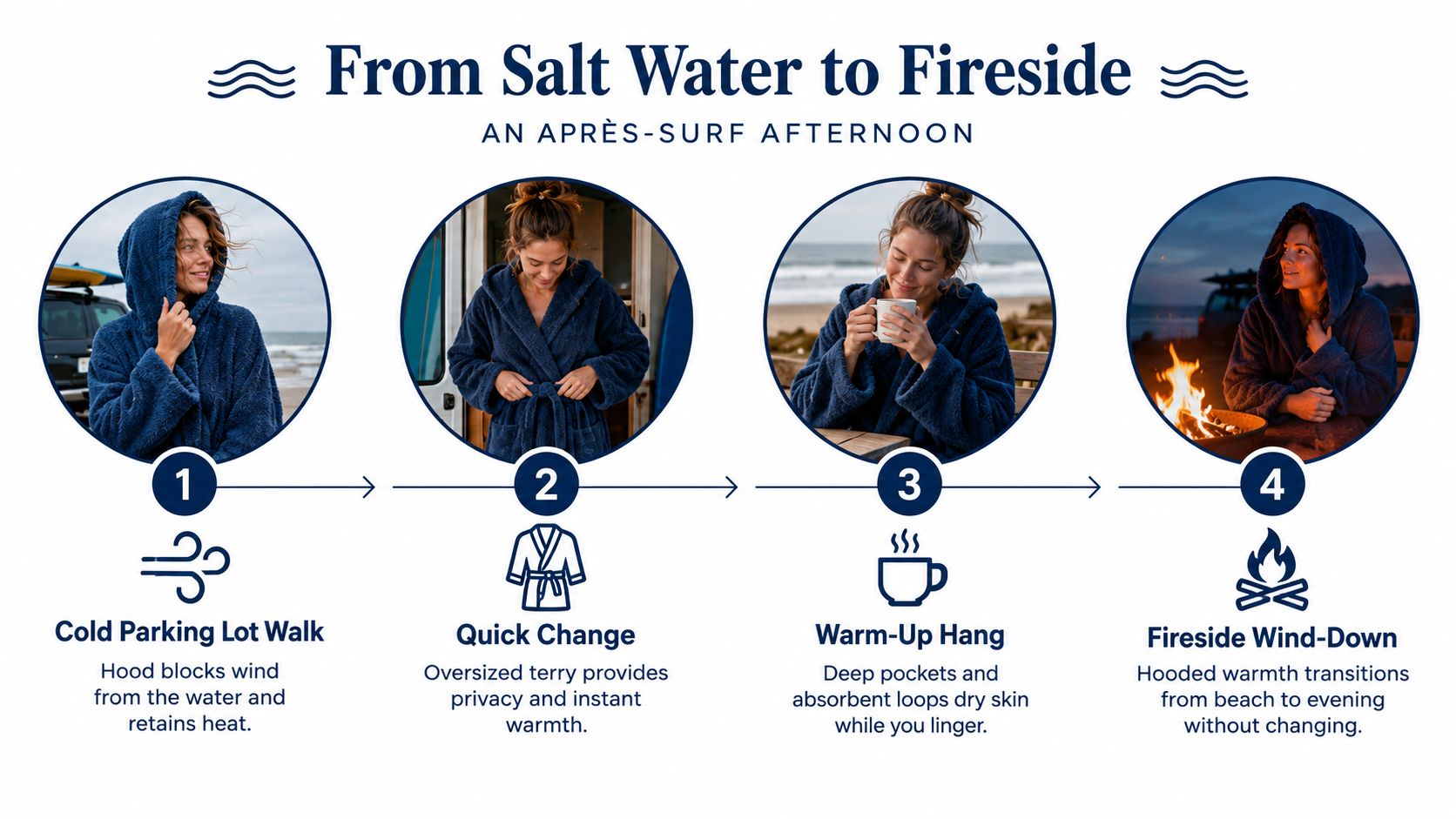
The robe earns its keep in sequence. At 4:12 p.m., someone walks from the water to the parking lot with salt drying on the skin and a wetsuit hanging around the waist. The hood blocks the first gust off the ocean. The terry loops start working against damp hair and shoulders. Nobody looks elegant yet, but nobody is shivering either.
At the truck, the robe becomes a portable changing room. A mid-thigh cut keeps the legs covered while leaving enough freedom to sit on the bench seat or reach for a dry shirt. The closure keeps the front from opening every time the wearer bends over, and the fabric creates a warm barrier between wet skin and cold upholstery.
Four transitions, one layer
The useful test is whether the robe keeps working after the wetsuit is gone.
- Salt-skin-to-seat: The terry surface catches leftover moisture before it spreads across the truck bench.
- Seat-to-shower: A roomy cut gives privacy and warmth during the walk from parking spot to bathroom.
- Shower-to-firepit: The hood and collar keep the first post-shower chill from taking over.
- Firepit-to-bed: Deep pockets hold small essentials while the robe stays comfortable through the final conversation.
That continuity is the point. Most surf apparel stops at the water's edge. Most loungewear begins once someone is already dry, indoors, and settled. Hooded terry robes with hoods occupy the missing middle, where wet hair, cold feet, public changing, and spontaneous plans all collide.
The winning robe is the one nobody rushes to take off.
A robe that spans beach, truck, shower, porch, and firepit doesn't need a costume change every time the afternoon shifts. The wearer can grab coffee, carry a board, sit by the heater, or join a low-key deck conversation without disappearing into a bathroom to rebuild the outfit.
For a more coastal take on the category, explore luxury beach robes for men. The same transition logic applies to pool days, lake weekends, and tropical travel where the water is warm but the wind after sunset has opinions.
Care and Durability for Robes That Earn Their Keep
After a salt-heavy session, the robe may collect sunscreen, sand, chlorine, damp car-seat grit, and a splash from the firepit cooler. Treat it like working gear, not a decorative lounge layer. Good care keeps the terry loops springy, absorbent, and ready for the drive home, cabin deck, or next dawn start.
Protect the pile in the wash
Separate the robe for its first wash, then wash it with similar colors and fabrics. Keep terry away from denim, hook-and-loop closures, rough zippers, and anything that can catch a loop. One snag can tug its neighbors and turn a tiny catch into a visible run.
Use cold water and gentle detergent. Walmart's robe care guidance also advises a separate first wash, skipping fabric softener, and using low heat. Fabric softener leaves a slick coating that can interfere with cotton's ability to take in water. If the robe feels unusually smooth but dries poorly, residue may be the culprit.
Dry gently and store it dry
Tumble dry on low or air dry where air can move through the pile. High heat can stress the loops, distort the hood, and roughen the fabric over time. A bunched robe in the hamper creates the same problem in miniature. Leave the hood seam and dense torso panels room to breathe before folding or hanging.
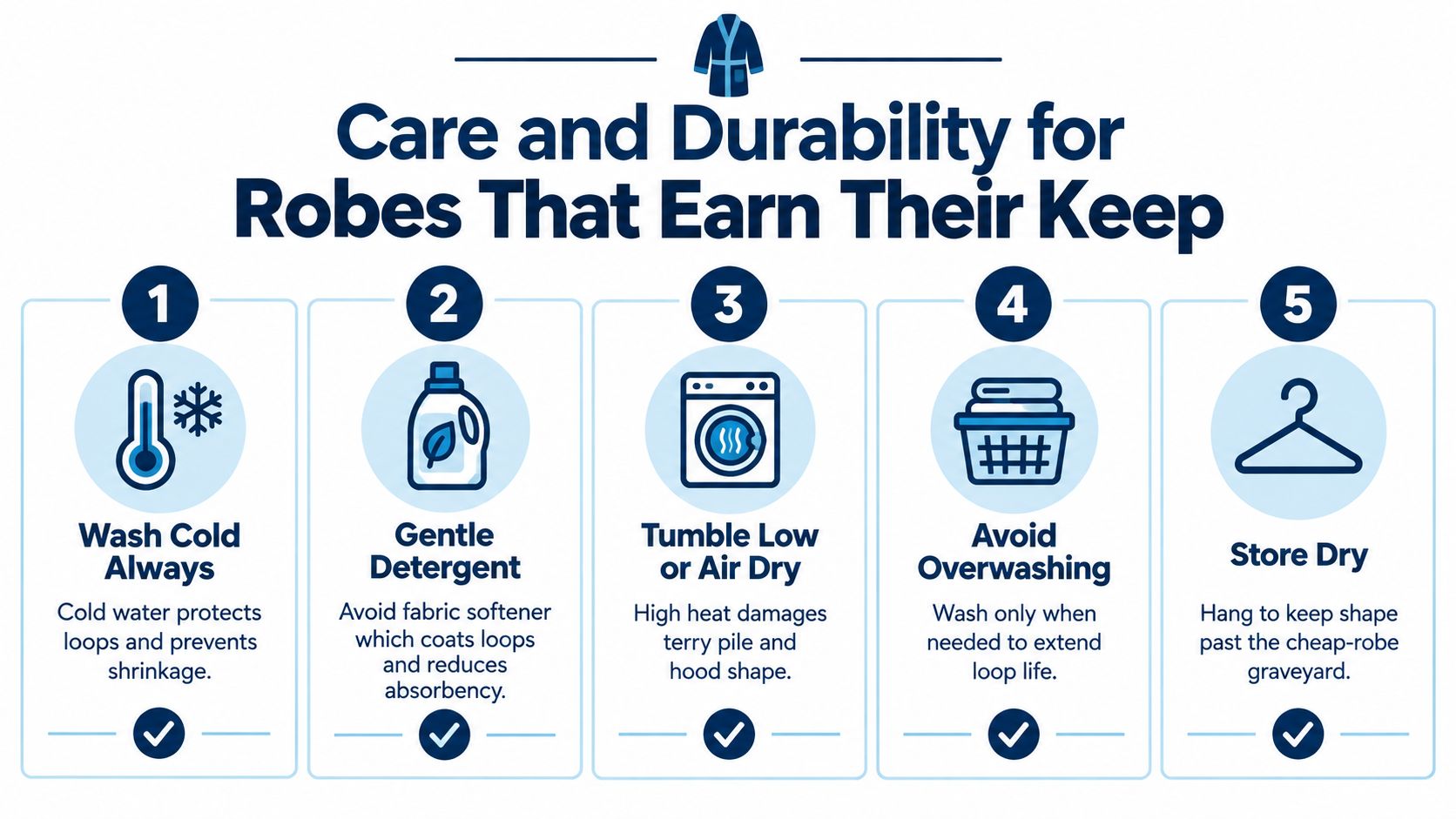
Check the texture before damage becomes dramatic. Persistent pilling, flattened loops, loose seams, or weaker absorbency point to too much friction, heat, or residue. Store the robe fully dry on a hanger or broad hook, giving the shoulders and hood support while it waits in the transition zone.
Build in rest days
A two-robe rotation lets each piece dry completely between outings. One can handle the beach while the other waits for the cabin deck, reducing the temptation to wash and dry the same robe in a hurry. That simple rotation limits wear without promising a fixed lifespan.
For a wider look at luxury terry cloth robes, compare construction and intended use, then follow the care label. Finishes, seams, and fabric blends can vary, so the label gets the final say.
Why the Right Hooded Terry Robe Changes the Whole Trip
Three cheap robes can look like sensible planning until the first one sheds loops, the second fits like a child's costume, and the third stays damp long after everyone else has moved on to dinner. The hidden cost isn't only replacement. It's the repeated annoyance of a garment that never quite handles the transition it was bought for.
One well-chosen robe earns value through repeated moments. It covers the walk from the beach, keeps a wet scalp warm, gives privacy beside the truck, settles over a swimsuit on the cabin deck, and stays useful when the evening shifts toward the firepit. The question isn't whether the robe looks luxurious on arrival. It's whether the garment keeps solving problems after the first wash and the first unexpected weather change.
What to look for in a serious robe
A premium hooded terry robe should make its purpose visible through construction rather than vague adjectives.
- Fabric with useful weight: Enough loop density and mass to dry and warm, without turning every movement into a workout.
- A generous unisex cut: Room for damp layers and real movement, not a narrow fashion fit.
- A deep hood: Coverage that reaches over wet hair and stays useful in wind.
- Hands-first pockets: Side pockets placed for warmth and practical storage.
- A stable wrap: Collar and tie details that keep the front closed when the wearer sits, walks, or bends.
- Personalization potential: A surface that can carry initials or a short name for gifting, weddings, cabin ownership, or group outfitting.
California Cowboy offers robe styles including the El Garibaldi Robe, with a broader apparel system built around beach, cabin, and post-adventure use. Its relevance here is functional. The garment belongs in the interval when surf brands have stopped designing and loungewear brands haven't started yet.
Make it yours without making it precious
Monogramming means stitching initials, a name, or a short personalized word onto one garment rather than repeating the same design across a production batch. An apparel glossary estimates that a three-letter monogram typically uses about 1,500 to 3,000 stitches, depending on the font (Viseprint's monogramming glossary). That small detail changes the robe's identity. It becomes cabin property, a wedding-weekend keepsake, or a recognizable piece at a group retreat instead of anonymous bathroom inventory.
The same robe can serve a solo morning, a bachelor party gift, or coordinated wedding robes without looking like disposable event merchandise. For the recovery side of the ritual, ArtNaturals' self-care routine guide offers a useful reminder that comfort is often built from small, repeatable actions.
The best purchase fills the gap between adventure and recovery. Once that gap has a dependable layer, the beach house, ski weekend, and coastal cabin all feel less rushed.
Complete the Look and Stay in the Moment
A hooded terry robe makes sense as part of a life-offline wardrobe, not because every piece needs to match perfectly, but because the right companions remove small decisions when the day is already full. After a surf, nobody wants to debate whether the next layer is technically appropriate. They want coffee, dry feet, and a place to sit where the wind can't reach.
Start with a terry-lined button-up for the drive from the beach to the bar. The looped interior echoes the robe's moisture-friendly feel while giving the outfit a more socially confident shape. For a cabin morning, pair the robe with relaxed joggers or shorts, then add a casual tee once the day warms up. The effect is coordinated without looking like a team uniform.
Complete the look
- Terry-lined shirts: A practical bridge between beach lifestyle apparel and California casual dressing.
- Cabin-ready tees: Easy under the robe, relaxed enough for coffee on the deck, and useful once the hood comes down.
- Joggers or shorts: Choose based on whether the transition ends at the firepit or the boardwalk.
- A hat: Helpful for wet-hair days when the hood comes off but the hair situation remains confidential.
- Insulated drinkware or a koozie: Keeps the morning coffee, sparkling water, or first post-surf drink in the ritual without requiring a phone check.
- A pocket-minded outer layer: Useful when the group heads from the deck to the market and nobody wants to carry a bag.
The design logic is social as much as technical. Deep pockets keep hands free for a mug or board leash. A warm collar makes it easier to stay in the conversation. A recognizable robe helps a group coordinate for a bachelor weekend, wedding morning, or cabin gathering without forcing everyone into identical outfits.
California Cowboy's wider collection treats the transition zone as a real design category, connecting après-surf apparel, High Sierra gear, and accessories for the hours when the activity is over but the day is nowhere near finished. Monogramming adds a personal mark, while coastal-inspired colorways keep the result relaxed rather than overly polished.
The second cup of coffee is cooling beside the chair. The robe is still on. Someone is telling a story from the morning session, nobody is filming it, and the deck has finally warmed up. That's the purchase: not just terry, not just a hood, but more time before the day asks for another outfit.
California Cowboy offers hooded and terry-lined robes, coastal layers, cabin wear, and accessories built for the stretch after the surf, ski run, or swim. Visit California Cowboy to find a robe that can handle the transition, then join the Vital Few newsletter for product drops and a better excuse to stay offline a little longer.

