


Woodsmoke drifts across the cabin deck, the railing's cold, and someone's pouring the first drink after the lifts close. You're still warm from the mountain, but your damp base layer has stopped being charming. A velvet button down shirt makes sense right here, between the activity and whatever happens next, provided you choose it for the night you're really having.
Why a Velvet Button-Down Belongs at the Cabin and the Bar
A good social layer changes the mood without requiring a complete wardrobe change. Pull velvet over a clean tee, trade ski boots for something you can walk in, and you're dressed for dinner rather than stranded in your equipment.
The same idea works at a beach bar, with salt drying on the deck and the Pacific catching the last light. The familiar button-front shape keeps things relaxed; the surface makes the evening feel like an occasion. A little ceremony, no velvet rope required.
This is the balance to aim for.

There's a useful distinction behind the name. A true button-down has collar points that fasten to the shirt, while button-up describes the front closure; Brooks Brothers' account of its original polo shirt explains the practical collar fastening behind the style. For shopping purposes, check both terms, since a velvet shirt may have an unbuttoned camp or point collar.
Dress to feel socially confident, then holster your tech. The best feature is still being available for a conversation.
For mountain weekends, men's après-ski wear should handle the transition from exertion to lingering, not pretend dinner is another endurance event. Velvet earns its place through texture, adaptable styling, and enough polish for serendipitous encounters.
The catch is material, not social. Fiber, pile, fit, and cleaning tolerance decide whether the shirt becomes a regular companion or an expensive souvenir of the first spill.
Velvet Button-Down Fabrics Compared at a Glance
Read the care label before the first spill, not after. Two shirts can look identical under cabin lamplight and behave completely differently in a suitcase or a sink, because velvet is a construction rather than a fiber. As Britannica's explanation of velvet describes, its defining feature is a short, dense pile of clipped yarns over a comparatively smooth reverse. Silk, cotton, or synthetics can supply that pile, so matching the sheen says nothing about matching the behavior.
Velvet button-down fabrics at a glance
| Fiber | Feel and sheen | Care tolerance | Best use |
|---|---|---|---|
| Polyester velvet | Dense, smooth, sometimes slightly slick | Often more forgiving; gentle machine washing only when permitted | Travel, events, low-fuss evenings |
| Cotton velvet | Soft, warmer hand; pressure marks can show | Treat cautiously; wash only when authorized | Cabin evenings and dinners |
| Silk velvet | Fluid drape and pronounced luster | Delicate; professional cleaning is often the safer choice | Formal dinners and special occasions |
| Stretch or crushed velvet | Stretch gives movement; crushed finishes create intentional texture | Follow the base fiber and finish instructions | Bar nights and statement looks |
Weight is worth a glance rather than a ranking. Selected polyester velvet specifications list 260–420 g/m², according to Germes' velvet specifications, and pile density or backing construction can shift that figure enough that declared weights compare individual fabrics, not whole fiber categories.
Choose the compromise you can live with
Polyester velvet is the sensible starting point for a shirt that travels between a suitcase, dinner, and a crowded bar. Its advantage is cleaning flexibility, though it still is not a gym tee. If the evening runs from a hot tub deck to a packed bar, this is the fiber most likely to keep up without demanding a care routine of its own.
Cotton velvet earns its place when you want a softer hand and a less slippery look, and it sits naturally beside denim at a cabin dinner. The trade-off is pressure: sitting, leaning, or a tight pack can leave the surface flattened before the shirt is actually dirty.
Silk velvet belongs to occasions that justify a gentler ownership routine. Choose it for drape and luster, and accept that a bar stool becomes a hazard rather than furniture. A shirt you are afraid to sit in does not help much at the lodge.
Buying judgment: pick the fiber that matches your maintenance tolerance, then pick the color that matches your wardrobe.
Stretch and crushed velvet need separate scrutiny. Stretch describes movement, crushed describes a deliberately disrupted surface, and neither word reveals the fiber content or guarantees washability.
A short, even pile gives richness without excess bulk, and the nap direction shifts how the surface reflects light, which is why one velvet can read as two colors from different angles. For broader buying context, compare luxury shirt brands through fabric and construction instead of treating sheen as proof of quality. The useful luxury is wearing the shirt often.
Warmth and Layering Strategies for Apres-Ski and Cabin Nights
Use velvet as the social layer, not the weather barrier. A smooth base underneath and a smooth-lined outer layer above will generally be kinder to the surface than a rough, tight sandwich of fabrics.
The target is comfortable conversation, not surviving a lift shutdown.

Velvet's dense pile traps still air near the surface, while its directional nap changes how it reflects light; TextileTuts' velvet construction guide describes fine apparel pile heights around 0.5–3.0 mm and reported densities of approximately 200–600 pile loops per cm². Those are construction references, not a warmth rating for a finished shirt.
Layering combinations by setting
| Setting | Base layer | Velvet button-down role | Outer layer |
|---|---|---|---|
| Fireside cabin evening | Lightweight thermal crew | Buttoned or open as the main layer | Smooth-lined quilted vest or roomy fleece |
| Après patio at dusk near freezing | Midweight thermal top | Social layer beneath insulation | Insulated shell or puffer, removed indoors |
| Spring lift close, mild air | Thermal tee | Main shirt, cuffs adjusted for comfort | Packable light shell carried separately |
| Coastal sunset with damp wind | Smooth tee or fully dry terry-lined layer | Buttoned against the base | Windbreaker or lightweight jacket |
Keep warmth without grinding down the pile
A velvet shirt isn't windproof just because it feels substantial. On an exposed patio, add an outer layer rather than tightening every button and hoping for a personality-based weather exemption. Use thermal layering for ski trips to plan the base and insulation before choosing the evening shirt.
- Open the neckline: Leave the top button open over a thermal crew when you're warm enough.
- Add a vest deliberately: A smooth-lined quilted vest adds insulation without crowding the sleeves.
- Unpack yourself indoors: Remove the puffer so you don't sit through dinner compressing the shirt beneath it.
Check the front, collar, and cuffs under changing light before buying. Pattern pieces cut in inconsistent nap directions can look like different shades; brushing won't correct the underlying cutting choice. For everyday grooming, work gently with the nap rather than scrubbing across it.
Keep the post-mountain mood in mind while choosing layers.
The Social Anatomy of a Velvet Button-Down
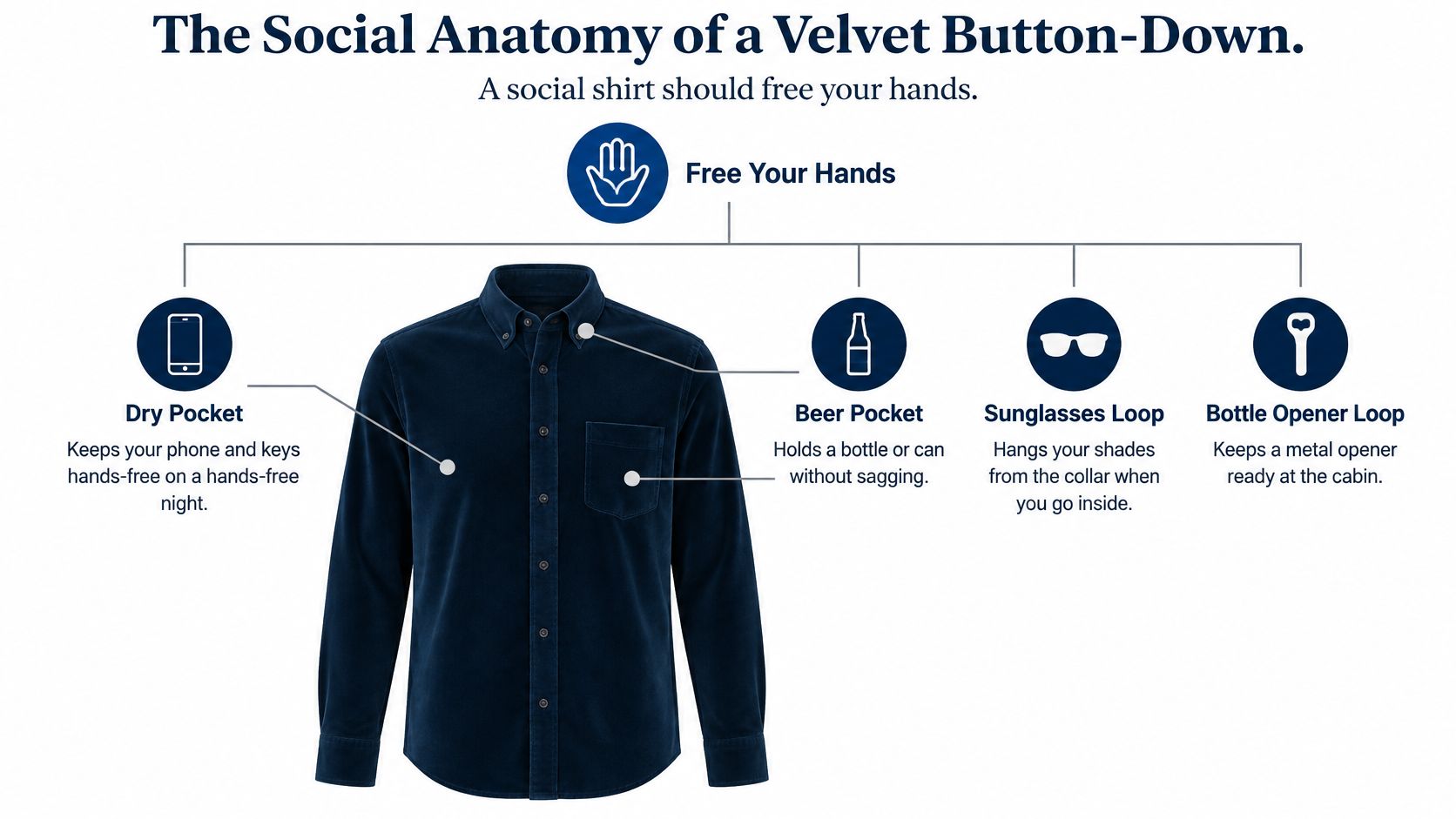
A social shirt should free your hands. That's the useful meaning of Social Technical clothing: storage and access that help you participate, rather than another collection of gadgets to manage.
The diagram illustrates features to look for, not features every velvet shirt includes. Confirm each detail on the actual garment before asking a pocket to hold your evening together.
Judge storage by what it lets you do
A dry or phone pocket gives your phone and keys somewhere to go while you carry snacks to the deck. “Dry” shouldn't be read as waterproof unless the manufacturer explicitly establishes that protection. Keep it away from hot-tub splashes.
A beer pocket can free a hand briefly, provided its construction supports the container without pulling the shirt sideways. A sunglasses loop helps during the walk indoors, while a bottle-opener loop keeps a separate opener accessible at the tailgate. None replaces checking retention before bending over.
Social Spec
A champagne pocket changes the tailgate game when it provides stable, accessible storage without distorting the shirt. Test it with the intended item while standing and sitting; useful storage shouldn't turn a relaxed shirt into a listing sailboat.
Let terry handle the wet transition
Velvet isn't a towel. Research on terry's wetting behavior found approximately 26–40% of total water-absorption capacity was taken up during the first 10 seconds, more than 50% after 30 seconds, and about 75% after 100 seconds, with results changing by yarn and construction, as described in the terry absorption study.
Those findings support terry's role after swimming, not an absorbency claim for a velvet outer. Dry off, let the moisture-handling layer do its job, and put velvet on once you're dry enough for the bar. The hot tub gets its own wardrobe.
- Check pocket depth: Test your actual phone, including its case.
- Check reach: Make sure the loop sits where your hand naturally lands.
- Check moisture: Keep an absorbent terry layer against the skin during drying, then change if it remains damp.
Fit, Sizing and a Buyer's Checklist for Velvet Shirts
Pass a bowl across the table before you commit. Button the chest, reach forward, and watch what happens: the placket shouldn't gap open, and the back shouldn't pin your arms. Begin the inspection at the shoulder seam, then check sleeve length with the cuff resting near your wrist bone.
Velvet rewards drape over tension. A shirt straining at every button reads like a costume by the second round; the same shirt with breathing room reads like you planned the evening. Try it over the thermal or tee you'll wear most, and size up only if that fixes the pull without sliding the shoulder seam down your arm.
Shopping from a couch adds a step. You can find men's sizes using body measurements through Robosize, then compare those numbers with the seller's chart. A size letter is a rumor; a shirt measured flat is a fact. I'd run a shirt-measurement guide over the best-fitting shirt you own before ordering gifts or coordinating a group.
Inspect the parts that work hardest
- Fiber content: Read the full composition, including lining and any stretch fibers blended into the face.
- Fabric weight: Ask for the declared g/m² if heft matters, but heavier cloth isn't proof of better tailoring.
- Pile: Look for an even surface with no unexplained bald spots. Panels cut against the nap will read as different shades under bar lighting, and nobody will assume that was intentional.
- Care label: Confirm whether washing, steaming, or professional cleaning is permitted. Read this before the first spill, not after.
- Buttons and placket: Look for secure stitching and a front that lies flat when you move.
- Collar and cuffs: Check for stable seams, puckering, and bulky edges that will fight a blazer.
- Pocket placement: Load your actual phone and see whether it drags the chest down.
- Lining attachment: Make sure it doesn't twist, pull, or hang below the outer fabric.
Read price without guessing quality
In 2026, Nordstrom Rack listed the Eileen Fisher Velvet Button-Up Shirt at $144.97, roughly half of a comparable value of $288, while Nordstrom listed the R13 Leopard Print Drop Neck Velvet Button-Up Shirt at $1,195. That spread is real, and the tag won't tell you which end of it you're paying for.
Judge fiber, construction, finishing, and fit on their own merits. Price is where inspection starts, not where it ends. For personalized gifts, confirm embroidery placement and whether the pile needs specialist handling. A vague care label means you're buying blind.
Care Fixes for Spills, Salt Water and Flattened Pile
The sewn care label beats general advice. Unknown fiber content, mixed constructions, linings, and decorative finishes make a universal velvet laundry recipe a bad bet. Before applying water or steam, check what the complete garment allows.
Published fabric abrasion results don't tell you how a finished collar, cuff, or seam will age. Localized bending, edge wear, and surface crushing can spoil appearance while the underlying fabric remains intact. Strong fabric isn't permission to use strong treatment.
Velvet care problems, causes and fixes
| Problem | Likely cause | Fix |
|---|---|---|
| Red wine or drink spill | Liquid, sugar, and pigment in the pile | Blot with a dry white cloth, never rub; use cool water only if wet cleaning is permitted |
| Salt water and sunscreen | Salt residue and oily product on the surface | For washable garments, rinse with cool fresh water and dry as directed; send persistent oils to a cleaner |
| Flattened or crushed pile | Backpack straps, seat belts, or stacked storage | If steaming is allowed, steam without touching the surface, let dry, then brush lightly with the nap |
| Body odor after dancing | Perspiration and retained moisture | Air on a padded hanger; clean if odor remains |
| Shade shifts across the shirt | Nap displaced against its lay | Brush gently in a consistent direction; don't iron the face flat |
| Storage between seasons | Dust, creasing, compression, or pests | Store clean in breathable protection; use a padded hanger or loose, supported folds |
Use less force, not more optimism
For a washable shirt, select the gentlest label-approved cycle, turn the garment inside out, and avoid a crowded drum. Don't wring it, tumble it without permission, or leave it baking in direct sun. Low-temperature ironing, when allowed, means supporting the pile and working cautiously from the reverse, not pressing the face like a cotton business shirt.
Fabric Fabric's velvet-care guide distinguishes cleaning tolerance by fiber and construction and prioritizes the sewn label. That distinction matters more than whether the shirt looks sturdy.
A night out doesn't automatically create a laundry emergency. Air a clean-smelling shirt away from sunlight before deciding it needs washing.
- Call a professional for unknown fibers: Don't identify silk by shine or polyester by touch.
- Stop after color transfer: If a discreet test lifts dye onto a white cloth, don't enlarge the experiment.
- Escalate oily or persistent stains: Explain the spill and any treatment already attempted.
Styling Plans for Each Crowd From Après Crews to Groomsmen
The après crew has dinner booked, but nobody wants to dress like they're attending a board meeting. Choose a dark velvet shirt, straight dark denim, and suede boots for dry conditions. Add a beanie outdoors and leave the neckline relaxed over a clean crew.
For the surf-to-bar crowd, start with the drying step rather than the outfit photograph. Once your terry-lined layer is dry, add velvet, relaxed trousers, and shoes that suit the venue. Push sleeves up loosely instead of making tight rolls that crush the cuffs.
Different crowds can share texture without sharing a uniform.

Coordinate the weekend, not every button
For a bachelor or bridal-party weekend, choose a color family such as forest, navy, and burgundy. A shared hat or discreet embroidery creates continuity without making the group look like the entertainment staff. These guys' wedding outfit ideas help separate welcome-drink outfits from ceremony requirements.
For groomsmen gifts or corporate thank-yous, personalization works best when the shirt already suits the recipient. Choose initials in a restrained location and confirm the embroiderer can support the pile without crushing it. Ask about exchange restrictions before approving custom work.
What to pack for a short weekend
- Shirt rotation: A velvet evening shirt, an activity-appropriate shirt, and a clean spare.
- Base options: A thermal for mountain evenings and a smooth tee for milder weather.
- Useful extras: Sunglasses, a weather layer, and footwear suited to wet ground.
- Lounge change: A robe for after-dinner unwinding, especially when velvet deserves a break from deck chairs and late-night snacks.
Keep the shirt for the gathering, not every task around it. Carrying wet firewood and cleaning the grill are excellent reasons to change.
Complete the Look and Pick Your Velvet Shirt
Choose the shirt by the evening ahead. For a cabin dinner, consider cotton velvet with a tidy, short pile and enough room for your base layer. For a water-to-bar day, separate drying from dressing rather than expecting velvet to manage both.
For travel, prioritize a forgiving fiber, clear cleaning instructions, and a fit that survives sitting comfortably. For gifting, check the recipient's measurements and leave suitable space for personalization. Don't buy a difficult-care shirt for someone who wants everything to go through the same wash.
The right velvet shirt is the one you can enjoy wearing, not the one that requires the most careful explanation.
Finish with useful accessories
- A hat for the setting: Choose a beanie for a cold deck or a cap for the coast. Let velvet provide the texture rather than competing with it.
- A smooth tee underneath: Pick a neckline that sits neatly below the open collar and a fit that won't bunch at the waist.
- A koozie for the gathering: Give the cold drink its own insulation instead of wiping condensation on your shirt.
- A separate weather layer: Bring the jacket you need for the walk home, even when dinner starts beside a fire.
Keep the rest of the outfit quiet enough that the shirt feels natural. You don't need matching velvet trousers, elaborate jewelry, and a backstory. Good company supplies plenty of atmosphere.
Choose the fiber you can maintain, the fit you can move in, and the features you'll really use.
California Cowboy offers High Sierra après-ski shirts, High Water terry-lined après-surf styles, robes, and accessories built for the moments after the adventure. Visit California Cowboy to build your cabin-to-coast wardrobe and join the Vital Few newsletter for first access to product drops. Then holster your tech, find a seat near someone new, and make an evening of it.

