


You're standing beside the car with salt still drying on your sleeves, or maybe the snowmelt is running off your boots onto the cabin porch. Someone has found the bottle opener, someone else is pouring the first drink, and the phones are finally face down. This is the handoff from activity to après, where custom embroidery clothing earns its keep by turning a practical shirt, robe, or cap into something your group recognizes, remembers, and keeps wearing.
A raised monogram catches the light. A team mark on a flannel starts a conversation with strangers. A robe embroidered for a wedding weekend becomes useful long after the last toast. The right design doesn't shout across the room. It makes you look socially confident while leaving both hands free for the important work of holding a mug, a surfboard, or a celebratory beverage.
The Art of the Social Upgrade
The handoff from a day outside to dinner reveals whether custom apparel has been designed for real use. A towel-lined High Water terrycloth shirt can carry a small tonal monogram near the chest, while a High Sierra wool-blend flannel can take a restrained group mark without looking like a uniform. Both pieces give a social setting its own visual language, yet remain useful after the weekend.
Placement and stitch scale determine whether that upgrade feels considered. A small chest mark keeps the garment easy to wear with denim or technical layers. A larger back design creates stronger group recognition, but it also adds weight and draws more attention to the stitching. On dense wool, that structure can look refined. On terrycloth, dense embroidery needs enough support to sit above the pile rather than sink into it.
Embroidery is a decoration method that stitches thread directly into fabric, creating a raised, textured finish valued for its professional appearance and permanence. A practical embroidery guide notes that embroidered designs can endure 50 or more washes, while polyester thread is often selected for workwear because it resists bleach and ultraviolet fading. The result feels integrated with the garment. It does not behave like a printed surface that can crack or peel.

From standard issue to shared identity
The market shows why useful construction matters. Tracked retailers in custom embroidery and personalized apparel generated $309 million in aggregate online sales in 2025, although sales fell 20% to 50% year over year, with a further 10% to 20% decline projected for 2026 before the trend moderates, according to market coverage of custom embroidery and personalized apparel. The category is under pressure, so disposable novelty has less room to succeed. Garments with strong hand feel, practical features, and restrained artwork make a better case.
Personalization can also support a considered purchase. Accenture found that 84% of fashion consumers in Europe and North America are interested in personalized products. Interested consumers spend about 500 Euro, or 610 USD, per year, compared with 340 Euro, or 420 USD, for those who are not interested, as summarized in the cited personalization industry data. A monogram works best when it serves a broader experience, such as a giftable robe, wedding keepsake, or coordinated garment that still belongs in an ordinary wardrobe.
Social Spec: A concealed pocket, bottle opener loop, or sunglasses holder gives the group a practical conversation starter. Embroidery gives the garment a reason to stay in rotation after the event.
For planners building a memorable group without novelty graphics, these personalized group gift ideas provide a useful starting point. Choose a garment people already want, match stitch density to its fabric, place the mark where it will be seen without limiting wear, and keep the artwork quiet enough for life beyond the occasion.
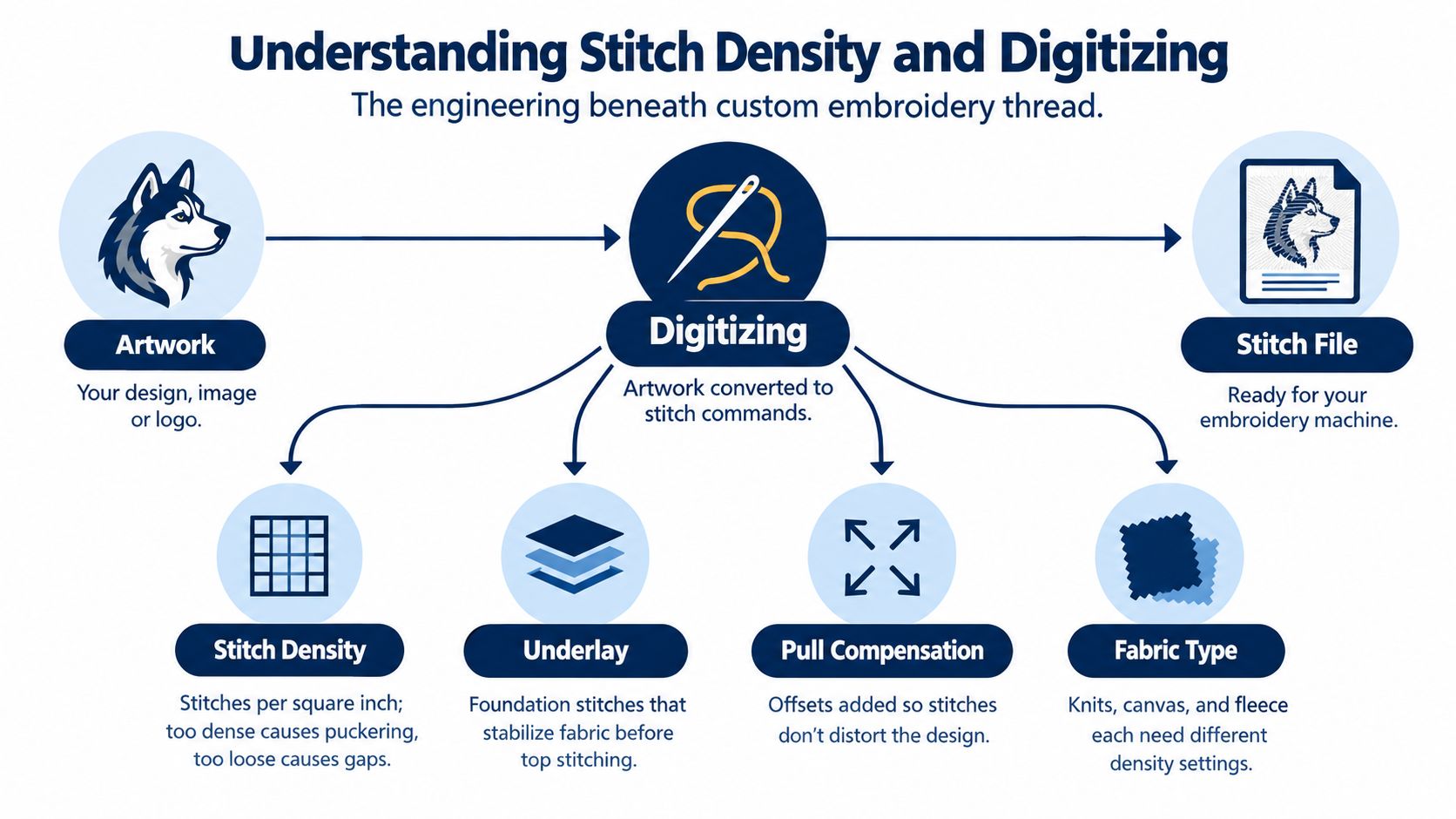
Understanding Stitch Density and Digitizing
A stitch file is the silent architect of custom embroidery clothing. It tells the machine which stitch type to use, where to change direction, how densely to fill an area, when to add underlay, and where to trim the thread. Artwork that looks clean on a screen can behave badly on a stretch polo, a soft knit, or a towel-lined robe if those instructions aren't built for the fabric.
Density sets the feel
Professional guidance for many apparel fabrics centers on roughly 0.4 to 0.6 millimeters of spacing between stitches, according to embroidery quality guidance on stitch density and thread durability. Denser settings can improve edge definition and coverage, but they also increase the risk of puckering, thread breakage, and a stiff hand when the garment can't support the stitch load.
Think of density as tension management, not a race toward maximum detail.
- Light knits and performance fabrics generally need lower density and stronger stabilization, because the material can move under the needle.
- Denim and structured twill can usually support tighter fills, giving broad letters and solid logos a crisp surface.
- Terry and toweling often need 0.5 to 0.6 millimeter spacing plus a topping and underlay so the stitches don't disappear into the pile, as the same quality guidance explains.
- High Sierra wool-inspired layers need a design that respects the fabric's loft and hand rather than forcing a dense, rigid patch into a soft panel.
- High Water terrycloth-lined robes and shirts benefit from a test sample before production, especially when the design includes small lettering or thin outlines.
The file decides whether the garment ages well
Digitizing controls more than appearance. It affects durability, production consistency, and how the design behaves after laundering. Expert embroidery guidance on digitizing explains that a well-built file can reduce show-through and help embroidery retain its shape through repeated washing. Over-digitizing can produce bulky, board-like areas, needle breaks, and fabric distortion. Under-digitizing can leave weak coverage, with the garment color showing through the design.
Ask for a fabric-specific sample rather than approving a universal file. The same logo may look sharp on a stable jacket back and muddy on a stretch polo. It may need a different underlay on a robe than on a cap. A production-ready process includes laundering the sample, checking the reverse side for thread buildup, and confirming that the fabric still feels comfortable against the skin.
Small details deserve suspicion. Thin script, tightly packed initials, and intricate shapes often lose legibility as the design shrinks. If the garment's job is to accompany people through après-ski lounges, post-surf drinks, and cabin breakfasts, readable restraint beats microscopic ambition.
For a practical placement conversation around headwear, this guide to six-panel hats helps frame the decision. Start with the fabric, then the placement, then the stitch file. Reversing that order is how a clever idea becomes a stiff little accident.
What Custom Apparel Actually Costs
A wedding party choosing embroidered robes, or a company preparing gifts in High Sierra wools and High Water terrycloth, is paying for more than thread and machine time. The budget has to account for artwork preparation, garment handling, stitch density, and the way a dense design interacts with a luxury performance fabric. Separate those costs before comparing suppliers.
The digitizing fee converts artwork into machine-readable stitch instructions. The per-unit charge runs that file on each garment. Stitch count, design complexity, placement, and material shape the final amount. A 2026 manufacturer guide places one-time digitizing at roughly $10 to $75 per design and per-unit embroidery at about $4 to $15, depending on stitch count and complexity, as detailed in this embroidery manufacturing guide. Treat those figures as planning benchmarks, not a quote for every garment.
Setup changes the group-order math
One shared design is usually easier to budget than several unrelated designs. Adding individual names, placements, or motifs increases the artwork workflow, even when every garment is identical. Ask whether personalized text remains part of one base design or creates separate digitizing charges.
The order size also affects the production route. Automated providers may accept a single piece, while traditional manufacturers often require minimums between 50 and 200 units, per the same guide. A small bachelor-party group and a corporate gifting program need different sourcing assumptions.
High-density embroidery can justify a higher garment budget when the fabric can support it. High Sierra wool may give a premium outer layer enough structure for a substantial crest, while High Water terrycloth calls for attention to hand feel, backing, and comfort. A design that looks rich on a structured wool can feel heavy or intrusive on soft terry. Request a fabric-specific sew-out before approving a full run.
A useful budget conversation covers:
- Artwork preparation: Confirm whether a clean vector file reduces preparation work or whether digitizing is still charged.
- Garment handling: Ask whether robes, fleece, terry, and structured outerwear carry different production charges.
- Stitch complexity: A compact monogram and a dense multicolor crest require different machine time.
- Proofing: Request a visual proof and, for demanding fabrics, a physical sew-out before releasing the order.
- Reorders: Establish whether the original stitch file remains available for future groups or seasonal gifting.
For another practical view of setup, labor, and production, B-Sew Inn embroidery rates offers useful pricing context. The lowest line item is not always the lowest total cost. A cheaper file that distorts a luxury garment can waste the entire order.
Pay for the part people keep
Embroidery earns its place in a premium order when the garment remains useful after the event. A coordinated robe can become a morning layer, a flannel can move from a tailgate to a restaurant, and a cap can gather wear that recalls the trip.
For corporate gifts, choose a restrained mark, a useful garment, and colors that will not date quickly. This guide to premium corporate gifting apparel helps organizers make personalization feel intentional rather than promotional.
Choosing the Perfect Placement
Placement decides whether embroidery feels like a signature or a billboard. The right location also protects legibility, comfort, and the garment's original function.
For a conventional left-chest logo, one industry guide gives a practical benchmark of 3 to 4 inches wide. Sleeve embroidery usually sits around 2 to 3 inches wide, while a cap front commonly accommodates a design about 2.25 inches high by 4.5 inches wide, according to this custom embroidery clothing sizing guide. Use those dimensions as starting points, then adjust for the specific garment and artwork.
Compare the main placements
Left chest is the quietest choice. It suits initials, a small crest, or a compact group emblem on a flannel, polo, robe, or overshirt. The mark remains visible during conversation without taking over the garment.
Sleeve placement creates a more considered look. It works for a short word, a location, or a simple symbol, but the design has less room to breathe and can rub against cuffs, tables, and pack straps.
Back-panel embroidery carries more presence. It works for a large group identity on a structured outer layer, especially when the wearer wants to be recognizable from across a parking-lot tailgate. It can feel excessive on a soft lounge piece, so keep the shape uncomplicated.
Cap-front embroidery handles bold, compact artwork well. Avoid fine interior details that collapse when the crown curves. A simple icon and strong letterforms will usually outperform a complicated illustration.
A useful decision test is to ask where the garment will be seen. The left chest supports an intimate gathering or business-casual setting. The back panel supports team visibility outdoors. The sleeve adds a flash of personality when the wearer is moving between the beach, bar, and boardwalk.
Placement rule: If people need to stand still to read it, the design is probably doing too much.
Tonal thread can make a robe or luxury thermal layer feel refined. Contrast thread works when group recognition matters. On a terry-lined piece, keep the design away from high-friction zones and avoid putting dense stitching where it will fight the garment's soft, absorbent hand.
Elevating Group Events and Weddings
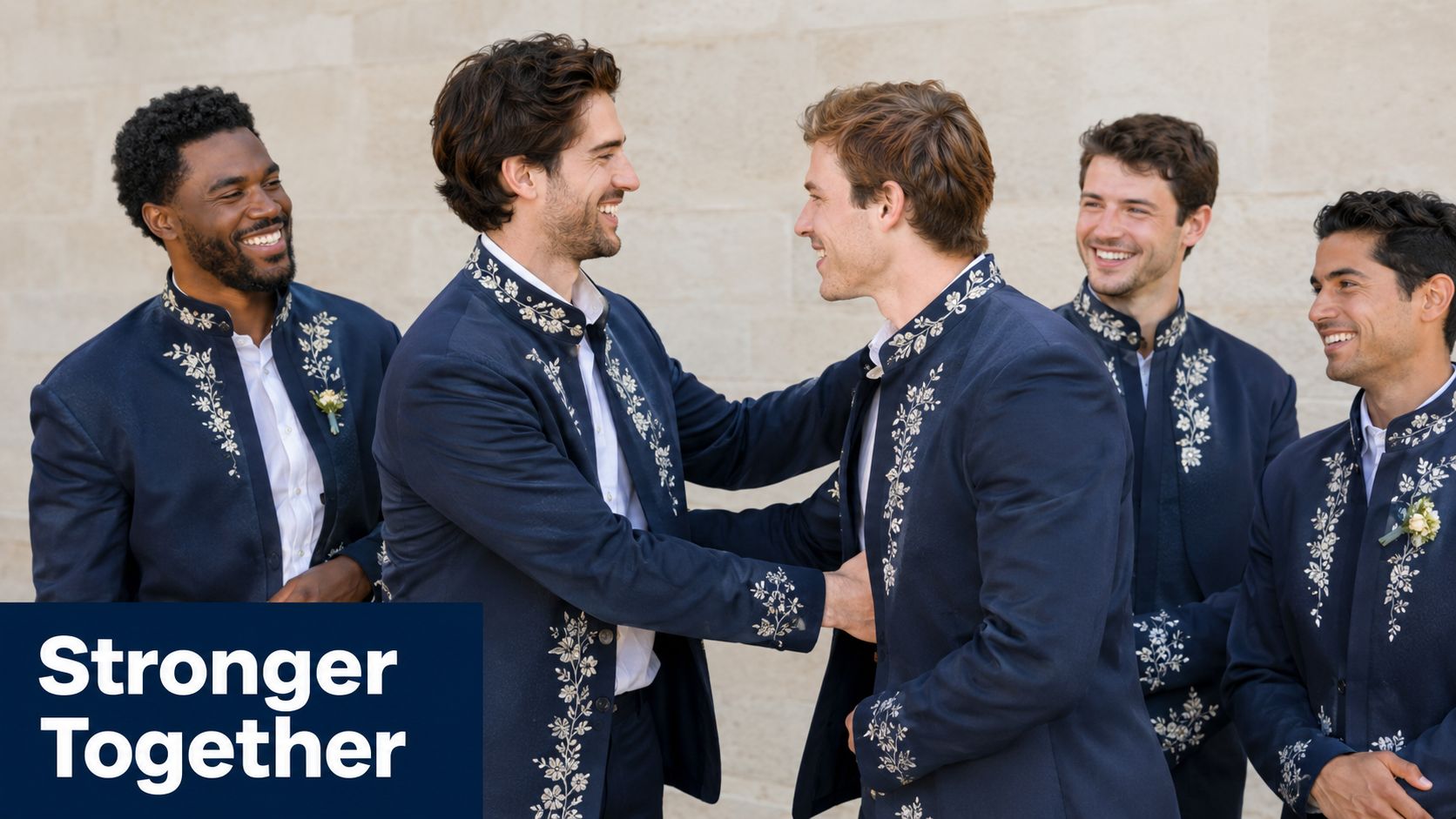
Coordinated group gear works because it removes a small amount of social friction. Guests arrive at a beach rental, cabin, or wedding suite and immediately have a shared reference point. Nobody needs to ask who belongs to the group, and nobody has to wear a novelty shirt they wouldn't choose on an ordinary weekend.
That makes custom embroidery clothing especially useful for bachelor-party outfit ideas, bachelorette weekend outfits, unique groomsmen gifts, wedding robes, and coordinated group gear. A small monogram on a robe feels more personal than a loud slogan. A wedding-party mark on a flannel can survive the event because it doesn't look trapped in one date.
Coordinate without turning into a traveling logo
The strongest group programs establish one common element and leave room for individual choice. That might mean the same thread color across robes, different initials for each guest, or one shared emblem placed consistently on garments with different silhouettes.
For a wedding weekend, consider this arrangement:
- Getting-ready robes: Use names or initials in a restrained location, with a thread color that sits comfortably against the robe.
- Post-ceremony layers: Choose flannels or overshirts with a small shared mark rather than printing the entire itinerary.
- Groomsmen gifts: Match the garment to how recipients typically dress, not just to the wedding palette.
- Bachelor-party shirts: Let the base fabric and cut carry the style, then use embroidery as the inside joke, not the entire punchline.
- Group orders: Approve one sample on the most demanding fabric before collecting final sizes and quantities.
The emotional payoff comes after the event. A disposable party favor disappears into a drawer. A comfortable robe gets used on slow mornings. A durable flannel returns for road trips, tailgates, and the first drink after the lifts close.
Custom group shirt guidance can help organizers think through the balance between shared identity and wearable design. Keep the artwork legible, the placement comfortable, and the garment worthy of another invitation.
Caring for Your Embroidered Gear
High-density embroidery needs care that matches the fabric beneath it. Dense fills can stiffen a lightweight panel, flatten a raised design under high heat, or pull at the surrounding weave when washed with abrasive items. That matters on luxury performance fabrics such as High Sierra wools and High Water terrycloth, where softness, drape, and surface texture are part of the garment's value.
Turn embroidered garments inside out before washing. Use cold water and a gentle cycle, then remove the piece promptly so moisture doesn't leave it compressed in a heap. Air drying is the safest default for preserving loft and hand feel, particularly on wool-inspired layers, fleece, and terry-lined apparel.
A practical care routine
- Inspect the reverse side first. Check for loose threads or snagged loops before washing. Don't pull a loose thread with force. Have it trimmed or secured appropriately.
- Wash with compatible garments. Keep rough hardware, heavy zippers, and abrasive items away from raised embroidery.
- Control heat. Avoid excessive dryer heat. If a dryer is necessary, use a gentle, low-heat setting and take the garment out before it becomes fully compressed.
- Protect the surface while pressing. Don't iron directly over the stitched design. If pressing is necessary, use a protective cloth and a low setting, testing an inconspicuous area first.
- Store without crushing. Fold loosely or hang the garment so dense embroidered areas aren't permanently pressed against another surface.
Polyester thread is commonly chosen for outdoor and workwear applications because it resists bleach and ultraviolet fading, as described in this embroidery durability guide. That resistance does not make every garment indestructible. Fabric, stabilizer, thread, washing, and heat all shape how the finished piece ages.
Treat the embroidery as part of the garment's construction. Careful handling helps the robe stay soft, the flannel drape naturally, and the mark remain crisp. That is the standard for merchandise people continue wearing.
Complete the Look and Next Steps
The embroidered garment is the anchor, but the surrounding pieces decide whether the outfit feels finished or assembled in a hurry. After a cold morning on the mountain, pair a personalized flannel with a simple tee, a warm cap, and a drink-ready accessory. After a surf, a towel-lined layer can move toward the beach bar with understated headwear and a compact carry piece.
The useful rule is to personalize one focal point and let the supporting items stay easy. A monogrammed robe doesn't need a matching monogram on every surface. A group cap can carry the common mark while each person chooses a different tee. A coordinated wedding set looks more expensive when the thread, fabric, and silhouettes share a palette without becoming identical from collar to cuff.
Build around the transition
For après-ski style, start with a luxury thermal layer or High Sierra shirt, then add a cap and a durable tee underneath. The result should handle a cold walk to the lodge, a crowded bar, and a late cabin breakfast without requiring a costume change.
For post-surf comfort, use a terry-lined shirt or robe as the functional centerpiece. Add easy shorts, a clean tee, and an accessory that keeps keys, sunglasses, or a drink close without forcing a phone back into your hand. That's how you holster your tech without losing the things you need.
For wedding and group gifting, choose the garment before choosing the artwork. A robe, flannel, or overshirt that recipients already understand will get more use than an elaborate item selected only because it photographs well. If the project involves multiple garments or a custom mark, a guide to moving from sketch to production can help organize the handoff between concept, artwork, sampling, and final manufacturing.
The right accessories also create useful repetition. A hat can echo the embroidery thread without duplicating the design. A tee can carry the base color. A koozie or drinkware piece can support the social ritual while the primary garment remains comfortable and refined.
For bridal-party planning, custom bridal-party robes provide a natural foundation for a coordinated morning that still feels personal. Join the Vital Few newsletter for early access to new drops, product innovations, and curated ideas for living well after the activity ends.
California Cowboy offers embroidered shirts, robes, outerwear, hats, tees, and accessories designed for the transition from mountain, beach, or wedding weekend to the good conversation afterward. Visit California Cowboy to choose a useful base garment, add a considered personal detail, and give your group something they'll reach for long after the photos are finished.

