


The flannel comes off the hook on the cabin deck still carrying woodsmoke and cold pine, and by Sunday night it's in the pile by the washer with a dark spot near the placket where a champagne glass tipped. Somewhere under your thumb is a stitched monogram, a name across a robe, or a terry-lined shirt with a design on the chest. One careless cycle and crisp lettering turns into a puckered, faded patch you can't fix.
Most care advice stops at cold water and a gentle cycle. That's fine as far as it goes, and it doesn't go far enough. A key decision point is the small tag in the side seam, and what you do when that tag disagrees with everything the internet says about embroidery.
Read the Care Label Before You Touch the Washer
The sewn-in label outranks embroidery advice you read online. It accounts for the garment's fabric and construction, while the stitched design is only one part of the piece. In the United States, FTC care labeling rules require apparel labels to state whether an item should be hand-washed or machine-washed, provide an allowable water-temperature term when temperature matters, explain whether machine drying is allowed, and specify a permitted machine-drying temperature when it is.
Read the label, then turn its instructions into a clear action before the washer fills.
| Label says | What it allows | What to do at home |
|---|---|---|
| Machine wash, cold or 30°C | Machine cycle at cold, up to 30°C | Turn inside out, use a mesh bag and gentle cycle, and add mild detergent |
| Hand wash only | Water and soap, no machine agitation | Soak 15 to 30 minutes, swish gently, and avoid wringing |
| Do not bleach | No chlorine or other bleaching agents | Use bleach-free detergent |
| Tumble dry low or dry flat | Low heat, or no tumble drying | Remove while slightly damp, then dry flat or on a towel |
| Dry clean only | Home washing is not permitted | Choose a cleaner who handles embroidery and point out the stitching |
| Label missing or unreadable | Construction is unknown | Test a hidden spot, then wash cold and gently |
When label directions conflict with embroidery advice, follow the stricter instruction. The whole garment needs to withstand its care method, including the decorated panel.
A machine-wash label that gives no temperature permits water as hot as 145°F (63°C) under U.S. rules, according to the FTC's care symbol chart. Treat that as a legal ceiling, not a useful target for uncertain fabric and thread combinations. 30°C (86°F) is a more cautious upper limit, and a practical embroidery care guide also recommends letting the most delicate component guide the treatment.
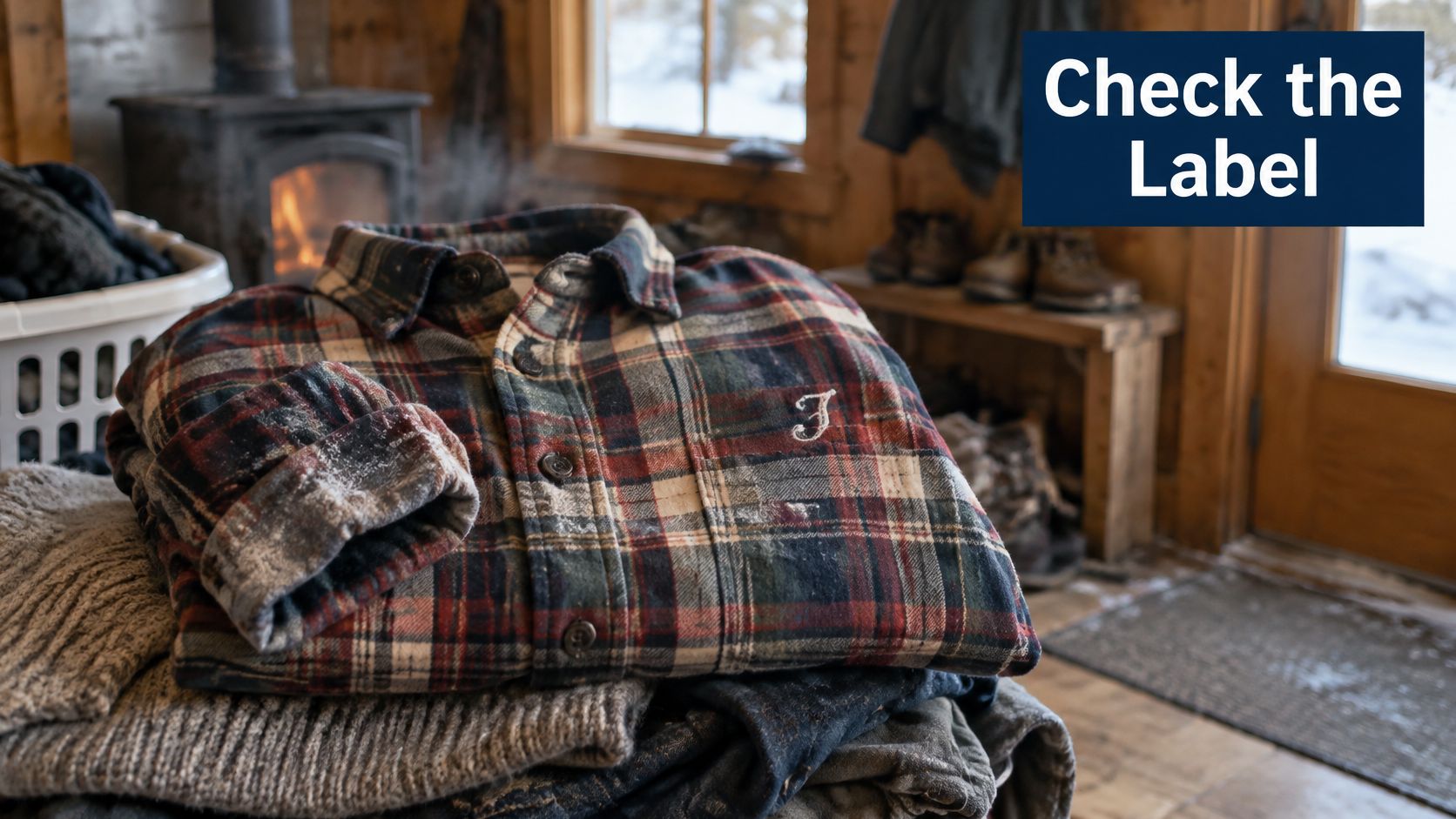
California Cowboy's baseline is machine wash cold on a gentle cycle, then tumble dry low or dry flat. Its custom embroidery is machine embroidered at the Fairfax, California location. Read more about custom embroidery on clothing. Care symbols can vary between countries, so UK care labelling rules explained can help decode a tag you are unfamiliar with.
Before the first wash, run a colour test. Press a damp white cloth against a hidden part of the embroidery for a few seconds, then check for dye transfer. If the cloth picks up colour, wash the garment alone in cold water on a gentle cycle, and let that result guide how you dry it. If the tag is unreadable, use cold water, a short gentle cycle and flat drying as the fallback.
Detergent, Stains and Bleach Mistakes to Avoid
Excess detergent leaves residue in dense stitching, terry loops and fleece. The panel can feel stiff, soil can cling to the residue, and rinsing takes more effort. A 2025 residential laundry study found 47% of respondents used excessive detergent. It also found that warm water beat cold water by 60% to 38%, according to the Zero Waste Washington analysis.
Measure mild, bleach-free liquid detergent according to the product instructions for load size and water hardness. Use a modest dose, and skip fabric softener, which can coat thread and flatten embroidery's raised texture. Dense stitches are harder to rinse clean, while chlorine and other bleaching agents can damage or alter coloured threads, as described in this care guidance for embroidery projects.
The stain playbook for a real weekend
Beach days leave sunscreen and saltwater; a night out can mean champagne or wine. Cabin weekends bring grill grease and trail mud. Treat stains promptly, without scrubbing the stitched face.
- Sunscreen and lotion: Dab liquid detergent on the reverse side and leave it for five minutes, then wash cold. Keeping the treatment behind the embroidery helps prevent pushing residue deeper into the backing.
- Saltwater: Rinse with cool water before the salt dries. Salt crystals can abrade thread as the garment moves in the drum.
- Champagne and wine: Blot rather than rub, then pre-treat from behind. Sugar lifts more readily than tannin and dye, so treat the spill promptly.
- Grill grease: Apply diluted dish liquid to the reverse side, leave it for ten minutes, then run a normal cold cycle.
- Trail mud: Let it dry, brush away what you can with a soft brush, then wash. Spreading wet mud can work it into the backing.
Before drying, rinse until the water is free of foam. Detergent left in the stitching can make it feel scratchy after the garment has dried.
Bleach can permanently change embroidery colour. Even gentler alternatives may shift rayon or viscose thread; the embroidery care guidance advises avoiding detergents with chlorine, peroxide, sodium carbonate or other bleaching chemicals. If a white shirt needs brightening, treat the base fabric while keeping bleach away from the decoration. Embroidery uses dyed thread, while screen printing applies ink to fabric. This comparison of embroidery and screen printing explains the difference between the two decoration methods.
How to Wash Embroidered Clothing Step by Step
A cabin morning can leave smoke in a flannel; a beach-to-bar night can add saltwater and sunscreen. Once stains are treated, the sewn-in care label is the decision point. Follow its washing instructions if they differ from general embroidery advice. These steps help protect the stitching without overriding the garment's care rules.
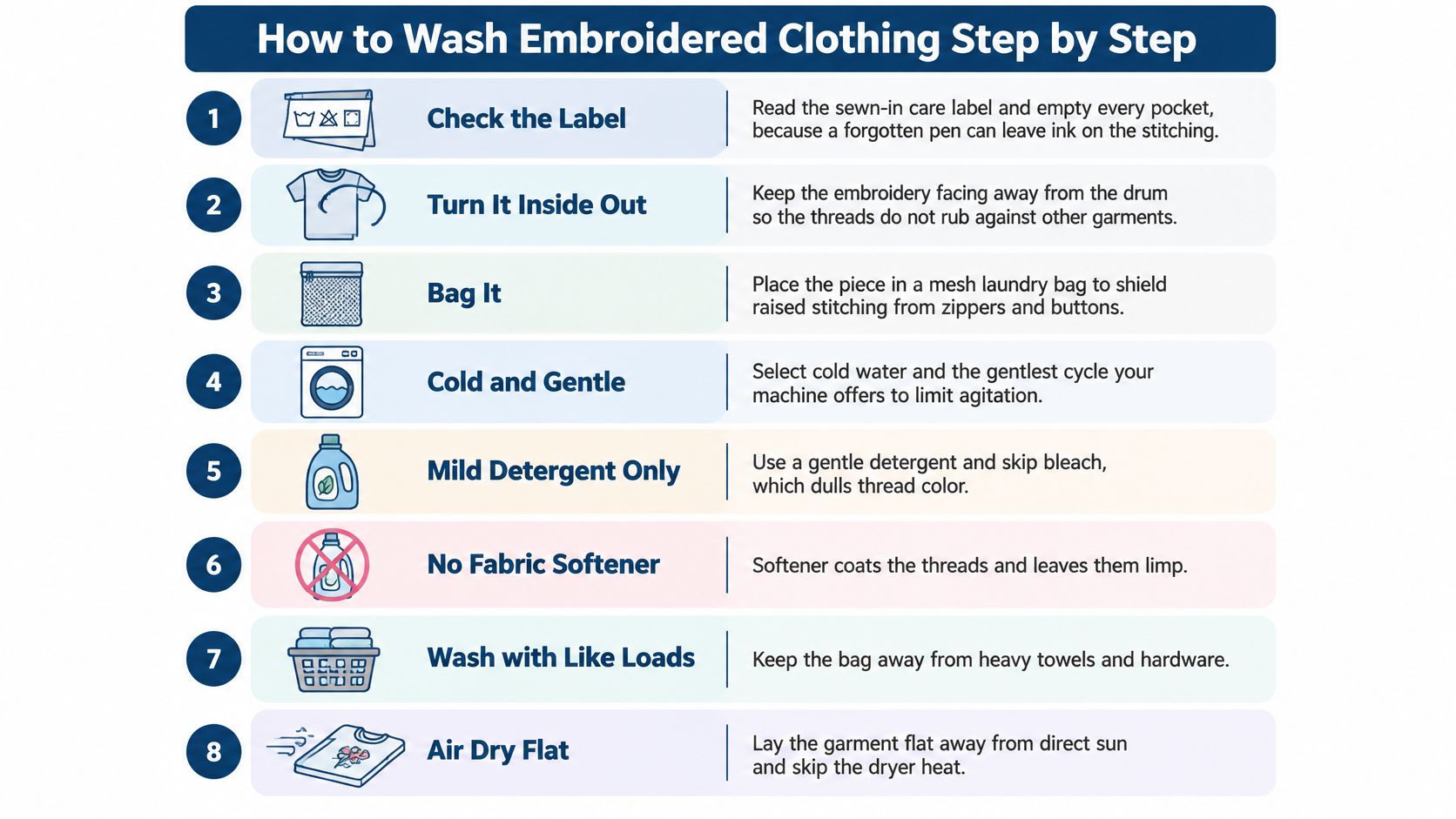
- Check the label and empty the pockets. A forgotten pen can leak ink onto the garment. Remove anything that could mark or snag the fabric.
- Turn the garment inside out if the label allows. This puts the embroidered face away from other items and reduces rubbing.
- Place it in a mesh laundry bag. The bag helps shield stitching from zippers, hook-and-loop fasteners, metal hardware and rough fabrics.
- Use the wash settings specified on the label. Add a small dose of mild liquid detergent, and avoid overloading the machine so the garment can move freely.
- Remove the piece promptly when the cycle ends. While it is damp, smooth the embroidered panel with your palms. Don't pull at its edges.
- Hand wash if the label permits and you want less agitation. Soak in cool water with a little detergent, then swish gently. Don't scrub the embroidery.
- Press out water without wringing. Lay the piece on a towel, roll it up and squeeze, or press it between two towels. Twisting can pull stitches and distort the stabiliser.
- Air dry away from direct sunlight if the label permits. Sun exposure can fade thread.
These steps limit four common problems: mechanical abrasion, heat-driven shrinkage, thread-dye bleeding and stabiliser distortion. Avoid bleach, fabric softener and optical brighteners, which can affect fibres, thread or the embroidered finish. This step-by-step washing guide also explains how to handle embroidered garments during washing.
The method matters as much as the cycle. Wash embroidered clothes with similar items, not with a sandy beach towel or a jacket covered in hardware. If the base fabric is cotton flannel, account for the possibility that flannel shrinks in the wash, which can pull the stitched area out of shape. For a custom shirt, browse embroidered bowling shirt options and consider how the embroidery backing and thread may affect care.
Drying Embroidered Clothes Without Puckering
Puckering develops when the fabric, stabiliser backing and thread shrink or relax at different rates. Drying heat can make that uneven movement more pronounced, pulling the stitched area out of shape. Choose a drying method by the sewn-in care label first.
The embroidery care guidance recommends air-drying garments in their natural shape, using a low tumble-dry setting only when the label permits it. If the label says line dry, keep the garment out of the dryer. When general embroidery advice and the care label differ, follow the label for that garment.
Knit tees, heavy fleece and robes are safer laid flat on a dry towel. Turn them over partway through drying so their weight does not pull one side out of shape. Woven shirts and flannels can hang on a padded hanger while damp, in a dry room away from direct sun. High-detail panels and monograms benefit from gentle reshaping by hand while damp. If the label allows tumble drying, remove cotton or terry pieces while they are still slightly damp, then finish drying them flat or on a hanger.
Drying shrinks gear back a bit, while wovens and knits can stretch out after a couple of wears. Flat drying is a sensible default for heavier garments and embroidered areas that need to hold their shape.
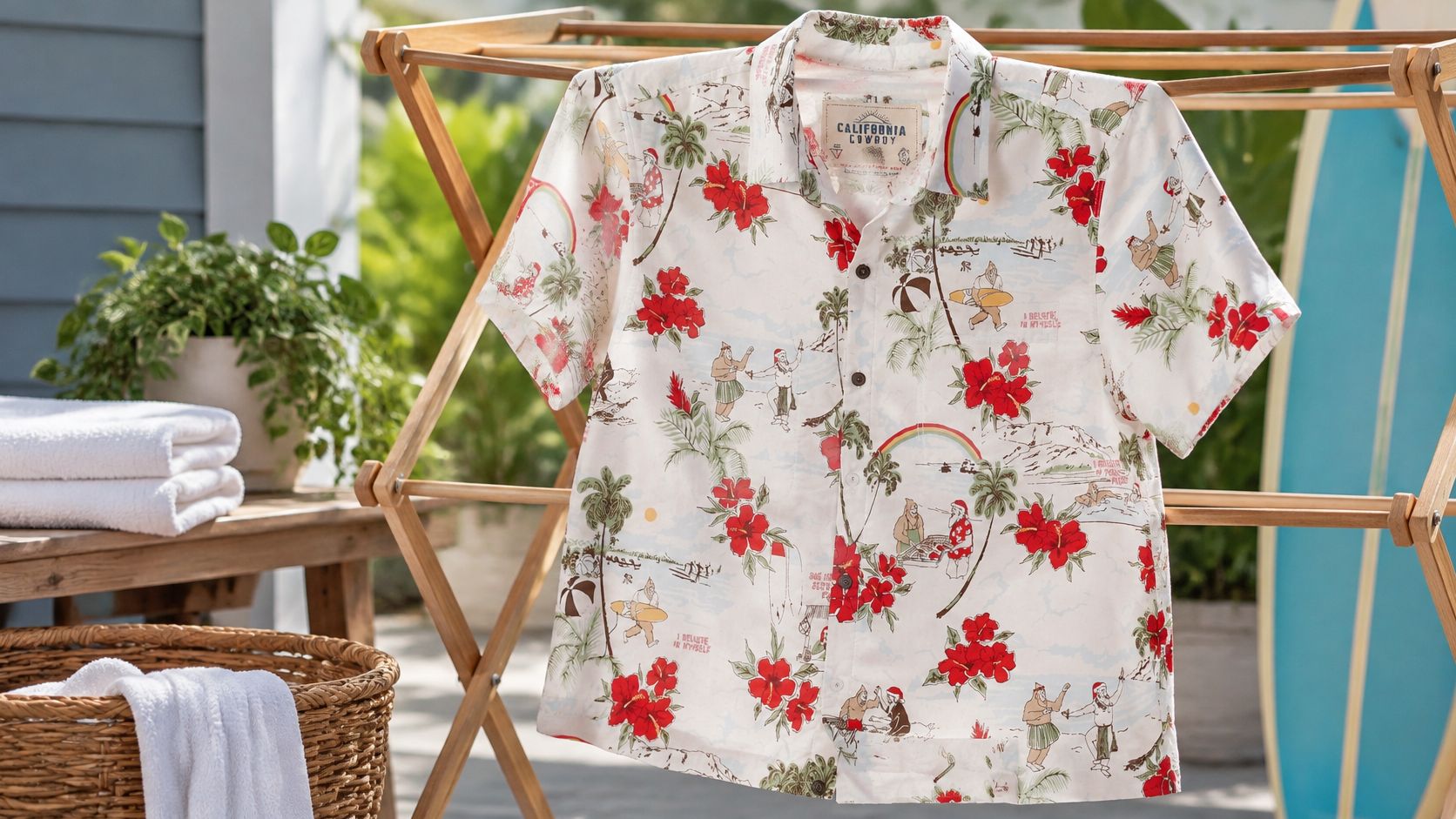
Terry-lined garments need enough time to dry through. The Men's High Water Terry Lined Hawaiian Shirt - Believe, White Sand should be washed on a cold, gentle cycle and tumble dried low or dried flat. Check its sewn-in label before choosing a method. After washing, take it out promptly, reshape it, and avoid leaving it bunched up, where the lining can stay damp.
Check the area beneath the stitched panel and along the seams before putting a garment away. The outer surface can feel dry while the backing is still damp, so give it more time if you find cool or moist patches.
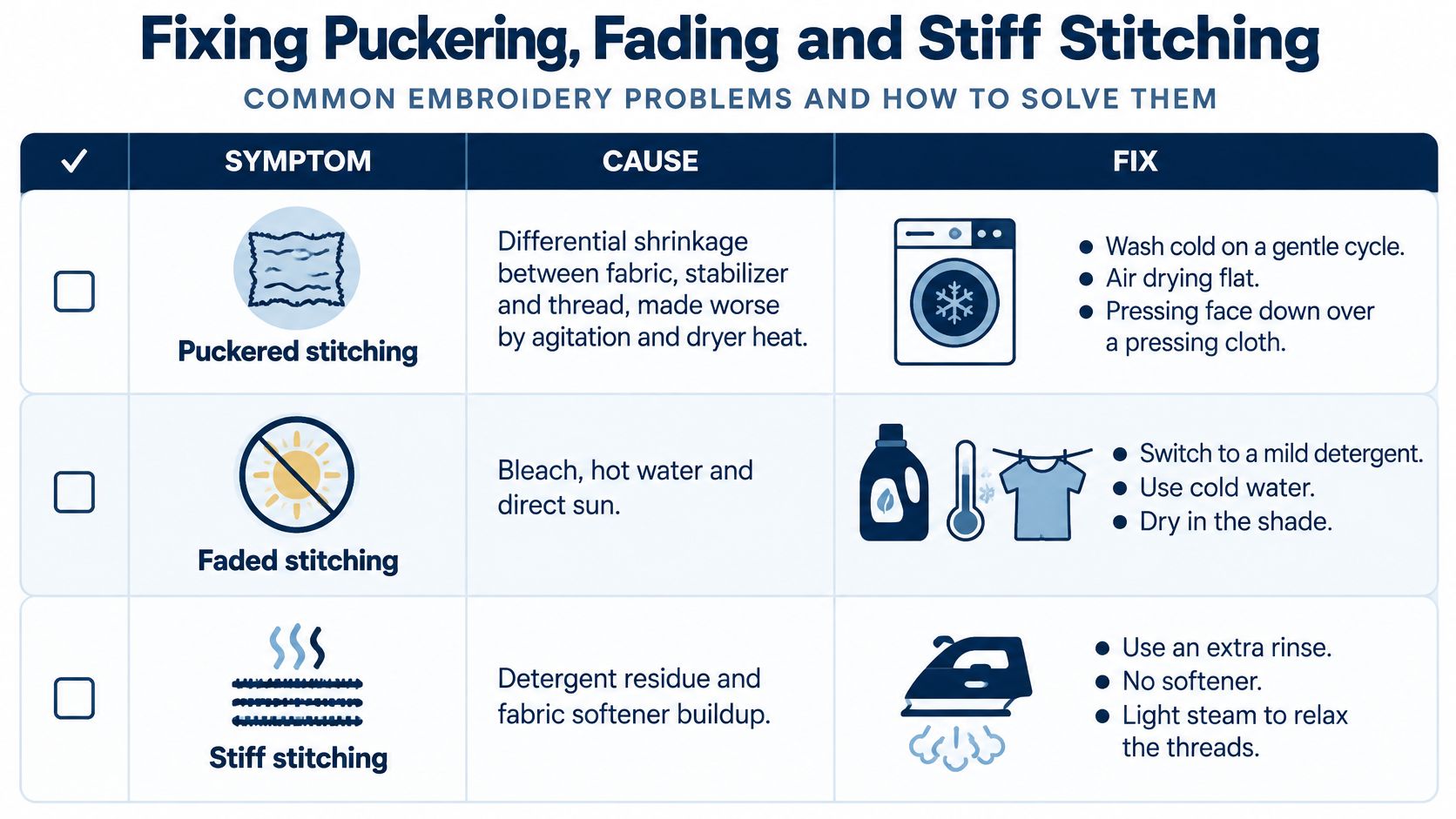
Fixing Puckering, Fading and Stiff Stitching
Diagnose the symptom before you change the routine. Most embroidery complaints trace back to one of six causes, and each has a fix that prevents a repeat.
| Symptom | Likely cause | Fix |
|---|---|---|
| Puckered stitching | Stabiliser heat and uneven shrinkage | Wash cold, reshape while damp, dry flat |
| Colour bleeding onto other clothes | Dye migration from hot water | Wash cold and separately; run the colour test first |
| Stiff or scratchy stitching | Detergent residue | Use less detergent and rinse until the water runs clear |
| Dull or faded thread | Bleach, harsh detergent or direct sun | Bleach-free detergent; dry in shade |
| Sour smell in terry or fleece | Left damp too long | Dry promptly and fully before storing |
| Garment shrinks | Hot water or hot dryer | Lower the temperature and dry flat |
Keep lab numbers in proportion. Durability is a colourfastness and construction question, not just a cleaning one. Professional evaluation uses ISO 105-C06 or AATCC TM61 accelerated laundering, both scoring colour change and staining on a 1 to 5 grey scale where 5 means no visible change. Well-built polyester embroidery with cut-away backing has been benchmarked at 4 to 5 after 50 industrial wash cycles at 60°C under ISO 105-C06 C2 conditions, per Amann's work on embroidery thread colour fastness. That's a benchmark, not a promise for your shirt, since thread fibre, dye system, backing, base fabric and stitch density all vary.
For premium cotton, terry, fleece and flannel, follow the label's lower temperature even when a test suggests more tolerance. And don't confuse a colour-stable thread with a stable garment: even perfectly colourfast embroidery puckers if the base fabric shrinks. Hoodies are the worst offenders because the fabric is heavy and the stitching is dense, and these notes on the best embroidered hoodies cover how density and fabric weight interact.
Storing Embroidered Pieces Between Wears
After a cabin evening or a beach-to-bar night, let a worn embroidered piece dry before putting it away. A damp shirt left in a hot car, gym bag or hamper with a wet towel can develop a stale smell. Airing it helps, but lingering salt, smoke or spills may call for washing.
Hang woven shirts on a padded hanger in a dry room to let body heat and sweat escape. Fold knit tees, hoodies and fleece instead. Their weight can pull at the shoulders and the embroidery when they hang.
Keep clean, dry pieces in a breathable cotton bag or closet, away from damp and direct sunlight. Sunlight can fade dyed thread over time. A lavender sachet can help deter moths without placing chemicals against the stitching.
Spot care and loose threads
For a fresh sweat mark or drip, use a damp cloth on the reverse side and dab gently. Rubbing across the embroidered face can catch or distort stitches. If a thread comes loose, trim it close to the fabric with sharp embroidery scissors. Don't pull it, since that can unravel nearby stitches.
For keepsakes such as a monogrammed robe or formal stole, check how the embroidery is backed and what thread it uses before storing it for a long stretch. If you're comparing graduation stoles for an event, consider those details alongside the design. California Cowboy offers custom embroidery machine-sewn at its Fairfax, California location. Read more about heritage brand clothing.
Wash frequency: For a shirt worn indoors, wash after two to three wears, or sooner if sweat or a spill leaves residue. Wash promptly after saltwater, champagne or a smoky fire, since salt, sugar and smoke can settle into the stitching. Airing out a garment can freshen it between wears, but it won't remove residue.
Confirm the Care Plan Before Your Next Wash
The sewn-in label settles the care question when it conflicts with general embroidery advice. Follow its instructions, especially if it calls for a more restrictive wash or drying method. For California Cowboy products, use a cold, gentle machine cycle and tumble dry low or dry flat.
The Men's Stretch High Water Terry Lined Hawaiian Shirt - Vintage Floral, Washed Navy is a High Water shirt, so check its sewn-in label rather than relying on a general rule. Embroidered products cannot be exchanged or returned unless defective. If stitching is flawed when the garment arrives, contact the business before washing it.
For sunscreen, saltwater, champagne or cabin smoke, treat the stain promptly using the care methods covered above, then let the label guide the wash. That keeps residue from sitting in the thread without overriding the garment's own care instructions.
California Cowboy makes shirts, robes and outerwear, with monogram and embroidery options. Take a look at the full collection at California Cowboy and find the piece you'll be washing for years.

